These essay writing pdf worksheets for 7th grade move students through the writing process in discrete, teachable steps — claim writing, planning, evidence integration, paragraph structure, and revision — rather than handing them a blank page and a deadline. Most 7th graders arrive with ideas; the gap is in knowing how to turn scattered thinking into a focused, organized response.
What the Set Covers
The resources span the three essay types most common at Grade 7: argument, informative/explanatory writing, and response-to-text. Each worksheet targets one specific move in the writing process, so teachers can pull individual pieces for a focused mini-lesson or run the full set in sequence during a writing unit.
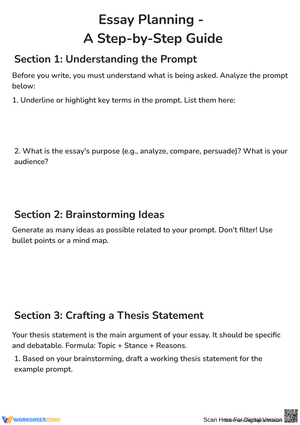
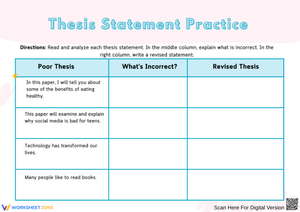
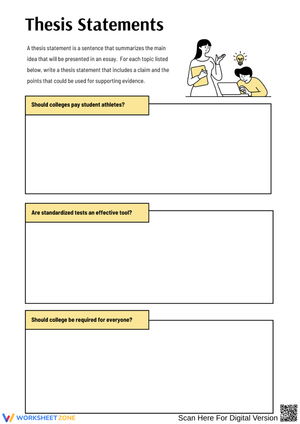
- Thesis and claim practice: Students compare weak topic announcements against arguable claims, then write and revise their own. These exercises work well as warm-ups in the days before students begin a longer draft.
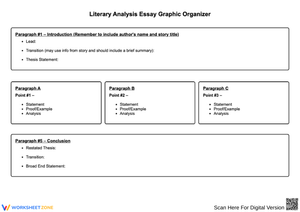
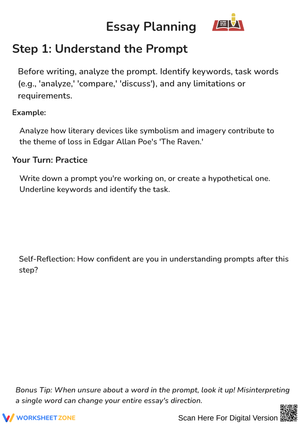
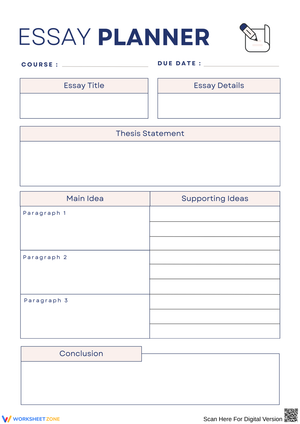
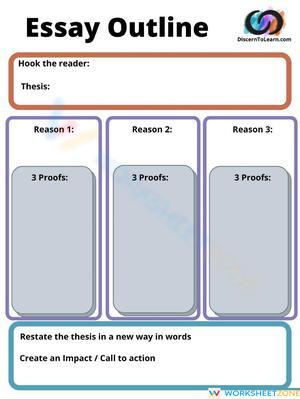
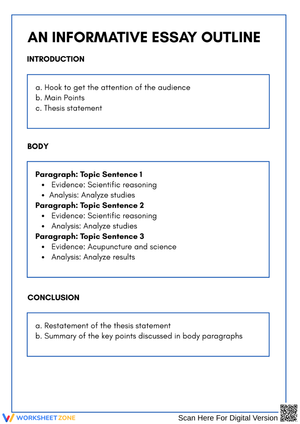
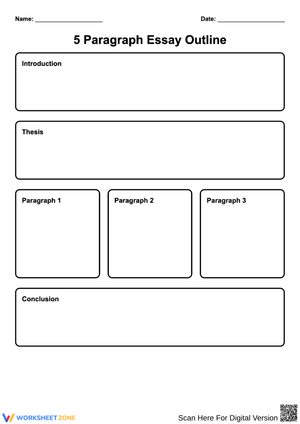
- Planning organizers: Boxes-and-bullets layouts, essay maps, and reason-evidence grids help students sort their thinking before drafting. The argument planning worksheet includes a dedicated space for a counterpoint and a brief rebuttal — an expectation that catches many 7th graders off guard the first time they encounter it.
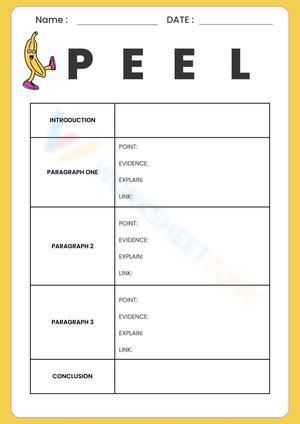
- Body paragraph structure: Each worksheet walks students through topic sentence, evidence, explanation, and transition in that order. This directly targets the most common structural collapse in Grade 7 writing: a quoted passage followed immediately by another quoted passage, with no reasoning about what either one proves.
- Introduction and conclusion support: Students work with sentence-level models for opening moves that go beyond "In this essay I will..." and for conclusions that connect back to the central claim without restating the introduction word for word.
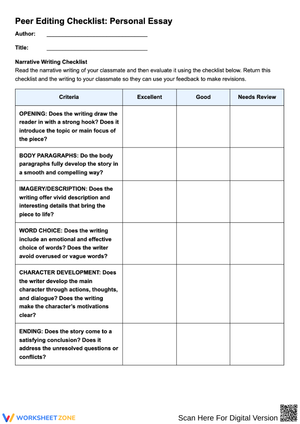
- Revision and editing checklists: Separate lists address organization, evidence quality, explanation depth, word choice, and conventions. Combining all of revision into one undifferentiated pass produces only surface-level fixes.
Student Mistakes Worth Knowing Before You Assign the Essay
The most predictable error at this level isn't weak evidence — it's quote-bombing. A student copies a sentence from the text, writes "This shows that..." and then restates the quotation in slightly different words rather than explaining what the evidence actually proves. The evidence integration worksheet targets that exact move: students write the evidence, identify what it proves, and then write two or three sentences of explanation. Running that worksheet before drafting means the pattern is at least partially in place when students attempt a full response.
Thesis writing reveals a second consistent problem: statements that announce a topic rather than stake a position. "This essay is about the causes of the American Revolution" is not a thesis, and students understand that intellectually when you explain it — but they keep writing topic announcements until they practice recognizing the difference. The thesis worksheet uses a categorization task, asking students to mark each statement as a claim or a topic announcement before revising the weak examples and writing three of their own.
Conclusions break down in a third predictable way. By Grade 7, most students know an essay needs one. What they do not know is that "In conclusion, this essay has shown that..." followed by a near-verbatim repeat of the introduction is not a real ending. The conclusion worksheet gives students a short analytical move to practice: connecting the argument to a broader question or implication, rather than summarizing paragraphs they already wrote.
How to Build These Worksheets Into Your Writing Units
The most practical approach is to run essay writing pdf worksheets for 7th grade in sequence against a single prompt across four or five lessons. Day one: brainstorm and plan. Day two: write one body paragraph using the structure worksheet. Day three: draft the introduction using the intro support page. Day four: revise with the checklist. That sequence lets teachers pinpoint exactly where a student's draft breaks down — in idea generation, in organization, or in revision — rather than receiving a weak final product that hides the real skill gap.
Station rotations work cleanly with this set because each worksheet carries its own directions. One station focuses on thesis writing, another on evidence selection, and a third on paragraph structure review. Students rotate with enough guidance on the page to work independently, freeing the teacher to pull a small group for targeted feedback. For emergency sub plans, the worksheets are self-contained — a substitute can run the lesson without additional notes because the tasks and directions are both printed on the page.
Peer review runs more productively when students work from the revision checklist rather than open-ended partner feedback. The checklist poses specific questions: Is the claim stated clearly? Does each body paragraph include evidence? Are transitions present? Does the conclusion go beyond restating the introduction? That level of direction pushes 7th graders toward substantive feedback rather than "It was good" or "Add more detail."
Standard Alignment
These worksheets align to CCSS.ELA-LITERACY.W.7.1 (writing arguments), W.7.2 (informative/explanatory texts), and W.7.5 (developing and strengthening writing through planning, revising, editing, and rewriting). The essay writing pdf worksheets for 7th grade set maps directly onto W.7.5's core requirement: that students improve writing through a deliberate process, not through a single draft. In classroom terms, this standard is the instructional justification for teaching thesis writing, planning, and revision as separate, explicit skills rather than assuming students absorb the process by writing essays repeatedly.
Leveling the Set for Different Writers in the Same Room
Teachers working with a range of writers can adjust the level of support without changing the essay task. Students who struggle to get started benefit from the planning organizers with partially completed examples and from the paragraph structure worksheet's sentence-level prompts. These built-in supports reduce the blank-page freeze common in mixed-ability classrooms without lowering the expectation that students produce their own thinking.
Students ready to work beyond sentence frames get the most from the evidence analysis and revision checklists, which ask them to evaluate and strengthen their own reasoning — a more demanding task than filling in a structured organizer. Advanced writers can also work with the open-ended planning pages, which require a full outline without guiding prompts. For students significantly below grade level, the thesis and claim worksheets function as targeted practice during intervention blocks. Those students can work on that single skill from the essay writing pdf worksheets for 7th grade set independently, without being locked into the same pacing as the full class draft sequence.
Frequently Asked Questions
Do these worksheets cover all three essay types in Grade 7?
Yes. The planning organizers and body paragraph worksheets work across argument, informative/explanatory, and response-to-text tasks. Claim and thesis practice are most directly connected to argument writing, but those same skills transfer into analytical response-to-text essays as well.
How much class time does each worksheet take?
Most take between 10 and 20 minutes during guided practice. Teachers who run the full set in sequence — one worksheet per day over a writing unit — find that students spend less time stalled, because the planning and structure stages are already laid out for them.
Can these be assigned as homework?
The planning organizers and paragraph practice pages hold up as homework. Revision checklists work better in class, when students have their actual draft in front of them and can act on feedback right away. Assigning the checklist at home tends to produce a faster, less careful review than completing it alongside the essay during a second-draft session.
What is the best way to grade these worksheets as part of the essay unit?
Collecting the planning worksheet and the evidence integration worksheet as part of the overall writing grade — not just the final draft — changes how students approach the process. When the organizer is assessed, students treat planning as real work. It also gives teachers a clearer record of whether a weak draft reflects a planning problem or a drafting problem, which makes the feedback more specific and more useful.












 Interactive Worksheet Maker
 Quiz Maker
 Word Search Maker
 Crossword Puzzle Maker
 Word Scramble Generator
 Sentence Scramble Generator
 Handwriting Worksheet Generator
 Name Tracing Generator
 Fill In The Blank Generator