


























Views
Downloads



Printable Kinetic & Potential Energy Worksheet | Grade 6
Paste this activity's link or code into your existing LMS (Google Classroom, Canvas, Teams, Schoology, Moodle, etc.).
Students can open and work on the activity right away, with no student login required.
You'll still be able to track student progress and results from your teacher account.
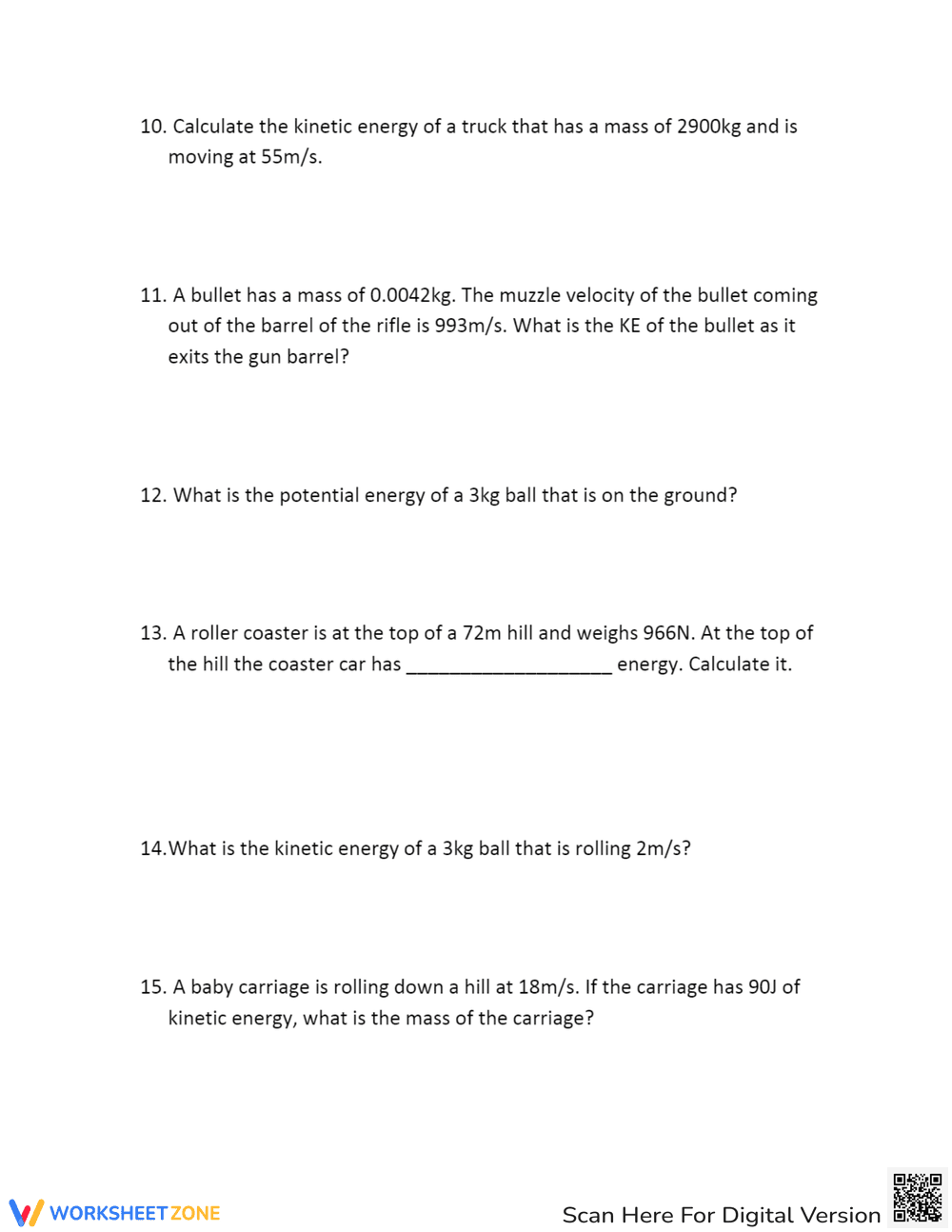
This Grade 6 science worksheet provides focused practice on calculating kinetic and potential energy. By applying standard physics formulas to real-world scenarios, students will strengthen their mathematical reasoning and solidify their understanding of how mass, velocity, and height affect energy levels.
At a Glance
- Grade: 6 · Subject: Science
- Standard:
MS-PS3-1— Describe relationships between kinetic energy, mass, and speed.- Skill Focus: Calculating kinetic and potential energy
- Format: 3 pages · 15 problems · PDF
- Best For: Independent practice and review
- Time: 25–35 minutes
This resource features 15 distinct word problems spread across three pages. The worksheet begins with a clear reference section providing the formulas for both kinetic energy and potential energy, along with the standard value for gravity. Students are tasked with reading each scenario, identifying the given variables, and calculating the missing energy, mass, or velocity values.
- Guided practice: The first few problems allow students to directly plug given mass and velocity or height values into the provided formulas.
- Supported practice: Mid-level questions introduce different contexts, requiring students to carefully identify which formula applies to the specific scenario.
- Independent practice: The final problems challenge students to manipulate the formulas to solve for variables other than energy, such as mass or velocity, ensuring a deep conceptual grasp.
This gradual-release approach ensures students build confidence before tackling more complex algebraic manipulations.
Aligned to MS-PS3-1: Construct and interpret graphical displays of data to describe the relationships of kinetic energy to the mass of an object and to the speed of an object. While this standard emphasizes relationships, the mathematical application in this worksheet provides the quantitative foundation necessary for mastery. Both standard codes can be copied directly into lesson plans, IEP goals, or district curriculum mapping tools.
This worksheet is highly effective as an independent practice assignment following direct instruction on energy types and formulas. It can also serve as a robust homework assignment to reinforce classroom learning. As a formative assessment tip, review students' work on problems where they must solve for mass or velocity to ensure they are manipulating the algebraic equations correctly. Expected completion time is 25 to 35 minutes.
Designed primarily for 5th and 6th-grade science students, this worksheet is ideal for learners who need structured, repetitive practice with physics formulas. For students needing differentiation, teachers can highlight the specific formula required for each problem. It pairs excellently with hands-on labs involving rolling objects down ramps or dropping items from measured heights.
Integrating mathematical calculations into middle school science instruction deepens students' conceptual understanding of physical laws and energy transfer mechanisms. According to EdReports 2024, providing students with structured opportunities to quantify scientific phenomena significantly improves their ability to analyze and interpret complex data sets across various contexts. By mastering the core skill to describe relationships between kinetic energy, mass, and speed, students move beyond rote memorization to the active application of fundamental physics principles. This targeted practice ensures that learners are not just reading about potential and kinetic energy, but actually calculating its impact in real-world scenarios like moving vehicles, roller coasters, or falling objects. This direct alignment with MS-PS3-1 ensures that learners are building the rigorous analytical and algebraic skills required for advanced STEM coursework, standardized assessments, and future scientific inquiry.


