


























Views
Downloads

Grade 5 Gravity & Air Resistance: Essential Worksheet
Paste this activity's link or code into your existing LMS (Google Classroom, Canvas, Teams, Schoology, Moodle, etc.).
Students can open and work on the activity right away, with no student login required.
You'll still be able to track student progress and results from your teacher account.
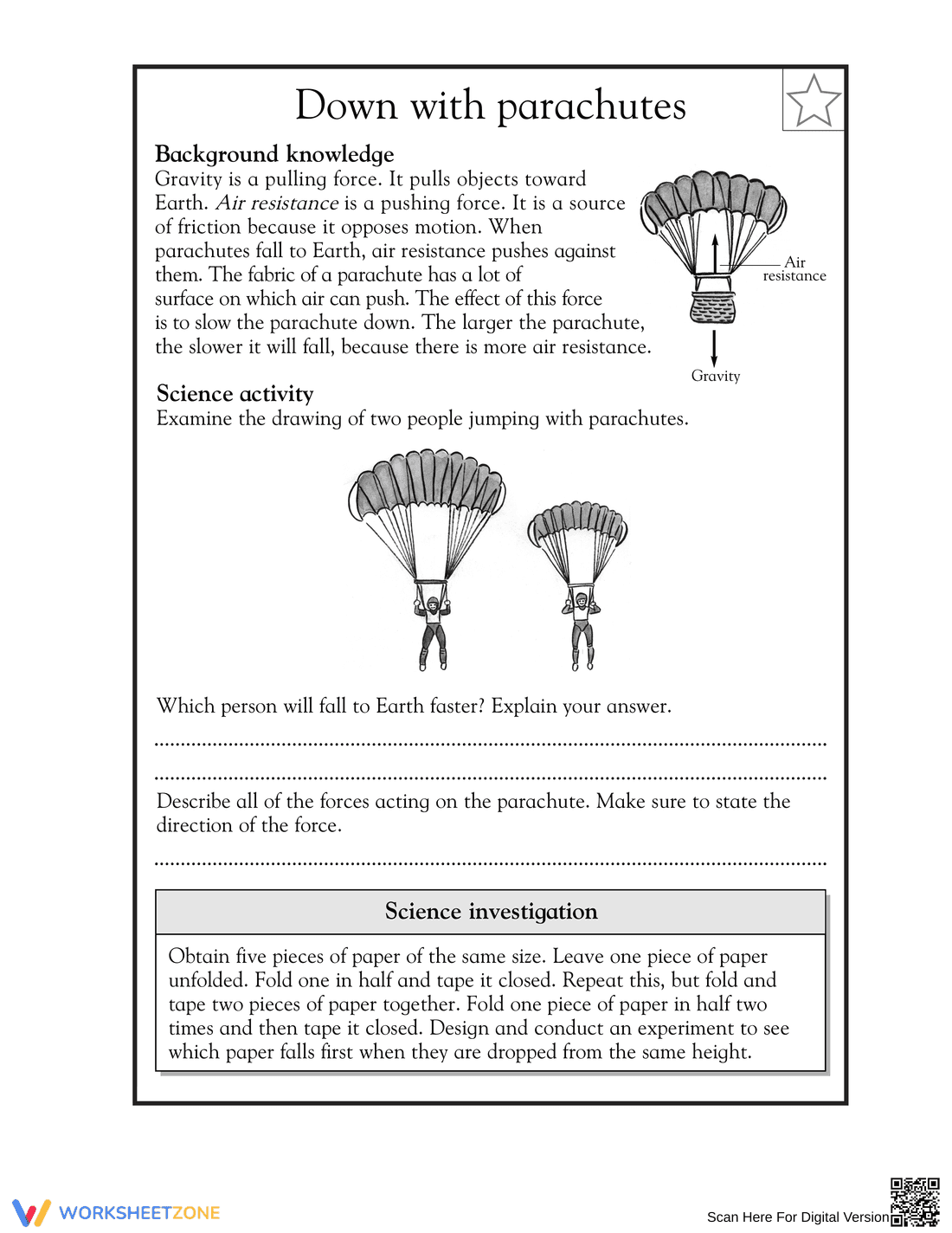
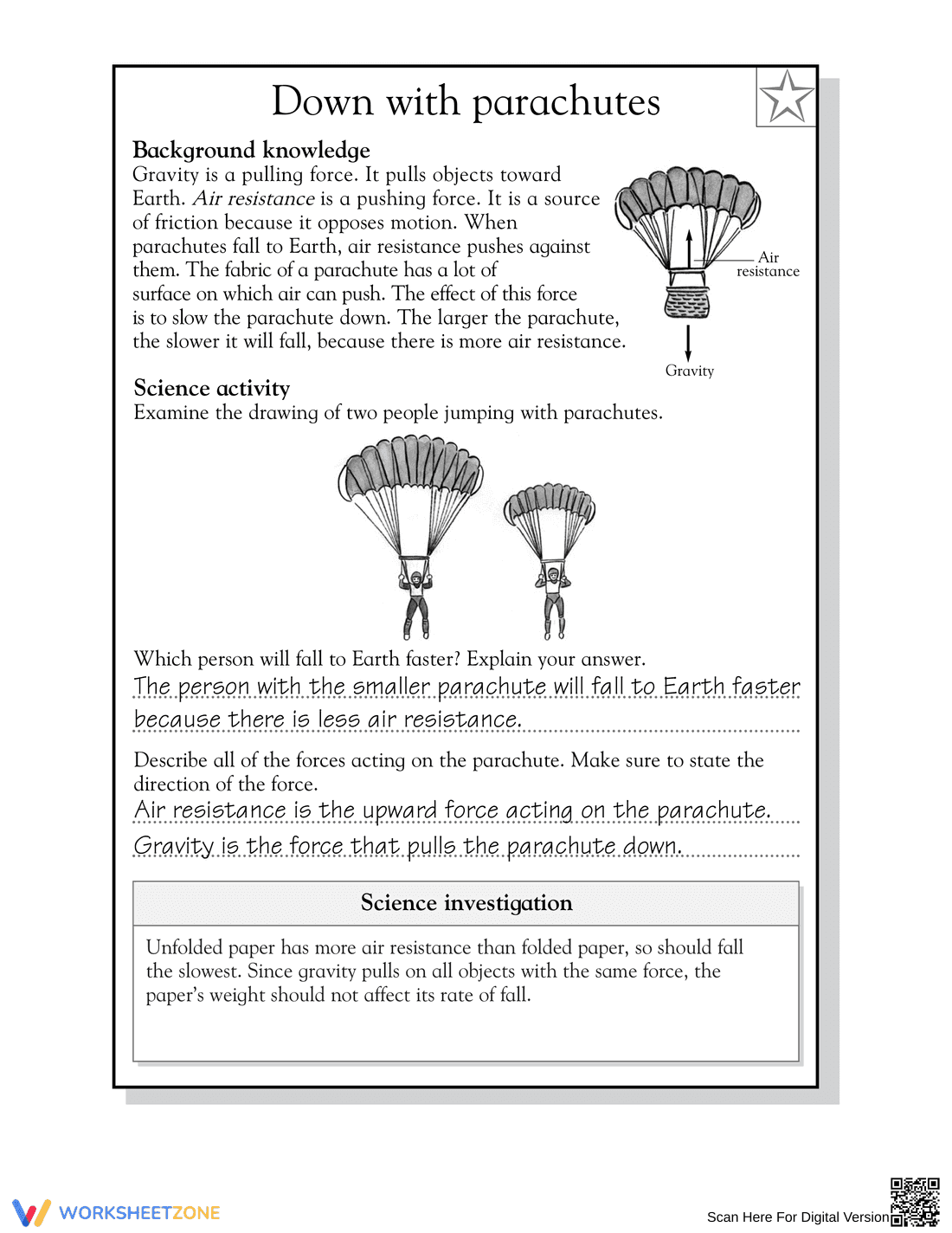
This Grade 5 science worksheet helps students master the concepts of gravity and air resistance through the engaging context of parachutes. Students analyze force diagrams and conduct a hands-on investigation to observe how surface area impacts descent speed. By completing these tasks, learners develop a concrete understanding of opposing forces in motion.
At a Glance
- Grade: 5 · Subject: Science
- Standard:
5-PS2-1— Support an argument that the gravitational force exerted by Earth is directed down- Skill Focus: Gravity and air resistance forces
- Format: 1 page · 3 problems · Answer key included · PDF
- Best For: Introduction to force and motion units
- Time: 25–35 minutes
What's Inside
The worksheet includes a concise background knowledge section defining gravity as a pull and air resistance as a push. It features a visual comparison task with two parachutists, a written analysis of force directions, and a structured science investigation using paper models. This resource provides a clear framework for exploring physical science variables.
Zero-Prep Workflow
- Step 1: Print the single-page PDF for your entire class in under 30 seconds.
- Step 2: Distribute the sheets for a 10-minute guided reading of the force definitions and diagram analysis.
- Step 3: Facilitate the 20-minute hands-on paper investigation at student desks with no specialized equipment needed.
This streamlined process minimizes teacher prep time to under 2 minutes, making it an ideal choice for sub plans or spontaneous science blocks.
Standards Alignment
This resource is primarily aligned to 5-PS2-1: Support an argument that the gravitational force exerted by Earth on objects is directed down. It also supports physical science standards regarding the effects of friction and surface area on motion. This standard code can be copied directly into lesson plans, IEP goals, or district curriculum mapping tools.
How to Use It
Use this worksheet during the 'Explore' phase of a 5E lesson cycle to introduce opposing forces. As a formative assessment tip, observe students during the science investigation to see if they can use the term 'air resistance' to explain why the unfolded paper descends slower than the taped bundles. The expected completion time is 30 minutes.
Who It's For
This activity is designed for Grade 5 students but can be adapted for Grade 4 review or Grade 6 reinforcement. It provides visual scaffolds for English Language Learners and clear, step-by-step instructions for the experiment.
According to the RAND AIRS 2024 report on elementary science pedagogy, hands-on modeling of invisible forces like air resistance significantly improves retention of abstract physics concepts in upper elementary students. This worksheet utilizes a dual-modality approach, combining visual analysis of parachute diagrams with a physical science investigation involving paper descent. Students must not only identify gravity as a pulling force but also conceptualize air resistance as an opposing push that interacts with surface area. Aligned with the 5-PS2-1 standard, the tasks require students to state the direction of forces, reinforcing the concept that Earth’s gravity pulls objects toward its center. By integrating a predictable classroom workflow with a structured experiment, this resource ensures that Grade 5 learners can distinguish between mass-driven and friction-driven motion. This evidence-based design bridges the gap between theoretical background knowledge and practical application, making it an essential tool for standard-aligned science instruction and formative assessment in force and motion units.


