


























Views
Downloads
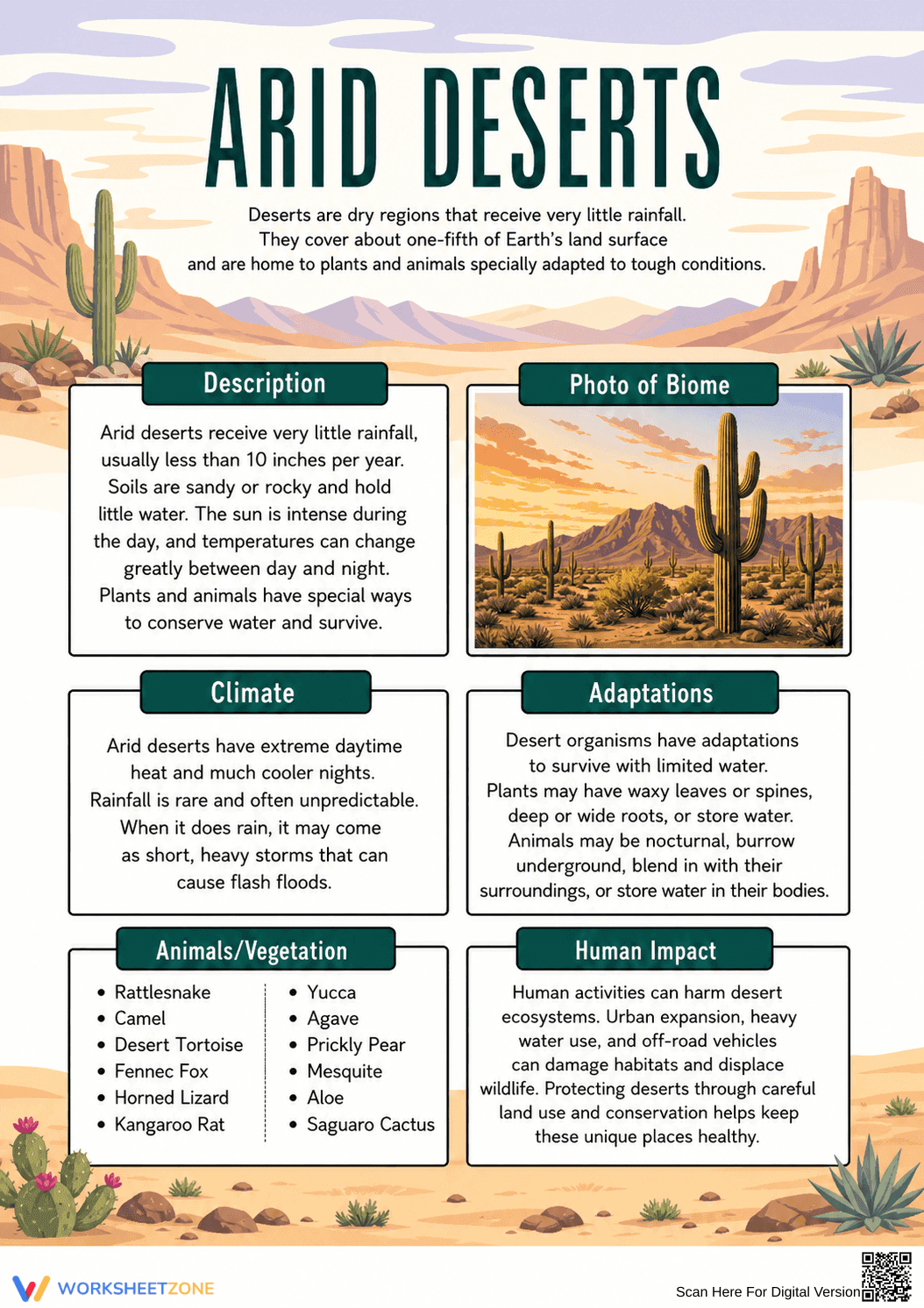

Grade 6 Arid Deserts Biome — Printable No-Prep Worksheet
Paste this activity's link or code into your existing LMS (Google Classroom, Canvas, Teams, Schoology, Moodle, etc.).
Students can open and work on the activity right away, with no student login required.
You'll still be able to track student progress and results from your teacher account.
This Grade 6 science reading guide introduces students to the arid desert biome, focusing on climate, plant and animal adaptations, and human impact. By analyzing this structured infographic, students will understand how organisms survive extreme heat and limited water while building foundational knowledge of Earth's ecosystems.
At a Glance
- Grade: 6 · Subject: Science
- Standard:
MS-LS4-4— Explain how traits help organisms survive in specific environments.- Skill Focus: Ecosystems and Adaptations
- Format: 1 page · 0 problems · No answer key · PDF
- Best For: Independent reading and reference
- Time: 10–15 minutes
What's Inside
This single-page resource features a beautifully designed, infographic-style layout that breaks down complex biome facts into digestible sections. It includes clear descriptions of the desert climate, specific examples of plant and animal adaptations, a list of native species like the fennec fox and saguaro cactus, and a summary of human impacts on the environment.
Zero-Prep Workflow
- Print (1 min): Simply print the PDF as a standalone reading passage or reference sheet.
- Distribute (1 min): Hand out to students at the start of an ecology unit or as part of a sub plan.
- Review (0 min): No grading required, making total teacher prep time under 2 minutes.
Standards Alignment
Aligned to MS-LS4-4, this text helps students construct an explanation based on evidence that describes how variations of traits increase survival in a specific environment. It also supports broader discussions on ecosystem dynamics. Both standard codes can be copied directly into lesson plans, IEP goals, or district curriculum mapping tools.
How to Use It
Use this resource before direct instruction to build background knowledge on desert biomes. It also works perfectly as a reference text during a research project where students compare different climate zones. As a formative assessment observation tip, have students highlight specific adaptations in the text and explain verbally how those traits conserve water. Expect students to spend 10 to 15 minutes reading and processing the information.
Who It's For
This reading guide is designed for middle school science students, particularly those in 5th through 8th grade. The chunked text and visual layout provide excellent differentiation for visual learners and students who struggle with dense textbook paragraphs. Pair it with a blank biome comparison chart or a direct instruction lesson on global climate zones.
Understanding how organisms adapt to extreme environments is a core component of middle school life science and environmental education. Aligned with MS-LS4-4, this resource helps students explain how traits help organisms survive in specific environments, such as the extreme heat and limited rainfall of an arid desert. According to a ScienceDirect TpT Analysis, providing students with highly visual, chunked informational texts significantly improves engagement and retention of complex ecological concepts compared to traditional, text-heavy textbook reading. By integrating clear examples of plant and animal adaptations—like the water-storing capabilities of the saguaro cactus or the nocturnal habits of the fennec fox—alongside critical human impact factors, this arid deserts guide supports comprehensive environmental literacy. It serves as an essential stepping stone for students to develop critical thinking skills regarding conservation and ecosystem dynamics in the science classroom.


