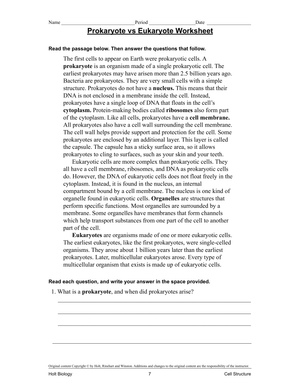
These 6th grade prokaryote and eukaryote cells worksheets resources give science teachers a focused comparison tool at exactly the point in life science where students first encounter one of biology's most foundational distinctions. The skill at stake is not memorizing a definition — it is recognizing why the presence or absence of a nucleus is significant enough to sort every living thing on earth into one of two categories. The set covers shared structures, key differences, organism classification, and compare-and-contrast practice using formats that hold up in a real middle school classroom.
What the Worksheets Ask Students to Do
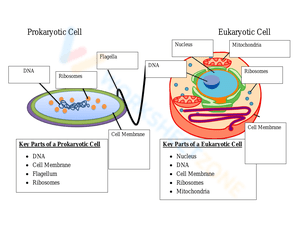
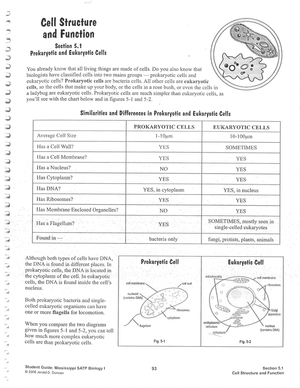
The comparison starts where it should: with what both cell types have in common. Cell membrane, cytoplasm, ribosomes, and DNA appear in both prokaryotic and eukaryotic cells, and students work through those shared traits before moving into distinguishing features. That sequence reduces early confusion about DNA, which is one of the more persistent misconceptions at this grade level.
Across the set, students:
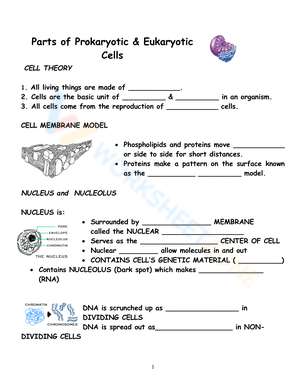
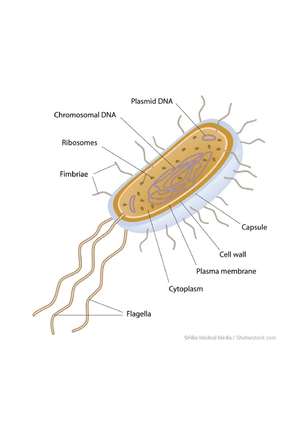
- Label cell diagrams, marking the nucleus in eukaryotic cells and its absence in prokaryotic ones
- Complete Venn diagrams that place shared traits in the center and cell-type-specific traits in the outer rings
- Sort organism examples — bacteria and archaea as prokaryotes; animals, plants, fungi, and protists as eukaryotes
- Answer short-response questions that require a full explanation, not just a category name
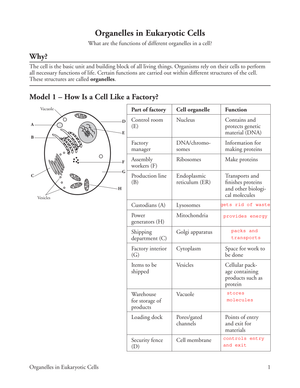
- Identify key organelles including mitochondria and, on plant cell worksheets, chloroplasts
Written response tasks are where the real learning becomes visible. A student who correctly circles "prokaryote" next to a bacterium diagram might still write, "It doesn't have a nucleus because it's too small" — that sentence signals incomplete understanding, and it only surfaces when the worksheet demands explanation rather than selection.
Student Errors Worth Knowing Before the Unit Begins
The most consistent error in 6th grade classrooms is students treating the nucleus as optional rather than definitional. They'll label a prokaryote diagram correctly, then write on the short-response section that bacteria "might have a nucleus, we just can't see it." They've anchored the nucleus to size, not to cell type, and that belief needs direct correction before the comparison tasks proceed.
A related confusion involves DNA. Both prokaryotes and eukaryotes contain DNA, and students who process that correctly on one worksheet will often contradict themselves on the next, writing that prokaryotes "don't have any DNA" because they've conflated DNA with a nucleus. Naming the distinction explicitly during instruction — prokaryotes carry DNA floating free in the cytoplasm; eukaryotes store theirs inside the nucleus — substantially reduces that error in subsequent student writing.
Organism classification also trips students up once examples move beyond the obvious. "Dog" and "bacteria" are easy placements. "Yeast," "amoeba," and "archaea" are not. Early worksheets that include a brief organism reference list give students a framework to work from; later worksheets can remove that support once the classification logic is stable.
Building These Worksheets Into Your Lesson Sequence
The most efficient approach treats the worksheets as a deliberate progression rather than interchangeable review pages. The first worksheet works best as a whole-class activity: display it, model a three-question decision process (Does this cell have a nucleus? Does it have membrane-bound organelles? What type of organism does that make it?), and work through two examples as a class before students finish independently. Using the same three questions on every worksheet turns an abstract concept into a repeatable decision routine — particularly useful for students who freeze when science vocabulary feels unfamiliar.
By mid-unit, a Venn diagram worksheet fits naturally into the 8 to 10 minutes before a period ends. Students who finish early can add a written summary below the diagram; students who need more time have a clear stopping point without feeling lost. For review days, individual worksheets from the set work well as station rotations — one station for organism sorting, one for unlabeled cell diagrams, and a third that asks students to write a single sentence naming the most important structural difference between the two cell types. That third station reliably surfaces who needs additional support before the summative assessment.
Answer keys are worth treating as a teaching tool rather than just a grading shortcut. When students self-correct vocabulary errors before a quiz — replacing "no inside parts" with "no membrane-bound organelles," for instance — the correction sticks better than if a teacher simply marks it wrong and returns the paper. These 6th grade prokaryote and eukaryote cells worksheets resources include answer keys formatted for that kind of fast, formative use.
Adjusting the Set for a Range of Student Readiness
Cell comparison is accessible to most 6th graders when the language stays consistent and the entry point is clearly defined. The adjustments below keep the learning target stable while changing how much support each student receives.
- Students still building academic vocabulary: provide a word bank with terms like nucleus, organelle, bacteria, and cytoplasm printed directly on the worksheet; remove it once students demonstrate they can access the terms independently
- Multilingual learners: pair diagram tasks with a sentence frame such as A prokaryotic cell does not have _____, but a eukaryotic cell does — the frame enforces accurate vocabulary use without requiring students to generate sentence structure from scratch
- On-level students: complete the Venn diagram first, then write a three-sentence summary paragraph using at least three academic vocabulary terms correctly
- Students ready for greater challenge: extend classification to less familiar organisms such as yeast and amoeba, and require written justification using structural evidence rather than memory alone
One adjustment that works across all levels: reduce the number of traits on the first worksheet. Starting with four or five essential characteristics — nucleus present or absent, cell membrane, cytoplasm, ribosomes, and DNA — gives students a manageable framework. Mitochondria, chloroplasts, and the cell wall enter on later worksheets once the core distinction is stable. With 6th grade prokaryote and eukaryote cells worksheets sets formatted consistently across the sequence, making that kind of gradual adjustment requires no rewriting of materials.
Standard Alignment
These worksheets align to NGSS Disciplinary Core Idea LS1.A: Structure and Function, which establishes that all living things are made of cells with specific structures that carry out essential functions. At the middle school level, this core idea sets the expectation that students can distinguish between cell types structurally, not just by name. The prokaryote-eukaryote comparison is typically one of the first concrete applications of LS1.A in 6th grade, which is why the classification and vocabulary skills practiced here appear directly on many district benchmark assessments before students move into more complex cellular processes in 7th and 8th grade.
Frequently Asked Questions
What is the most important structural difference for 6th graders to understand?
The nucleus. Prokaryotic cells do not have one — their DNA floats freely in the cytoplasm. Eukaryotic cells house their DNA inside a membrane-enclosed nucleus. That single distinction drives the classification of every organism students encounter in middle school life science, and every other comparison flows from it.
Are bacteria prokaryotes or eukaryotes?
Bacteria are prokaryotes. So are archaea. Animals, plants, fungi, and protists are all eukaryotes. Students who can sort those organism groups accurately and explain why have the core of this topic covered.
Which organelles belong on a 6th grade cell worksheet?
For this comparison, the essential structures are: nucleus, cell membrane, cytoplasm, and ribosomes for both cell types, plus mitochondria for eukaryotes. Plant cell worksheets typically add chloroplasts. Keeping the organelle list to five or six items prevents cognitive overload during initial instruction — students can add complexity once the nucleus distinction is solid.
Do these worksheets work for homework, or are they better kept in class?
Labeling and Venn diagram worksheets work well for homework once the core content has been introduced in class. Short-response worksheets are better suited to class time, where a teacher can monitor whether explanations are accurate or only superficially close. Using 6th grade prokaryote and eukaryote cells worksheets resources in both settings — structured practice during the lesson, reinforcement at home — spreads out the repetition students need to retain the distinction between cell types across the full unit.












 Interactive Worksheet Maker
 Quiz Maker
 Word Search Maker
 Crossword Puzzle Maker
 Word Scramble Generator
 Sentence Scramble Generator
 Handwriting Worksheet Generator
 Name Tracing Generator
 Fill In The Blank Generator