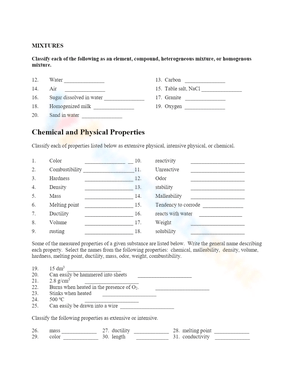
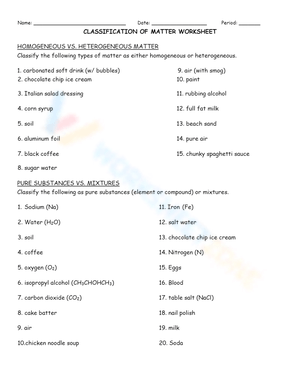
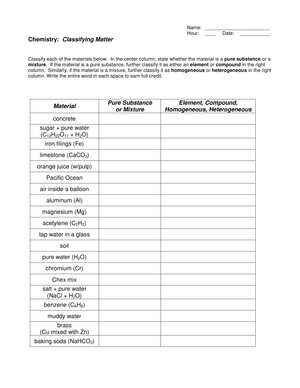
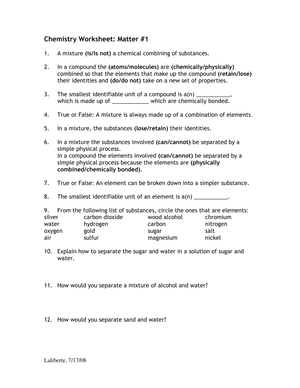
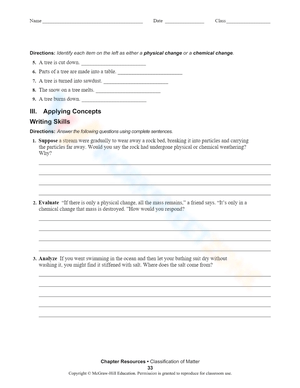
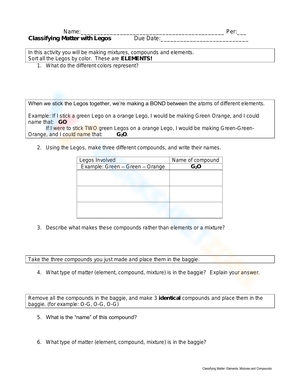
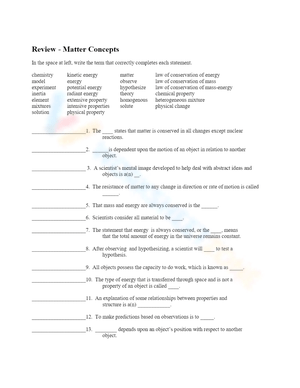
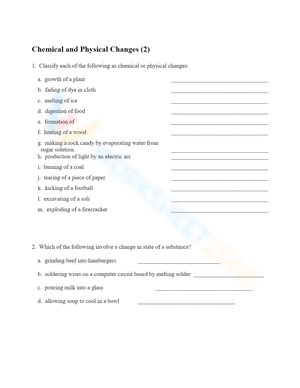
These classifying matter worksheets for 6th grade give teachers a set of focused chemistry practice resources built around one core expectation: students sort substances using observable and measurable properties, then write a reason for each classification. The everyday examples — salt water, trail mix, a steel spoon, air, and cereal — keep the reading load low so the actual science thinking can be the hard part.
The Specific Skills These Worksheets Target
At this level, classifying matter begins with direct observation. Students identify physical properties such as mass, volume, density, magnetism, solubility, and state of matter, then use those properties to place substances into categories. The skill is not just naming the category — it's explaining which property drove the decision.
The worksheets move through several important comparisons:
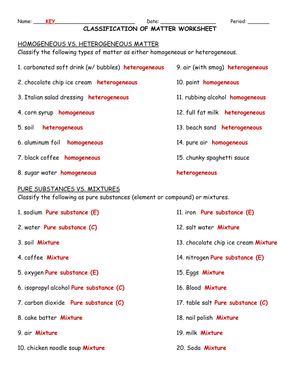
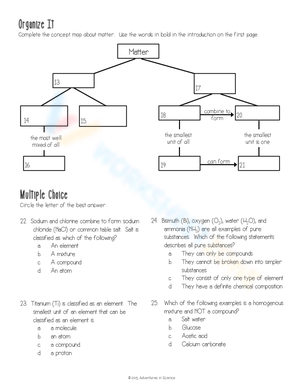
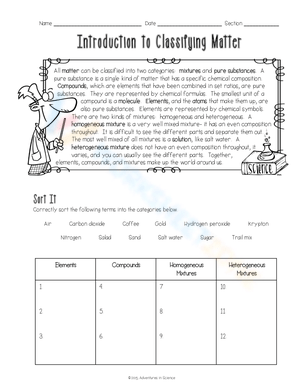
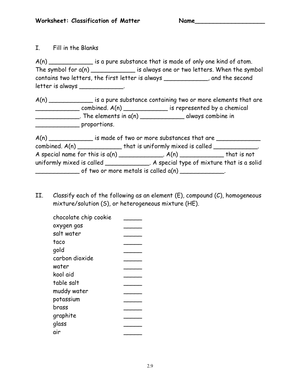
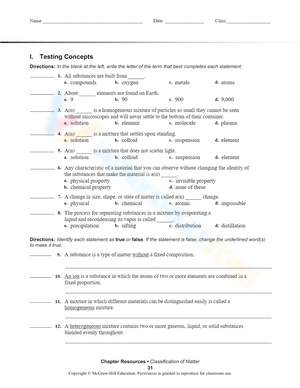
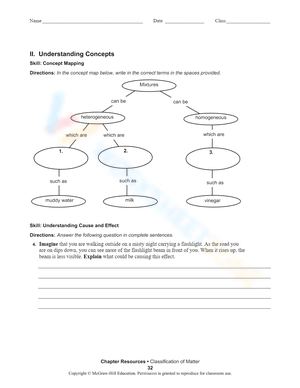
- Pure substances versus mixtures — students determine whether a sample contains one kind of matter or two or more substances combined.
- Homogeneous versus heterogeneous mixtures — students decide whether a mixture appears uniform throughout or shows visibly distinct parts.
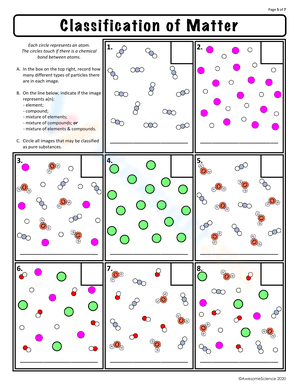
- Elements versus compounds — introduced through recognizable examples rather than particle diagrams, keeping the demand appropriate for students who have not yet studied atomic structure in depth.
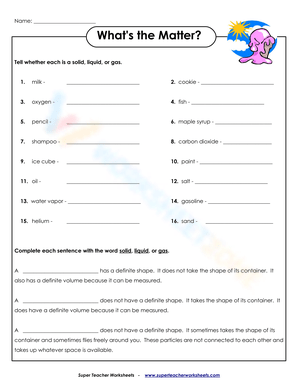
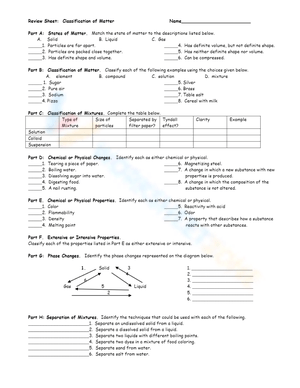
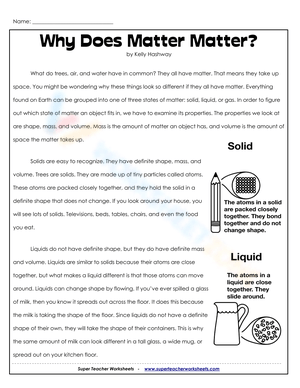
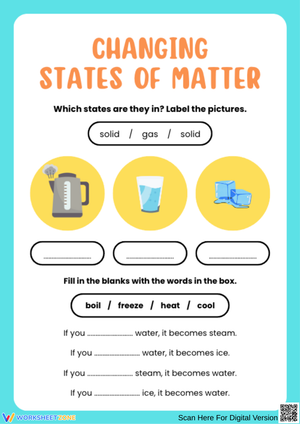
- States of matter as one dimension of classification — students practice using state alongside composition, learning that a single substance can be accurately described in more than one way simultaneously.
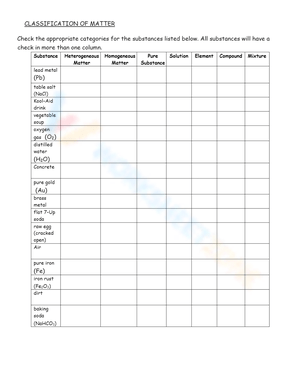
That last point matters more than it might seem. A sample of salt water is liquid, a mixture, and homogeneous — all at once. Students who can only assign one label at a time tend to fall apart during discussion and on assessments where the question asks for more than one property.
Predictable Errors Worth Catching Early
One error shows up almost every time this topic runs: students assume that if something looks simple or clear, it must be a pure substance. Salt water is the most common casualty. Students see a transparent liquid and mark it as a pure substance because it doesn't look mixed. A worksheet prompt that asks students to compare salt water and distilled water — then defend the difference in writing — exposes this reasoning quickly and gives teachers something specific to address in the follow-up discussion.
A second pattern is using state of matter as the only classification. A student who correctly identifies water as a liquid will sometimes stop there, missing that the prompt also asks whether the sample is pure or a mixture. Worksheet items that require two separate classification answers for the same sample address this directly without needing a separate reteach.
Students also confuse homogeneous and heterogeneous in a particular direction: they assume any liquid must be homogeneous and any solid must be heterogeneous. Cereal in milk disrupts that assumption well — the solid pieces are clearly visible, making the overall mixture heterogeneous even though part of it is liquid. That kind of counterexample is worth building into at least one worksheet early in the unit.
How to Build These Worksheets Into Your Lesson Plans
The most reliable sequence is a brief observation task first. Give students a few classroom samples or labeled images to examine before the printable practice begins. That grounding step keeps each worksheet from feeling like isolated vocabulary work, because students are matching written descriptions to things they have already handled or reasoned through in some form.
One instructional move worth building in: ask students to classify each sample in at least two different ways and defend both answers. A student who labels baking soda as a solid and a pure substance has done more science thinking than one who only checks "solid." That dual-classification expectation also reduces the single-label habit before it hardens into a pattern you have to undo later.
The set also runs well in a three-station rotation. One station focuses on physical properties, a second on pure substances versus mixtures, and a third on homogeneous versus heterogeneous examples. Fifteen minutes per station keeps the pace manageable and gives students repeated exposure to the vocabulary in slightly different contexts — which produces better retention than one long worksheet completed start to finish in a single sitting. Classifying matter worksheets for 6th grade that include short written justification prompts are especially useful at the third station, where the reasoning is most layered and a circulating teacher can catch errors in real time.
Standard Alignment
At the NGSS level, the relevant framework is Disciplinary Core Idea PS1.A: Structure and Properties of Matter, which establishes that substances have characteristic physical and chemical properties and that substances can combine to form mixtures. This DCI sits beneath MS-PS1-1 and MS-PS1-2, making classification the entry-level work students do before particle models or reaction analysis become the focus. Classifying matter worksheets for 6th grade address precisely this opening layer — the vocabulary, categories, and evidence-based reasoning students need before the chemistry sequence moves forward into more abstract territory.
State standards are often more explicit. Texas TEKS 6.6(A) asks students to classify matter based on physical properties including mass, magnetism, physical state, relative density, solubility, and conductivity — a near-direct match to the sorting tasks in this set. Many other state frameworks place matter classification at the beginning of the grade 6 physical science unit for a clear developmental reason: students need a reliable classification vocabulary before they can reason productively about chemical change.
Adjusting the Set for Mixed-Readiness Classrooms
Because this topic combines vocabulary with observation-based reasoning, differentiation should address both. For students who need more support, a word bank that includes terms like mixture, pure substance, heterogeneous, soluble, and homogeneous reduces the retrieval demand without lowering the conceptual target. Limiting the number of categories on early worksheets also helps — students who master pure substance versus mixture as a single contrast before the homogeneous/heterogeneous layer is added tend to carry both distinctions more reliably than students who try to sort all four categories at once.
On-level students benefit from mixed examples with no category cues, paired with a one-sentence justification requirement per answer. Advanced students can tackle an extension prompt asking whether the same sample could fit two different classification systems simultaneously — that question moves beyond recall into the kind of flexible scientific thinking the unit is ultimately building toward.
English learners often need picture-supported examples alongside sentence frames. A frame like "I classified this as a mixture because..." keeps the task demanding at the concept level while reducing the language load. That combination — high science rigor, lower language barrier — is what distinguishes a worksheet that assesses science thinking from one that accidentally assesses reading fluency.
Frequently Asked Questions
What prior knowledge should students have before using these worksheets?
Students should be able to name and describe the three basic states of matter and understand that matter has mass and takes up space. Familiarity with two or three physical properties — magnetism, color, or solubility — helps, but the worksheets use enough everyday context that most sixth graders can access the content without formal prior vocabulary instruction. A five-minute class discussion about what "observable" means is usually enough of a bridge.
Are these worksheets useful for formative assessment?
Any worksheet in the set that includes a short written justification column gives teachers immediate formative information. A student who circles "mixture" for salt water and writes "because I can see two different parts" needs different feedback than one who writes "because it contains water and dissolved salt." Both answers reveal something specific about where the student's reasoning is and where to push next — which is more useful than a correct bubble on a multiple-choice item.
How do I explain homogeneous versus heterogeneous without overwhelming students?
The most direct anchor is the visual test: if you can see distinct parts with the naked eye, the mixture is heterogeneous; if it looks the same throughout, it's homogeneous. Salt water passes — it looks uniform — so it's homogeneous. Trail mix fails it immediately. That simplified rule holds for almost every example at the 6th grade level without requiring students to reason through particle behavior, and it's concrete enough that students can apply it independently on a worksheet without prompting.
Can classifying matter worksheets for 6th grade be assigned as homework if students have no access to lab samples?
Yes. The worksheets at this level rely on written descriptions or simple images of common household materials, not physical specimens. Students can classify tap water, table sugar, a chocolate chip cookie, or cooking oil using only what they already know from daily experience. No lab equipment is needed, which also makes these resources a reliable option for substitute plans or distance learning days.












 Interactive Worksheet Maker
 Quiz Maker
 Word Search Maker
 Crossword Puzzle Maker
 Word Scramble Generator
 Sentence Scramble Generator
 Handwriting Worksheet Generator
 Name Tracing Generator
 Fill In The Blank Generator