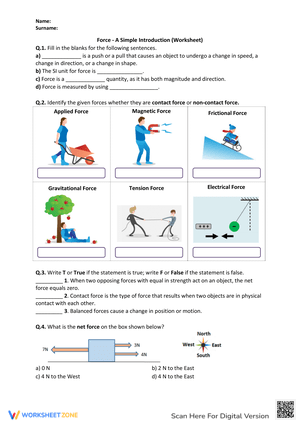
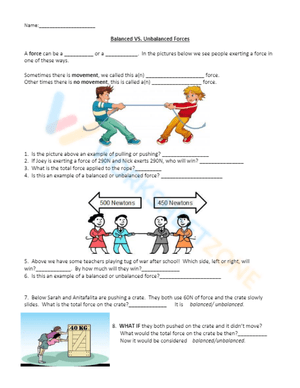
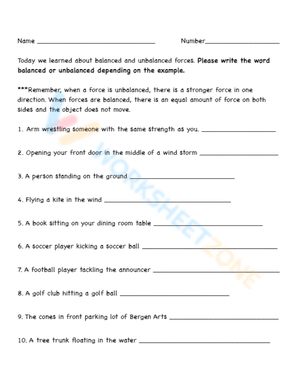
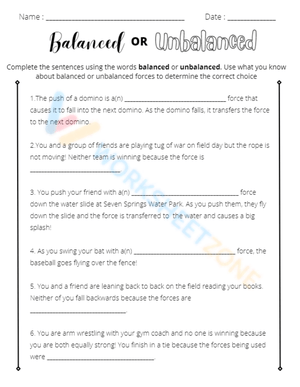
These balanced and unbalanced forces printable worksheets for 6th grade give teachers a set of standalone resources covering the concept across multiple question formats — force diagrams, vocabulary exercises, net force comparisons, and short written-prediction prompts — so students build understanding in more than one way. Each worksheet does a distinct job inside the unit rather than repeating the same format, which matters at this level because sixth graders frequently memorize a definition and then stall when a diagram shows three arrows instead of two or when a scenario describes something moving at a constant speed.
What's Inside the Set
Each worksheet targets a specific part of the concept:
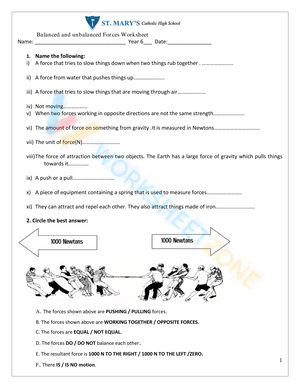
- Vocabulary work — students define force, net force, balanced forces, and unbalanced forces in their own words rather than copying from a glossary.
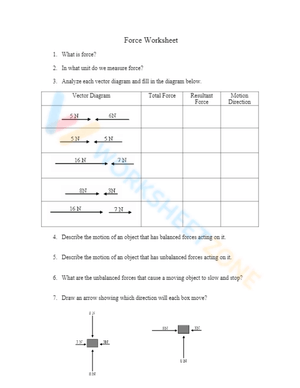
- Diagram reading — students compare force arrows by both direction and relative size, not by counting the arrows on each side.
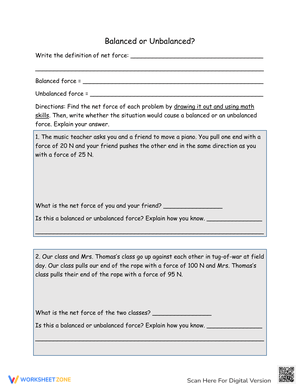
- Net force calculation — students work with labeled magnitudes, such as 10 N to the left and 6 N to the right, and identify the direction and size of the resulting net force.
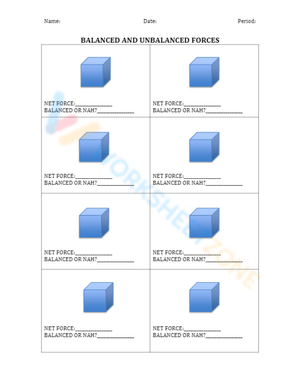
- Scenario classification — students sort familiar situations (a book on a desk, a braking bicycle, a kicked soccer ball) into balanced or unbalanced categories.
- Written explanation — students predict what will happen to an object's motion and state the reason in one or two sentences.
The written explanation task is where the most useful information surfaces. A student who writes "the forces are unbalanced because the 12 N forward push is greater than the 8 N friction force, so the cart speeds up" has made a connection that a multiple-choice question cannot reveal. These prompts show whether a student understands the relationship between force comparison and motion prediction — which is exactly what this standard demands.
Where Students Go Wrong With Force Diagrams and Scenarios
The most durable error in sixth-grade work on this topic is treating "balanced" as a synonym for "stationary." Students who learn the concept through the classic image of a book resting on a table — gravity pulling down, normal force pushing up, object stays still — lock that visual in and then misread constant-speed situations. Hand them a scenario where a hockey puck glides across nearly frictionless ice at a steady speed, and a significant number will mark the forces as unbalanced simply because the puck is moving. The correction isn't repetition; it's deliberate contrast. Present the stationary book and the constant-speed puck side by side and ask students what is the same about the forces in both situations before they classify either one.
A separate error shows up in diagram work: students count the number of arrows and declare whichever side has more the stronger force, ignoring the labeled magnitudes entirely. A diagram that deliberately places one large 20 N arrow against two small 6 N arrows in the opposite direction forces students to do the actual comparison rather than take a shortcut. Balanced and unbalanced forces printable worksheets for 6th grade that include these kinds of intentional mismatches between arrow count and arrow size are worth prioritizing — they surface the misconception during practice, not on the assessment.
Fitting These Worksheets Into Your Lesson Planning
The most effective sequence moves from visual to numerical to explanatory. On the day you introduce balanced forces, use a worksheet with large, clear arrows where the size difference is immediately obvious — no labeled magnitudes needed. Once students can reliably classify those simple diagrams, move to a worksheet with labeled force values so they practice computing net force before classification. Save the scenario and written-explanation worksheets for after a lab or structured discussion, when students have something concrete to connect to the vocabulary. Pushing scenario questions too early — before students have had practice reading diagrams — tends to produce guessing rather than reasoning.
Two or three force diagrams from a worksheet make a solid four-minute warm-up and immediately tell you who is still counting arrows instead of comparing sizes. For exit tickets, cut a worksheet into two or three strips and hand one strip to each student in the final five minutes before dismissal — you get a usable formative check without grading a full assignment. Reteach groups also benefit from targeted single worksheets: if post-quiz results show that several students still believe balanced forces require the object to be stationary, one worksheet focused on that specific misconception — using the constant-speed hockey puck, a car at highway cruise control, and an astronaut coasting in space — addresses the gap without revisiting the whole unit.
Making the Set Work Across Different Readiness Levels
Students who freeze in front of open-ended explanation prompts do better when a worksheet includes a sentence frame: "The forces are ___ because the ___ N force is ___ than the ___ N force, so the object will ___." That structure doesn't lower the bar — students still have to identify the force values, compare directions, and predict the motion — but it removes the blank-page stall that stops some students before they even start. Students who don't need the frame can ignore it; the prompt still functions as a full reasoning task either way.
On-level students work well with mixed-format worksheets that combine a few diagrams, one or two net force calculations, and a scenario question. For students ready for more challenge, remove the magnitude labels from a diagram and ask them to assign force values that would produce a specific named motion outcome — that requires genuine reasoning rather than pattern recognition. Balanced and unbalanced forces printable worksheets for 6th grade work best when teachers treat them as modular: use the first two problems for a supported small group, assign the complete worksheet to on-level students, and give advanced students the explanation-only questions with diagram labels removed. Because each worksheet is a separate file, splitting the workload this way is practical without retyping anything.
Standard Alignment
These worksheets align with NGSS MS-PS2-2, which requires students to plan investigations demonstrating that changes in an object's motion depend on the sum of the forces acting on it and on the object's mass. The balanced-versus-unbalanced distinction is the conceptual entry point for that standard: students need to understand that net force determines whether motion changes before they can reason about the proportional relationships in F = ma. At the sixth-grade level, this standard typically falls in the middle of a force and motion unit — after students have observed pushes and pulls in a hands-on context but before they move into quantitative proportional reasoning. The written-explanation tasks in these worksheets also address the NGSS practice of constructing explanations from evidence, which MS-PS2-2 expects alongside core content knowledge.
Frequently Asked Questions
What is the difference between balanced and unbalanced forces for sixth graders?
Balanced forces are equal in size and opposite in direction, so they produce no change in motion — the object either stays at rest or continues moving at a constant speed in a straight line. Unbalanced forces are not equal, so they cause a change in motion: the object speeds up, slows down, starts moving, stops, or changes direction.
How do students correctly read a force diagram?
Students should compare both the direction and the labeled size of each arrow, not count how many arrows appear on each side. If two arrows point in opposite directions and carry equal magnitudes, the forces are balanced. If one arrow represents a larger force, or if the forces pointing in opposite directions do not cancel, the forces are unbalanced — and the net force points in the direction of the larger value.
Does balanced forces always mean the object is at rest?
No. Balanced forces mean there is no change in motion. An object can remain stationary with balanced forces, or it can keep moving at a steady speed in a straight line if the forces stay balanced throughout. The defining feature is no acceleration — not that the object must be still.
How do these worksheets fit into a force and motion unit?
Balanced and unbalanced forces printable worksheets for 6th grade do their best work when distributed across the unit rather than assigned all at once. Use diagram and vocabulary worksheets early for structured practice, bring in scenario-based worksheets after a lab or class discussion, and save mixed-review worksheets for pre-assessment checks. Repeat exposure across different formats — diagrams one week, written scenarios the next — helps the net force concept take hold in a way that a single lesson cannot produce on its own.
What should an answer key include for force worksheets?
An answer key that only lists "balanced" or "unbalanced" next to each problem loses most of its value as a reteach tool. A more useful key names the stronger force, states the direction of the net force, and describes the expected motion outcome. That detail makes grading faster and gives paraprofessionals or substitute teachers enough context to support students who arrived at the wrong answer.












 Interactive Worksheet Maker
 Quiz Maker
 Word Search Maker
 Crossword Puzzle Maker
 Word Scramble Generator
 Sentence Scramble Generator
 Handwriting Worksheet Generator
 Name Tracing Generator
 Fill In The Blank Generator