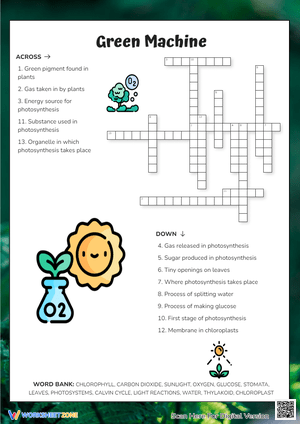
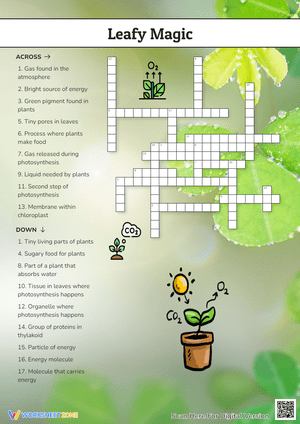
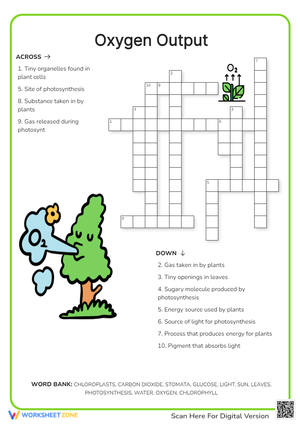
These 6th grade photosynthesis printable worksheets give teachers a set of targeted resources for a concept students consistently overgeneralize — they know broadly that plants make food, but they stumble when asked to explain the process precisely at the cell level. The worksheets move students from that vague recognition toward accurate, vocabulary-grounded explanations by giving them structured opportunities to label, sort, compare, and write. Each worksheet addresses one specific piece of the larger concept rather than asking students to hold the whole process in mind at once.
What Each Worksheet Targets
Photosynthesis sits at the intersection of cell biology, matter cycling, and energy flow — three ideas grade 6 life science builds toward through the year. The vocabulary load is heavier than it first appears: students need to distinguish reactants from products, name the organelle responsible for the process, understand why light is an energy source rather than a raw material, and connect glucose production to how plants sustain themselves. The worksheets address all of that in pieces, keeping the cognitive demand manageable at each step.
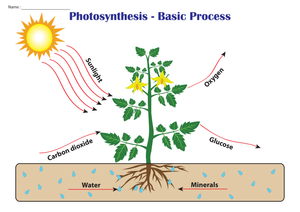
- Leaf-level diagram labeling: Students identify where sunlight enters, where carbon dioxide is absorbed, and where oxygen exits — connecting the leaf's physical structures to the chemical process happening inside.
- Cell-level diagram labeling: Students mark the chloroplast and chlorophyll within a plant cell diagram, establishing that photosynthesis is a cellular process, not just a plant-level one.
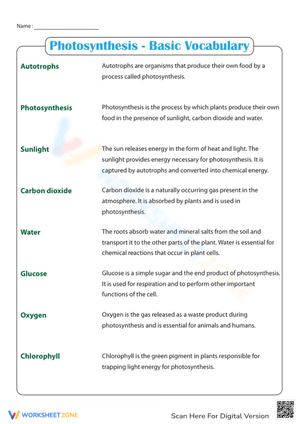
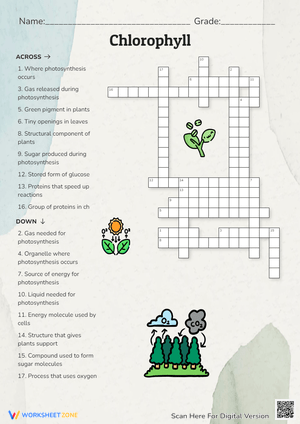
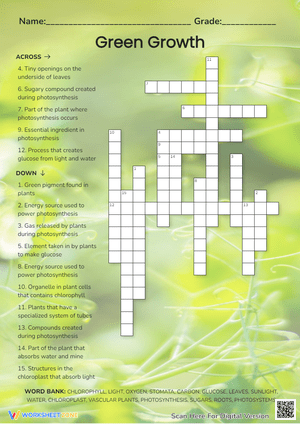
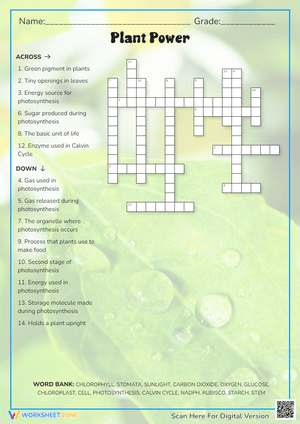
- Vocabulary matching: Students connect terms — chlorophyll, chloroplast, glucose, stomata, reactant, product — with precise definitions rather than loose synonyms.
- Input/output sorting: Students categorize carbon dioxide, water, sunlight, glucose, and oxygen as inputs or outputs using exact scientific language rather than casual descriptions.
- Short written response: Students explain the process in their own words with required vocabulary — a task that surfaces gaps diagram labeling alone misses.
- Comparison task: Students distinguish photosynthesis from cellular respiration at a basic level, noting which process consumes oxygen and which releases it.
Mistakes Students Make That These Worksheets Help You Catch
The most consistent error is treating sunlight as a material ingredient rather than an energy source. When asked to list what a plant uses to make glucose, students write "sunlight, water, and carbon dioxide" — which is not exactly wrong, but they then place sunlight in the same input column as water and carbon dioxide on sorting tasks without recognizing that distinction between matter and energy. That confusion shows up in short-response answers: students write things like "the plant absorbs sunlight and stores it as glucose," collapsing the energy relationship into something more like eating and leaving out the actual chemical transformation. A worksheet prompt that explicitly asks students to identify what provides matter versus what provides energy catches this before it firms up into a stable misconception.
The second reliable error is the photosynthesis/cellular respiration reversal. Students often believe oxygen is consumed during photosynthesis and released during respiration — exactly backward. This partly happens when curricula introduce respiration first, and the word "oxygen" becomes associated with breathing in. Even a two-column chart asking students to list the inputs and outputs of each process side by side tends to resolve the confusion faster than re-explaining by lecture.
A third problem is more localized but worth anticipating: students who can correctly describe photosynthesis as something "plants do" often cannot connect it to the chloroplast. They know it happens in plants, but they cannot name the organelle or explain why leaves rather than roots are the primary site. Worksheet tasks that include a cell-level diagram — not just a leaf cross-section — directly address this gap by asking students to locate and label the structure before they are asked to explain its function.
Fitting These Worksheets Into Your Lesson Sequence
A three-day spread works well for initial instruction. On day one, after a brief direct-instruction segment, students complete the leaf diagram labeling worksheet — marking inputs and outputs at the structural level before the chemistry is fully introduced. On day two, vocabulary matching and input/output sorting work as a partner activity before students finish them independently. On day three, the short written response worksheet functions as a low-stakes formative check: students explain what the plant uses, what it produces, and where in the cell the process takes place. That sequence uses spaced retrieval — students return to the same core ideas across multiple sessions — without repeating the exact same task format each time.
Individual worksheets also fill the classroom pockets that lesson plans rarely account for. A half-sheet exit ticket takes roughly eight minutes at the end of a lab day while students wait to finish cleanup. A vocabulary worksheet works as a bell ringer on the first Monday back after a break, when re-orienting students to content language matters more than launching new material. The photosynthesis-versus-cellular-respiration comparison worksheet anchors a small-group reteaching session without requiring a full whole-class re-teach — which means teachers can run it with six students at the back table while the rest of the class works independently.
For station rotations, three worksheets naturally serve as three stations: the cell-level diagram worksheet, the vocabulary worksheet, and the short written response. The teacher-led station addresses whatever error showed up most in the previous exit ticket — typically the sunlight-as-matter confusion or the oxygen reversal. That structure keeps stations purposeful rather than just busy.
Adjusting the Set for a Range of Learners
For students still building science vocabulary, adding a word bank to any worksheet removes a real barrier without lowering the conceptual demand. Students who freeze at a blank response box when they cannot retrieve chlorophyll or chloroplast from memory will often write accurate science explanations once those words are visible. Sentence frames — "During photosynthesis, the plant uses ___ and ___ to produce ___" — offer similar support: students demonstrate understanding rather than spending mental energy searching for vocabulary they do not yet own fluently.
For students ready to go further, the short-response and comparison worksheets carry an extension prompt below the main task: ask students to explain why photosynthesis matters to animals, not just to plants. That question draws on the same vocabulary while reaching toward energy transfer and food webs — content that appears in later units. The core worksheet stays the same for the whole class; the extension is optional and does not require preparing a separate assignment. 6th grade photosynthesis printable worksheets used this way allow the teacher to maintain one class-wide learning target while giving students at different points different amounts of linguistic and structural support.
Standard Alignment
These 6th grade photosynthesis printable worksheets align with NGSS MS-LS1-6, which asks students to construct a scientific explanation based on evidence for the role of photosynthesis in the cycling of matter and flow of energy into and out of organisms. In classroom terms, that standard requires more than listing inputs and outputs — students need to explain photosynthesis in terms of matter and energy, which is exactly what the written-response worksheets ask them to do. The vocabulary and diagram worksheets build the foundational knowledge; the written explanation tasks ask students to apply it toward standard-level performance.
The input/output sorting worksheets map directly to the "cycling of matter" component of MS-LS1-6. The energy-source prompts — asking students to explain why sunlight is described as energy rather than as a material ingredient — address the "flow of energy" component explicitly. Teachers collecting work samples for standards-based reporting can use the short written response as the most direct evidence of whether students can explain photosynthesis in the terms the standard requires.
Frequently Asked Questions
What background knowledge do students need before these worksheets make sense?
Students should have a basic familiarity with cells and organelles before working through the cell-level diagram worksheets. If chloroplast is completely new vocabulary, a brief introduction beforehand prevents early frustration. The vocabulary matching worksheet works well as the first entry point when students are starting with limited background knowledge — it builds the word-level familiarity that everything else depends on.
Are the worksheets locked into a specific sequence, or can I assign them in any order?
Each worksheet stands on its own and can be assigned in whatever order fits the unit. Most teachers find it natural to start with diagram labeling and vocabulary before moving to sorting and writing tasks, since those require students to already have core terms in working memory. The comparison task between photosynthesis and cellular respiration can be used at almost any point where the contrast becomes relevant — including at the start of a cellular respiration unit weeks later.
How do these worksheets work as sub plans?
Each worksheet includes directions explicit enough for students to follow without teacher explanation. The vocabulary and diagram worksheets require the least contextual setup, making them the most reliable choice for sub days. The short written response worksheet is better reserved for a day when students have already worked through at least one introductory activity. A combination of the vocabulary matching worksheet and the input/output sort makes a complete self-contained sub lesson with no additional prep required beyond leaving the worksheets available.
Does the set address cellular respiration as well?
One worksheet in the set asks students to compare photosynthesis and cellular respiration side by side — inputs, outputs, and location in the cell — at a level appropriate for grade 6 without going into biochemical detail. The comparison is enough to stop the most common conflation errors, and some teachers return to it when beginning a cellular respiration unit as a quick anchor for prior knowledge. The 6th grade photosynthesis printable worksheets in the set keep their primary focus on photosynthesis; the comparison worksheet bridges between the two topics without shifting that focus.












 Interactive Worksheet Maker
 Quiz Maker
 Word Search Maker
 Crossword Puzzle Maker
 Word Scramble Generator
 Sentence Scramble Generator
 Handwriting Worksheet Generator
 Name Tracing Generator
 Fill In The Blank Generator