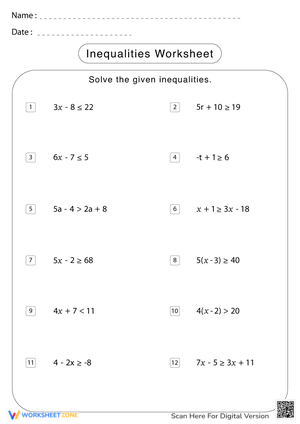
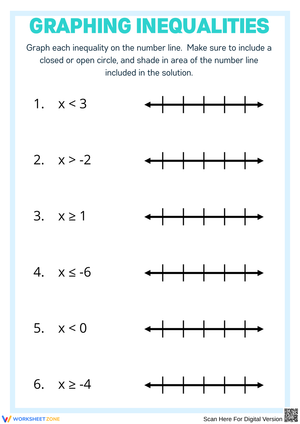
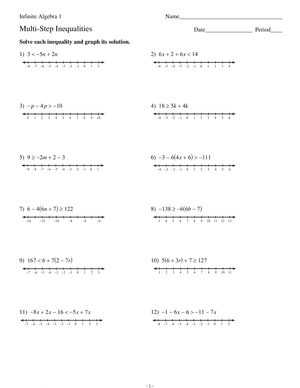
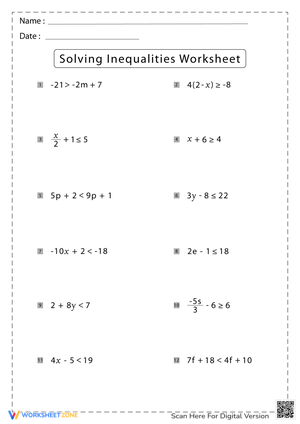
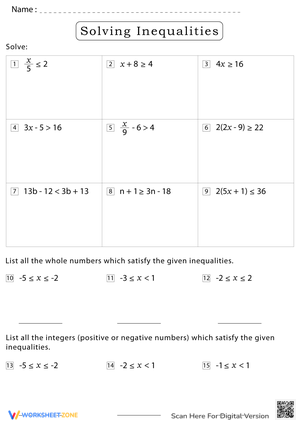
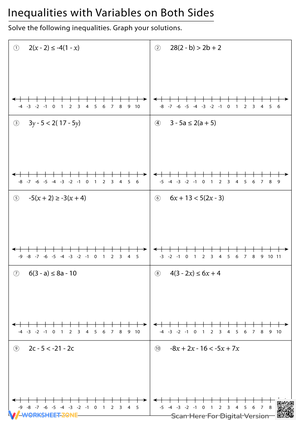
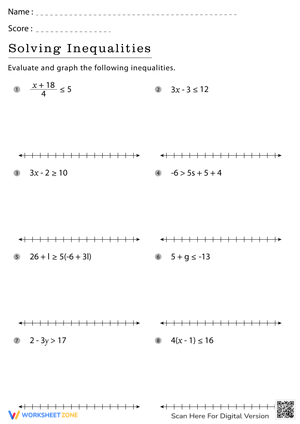
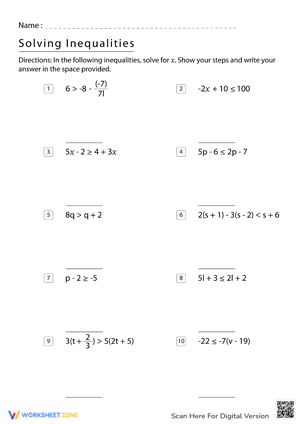
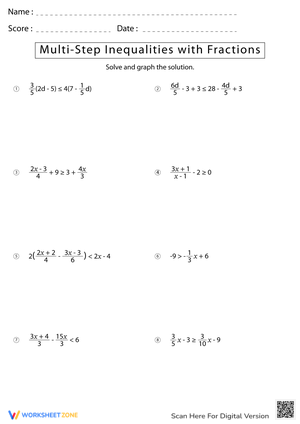
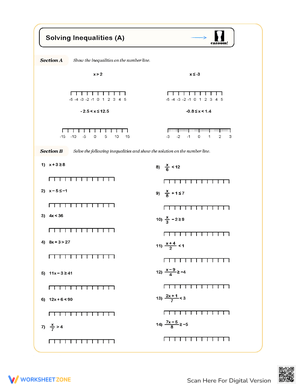
These inequalities printable worksheets for 6th grade give teachers a focused bank of practice material that spans the full unit — from symbol recognition and vocabulary translation through one-step solving and graphing solution sets on number lines. Each worksheet targets a distinct component of the skill, so teachers can assign exactly what a student needs rather than defaulting to the same mixed-review packet every time. That specificity is what makes the set worth returning to across the unit, not just at the end.
The Specific Skills Each Worksheet Targets
At grade 6, the shift from equations to inequalities is genuinely conceptual. Students are learning that a mathematical statement can have infinitely many solutions and that those solutions can be represented as a ray on a number line. The worksheets address this in stages:
- Symbol fluency: reading and writing less than, greater than, less than or equal to, and greater than or equal to with precision.
- Vocabulary translation: converting phrases like no more than, at least, fewer than, and a minimum of into symbolic form.
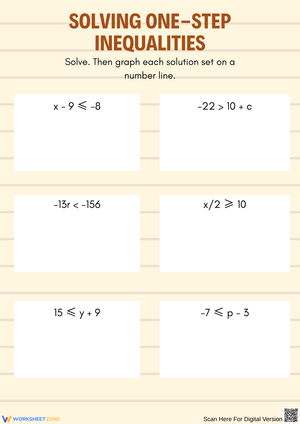
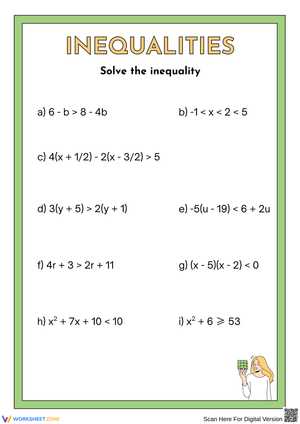
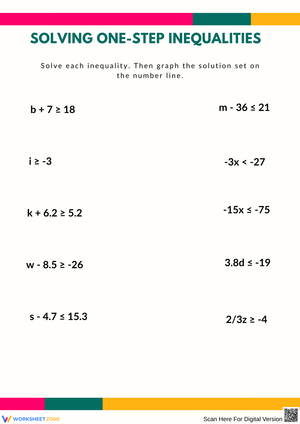
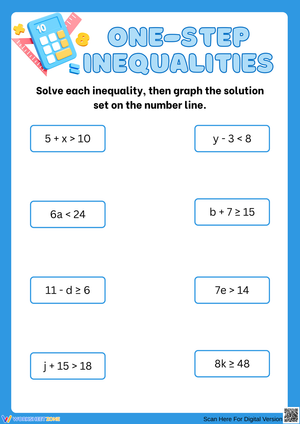
- One-step solving: applying addition, subtraction, multiplication, and division with positive values to isolate the variable.
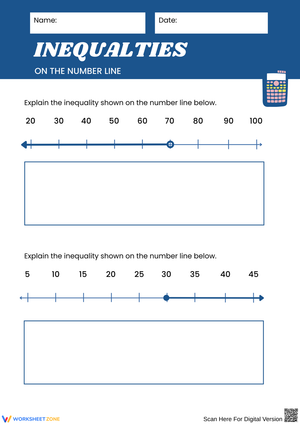
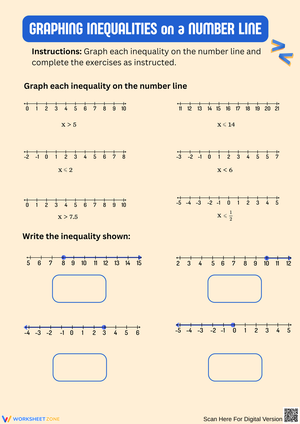
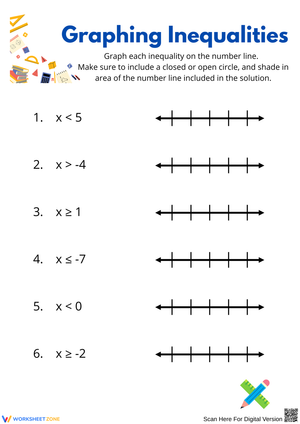
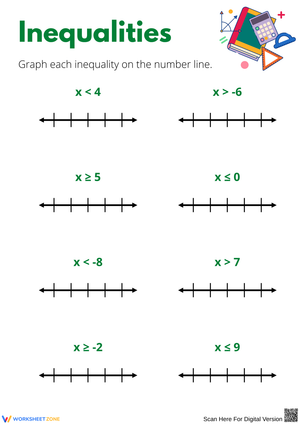
- Number line graphing: placing open or closed circles and shading the correct direction.
- Solution verification: substituting whole numbers, decimals, and fractions to confirm whether a value satisfies the inequality.
That last skill deserves more instructional weight than it usually gets. When students check solutions, they stop treating inequalities as answer-producing machines and start reasoning about what the symbol actually means — that reasoning is exactly what the grade 6 standards are targeting.
Frequent Student Errors Worth Watching For and Correcting
Inequalities produce a short, predictable list of misconceptions. Knowing them in advance helps teachers choose the right worksheet at the right moment rather than assigning general practice and hoping the error clears up on its own.
The most common is circle confusion on the number line. A student who correctly writes x greater than or equal to 4 will often draw an open circle at 4 — because the graph feels like a new, disconnected task from the symbolic work just completed. These students need side-by-side practice that explicitly ties the symbol to the graph, not more isolated graphing drills.
Vocabulary errors are a close second. Students frequently read at least 7 as more than 7, dropping the "equal to" component. In actual student work, this produces a correct-looking inequality — x greater than 7 — when the problem called for greater than or equal to 7. That's a meaningful misread, not carelessness, and it surfaces most often when the problem involves a real-world threshold like a minimum weight or a score cutoff.
There's a deeper misconception that takes longer to fix: many students initially believe an inequality has one answer, the way an equation does. They solve for x and stop, without recognizing that every number in the shaded region satisfies the statement. True-or-false substitution tasks — "does x = 3 work here? Does x = 10?" — directly address that assumption. These tasks belong early in the unit, not just during review.
Building These Worksheets Into Your Lesson Plans Throughout the Week
These resources fit more slots in the math block than most teachers initially expect. Three to four comparison problems as a Monday warm-up after morning meeting reactivates what students practiced Friday. A half-sheet immediately after a mini-lesson on graphing locks in the procedure before the visual fades from working memory. An exit ticket cut from one worksheet in the final six minutes before dismissal generates fast formative data without creating a significant grading load. None of those moves require a dedicated practice period.
For station rotations, pair a solving worksheet with number lines drawn on dry-erase strips so students can mark and redo without committing errors in pen. That physical flexibility reduces the anxiety some students feel when graphing feels permanent. During small-group intervention, pull a single-skill worksheet that isolates exactly where the breakdown happened. A student who can translate word phrases but can't graph doesn't need a full mixed-review worksheet — she needs the graphing worksheet and a few minutes of direct explanation, nothing more.
One organizational habit worth building into the unit: sort the set by representation type rather than difficulty. Keep translation worksheets in one folder, solving worksheets in another, and graphing worksheets in a third. When a student misses a problem type on a quiz, the response is immediate and precise rather than a hunt through a mixed packet. That structure also makes it easier to send targeted practice home without flagging who's struggling.
Standard Alignment
These worksheets align to CCSS 6.EE.B.8, which expects students to write an inequality of the form x greater than c or x less than c to represent a constraint or condition in a real-world or mathematical problem, and to recognize that inequalities have infinitely many solutions and represent those solutions on number line diagrams. In classroom terms, 6.EE.B.8 typically arrives mid-unit in the Expressions and Equations domain — after students have worked with one-step equations and before they move into analyzing relationships between variables. The inequalities printable worksheets for 6th grade that cover both the symbolic and graphical demands of 6.EE.B.8 give teachers full-standard coverage rather than addressing only the procedural surface. The vocabulary translation items connect directly to the "constraint or condition" language in the standard, which matters when students encounter inequality problems embedded in a real-world context rather than presented in pure symbolic form.
Differentiating These Worksheets Across Ability Levels
Because each worksheet in the set focuses on one component of the skill, assigning different worksheets to different students doesn't require a separate lesson plan or an obvious tracking system. A student who needs more time with symbol meaning works through the comparison and translation worksheets. A student who is solid on vocabulary but shaky on graphing gets a focused graphing worksheet. The content stays grade-appropriate for everyone; only the entry point changes.
For students who need additional support, the vocabulary worksheets work well in partner pairs where one student reads the phrase aloud and the other writes the symbol. That verbalization step slows down the reflexive guessing that trips many struggling learners. Using two colored pencils for shading — one for "shade left," another for "shade right" — also builds directional automaticity faster than repeated correction after the fact. These adjustments don't require separate materials, just a deliberate setup at the start of the activity.
For students ready to extend, ask them to work through solving worksheets using decimals and fractions in the variable position, or have them write a real-world situation that matches a given inequality. That second move — going from symbolic to contextual rather than the reverse — is genuinely harder and distinguishes conceptual flexibility from procedural fluency. These inequalities printable worksheets for 6th grade support that kind of extension without requiring a separate advanced resource or a different lesson structure.
Frequently Asked Questions
What does a strong sequencing plan look like when using these worksheets across a unit?
Start with symbol recognition and vocabulary translation — students need the language before they can solve. Move into one-step solving once they write inequalities from word phrases with confidence. Introduce graphing alongside solving so students always connect the symbolic solution to its visual representation on a number line. Save mixed-review and substitution-checking tasks for the back half of the unit, when students are ready to move between formats without losing their footing.
How do I help students remember whether to use an open or closed circle?
Tie the circle directly to the symbol. If the inequality includes "or equal to" — less than or equal to, greater than or equal to — the endpoint is included and the circle is closed. If it doesn't, the endpoint is excluded and the circle is open. Teaching students to underline "or equal to" in the written symbol before touching the number line gives them a physical check that catches the error before it happens. That two-second habit is more reliable than asking students to recall an abstract rule under pressure.
Can these worksheets work for both in-class formative checks and homework?
Yes, and that flexibility is one of the more practical things about the set. A solving worksheet sent home covers the procedural side; a graphing worksheet used the following morning as a warm-up checks whether students retained the visual component overnight. The inequalities printable worksheets for 6th grade travel well across both settings because each worksheet stays focused enough that students can work through it independently once the concept has been introduced in class — no mid-homework clarification needed.
What should I do when students repeatedly reverse greater than and less than?
Repeated reversal is almost never a memory problem — it's a habit of guessing that hasn't been interrupted. Four to five comparison problems at the start of class for several days in a row, ungraded and brief, builds enough automatic recognition that the guessing drops off. Matching tasks — where students pair a symbol with a phrase and then write a number sentence proving the match is correct — work better than flash cards because they require a layer of reasoning on top of simple recall. The extra step is what makes it stick.













 Interactive Worksheet Maker
 Quiz Maker
 Word Search Maker
 Crossword Puzzle Maker
 Word Scramble Generator
 Sentence Scramble Generator
 Handwriting Worksheet Generator
 Name Tracing Generator
 Fill In The Blank Generator