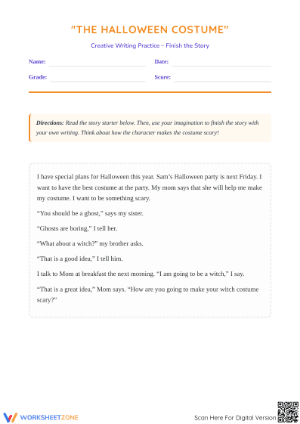
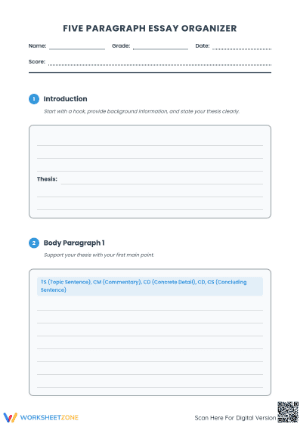
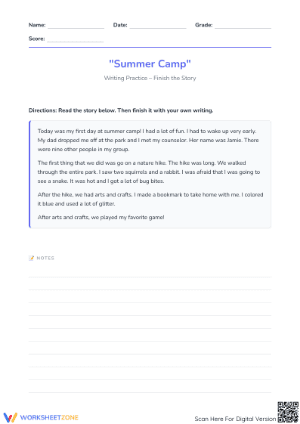
These essay pdf worksheets for 6th grade give teachers a ready-to-use set of targeted, printable resources — each focused on a specific writing skill, so instruction doesn't have to restart from zero every time students need support. Sixth grade is the year essay expectations shift hard: students move from three-sentence responses to multi-paragraph writing with a thesis, body paragraphs built on evidence, and a conclusion that actually closes the argument. These worksheets address that shift directly, one skill at a time.
The Writing Moves Each Worksheet Targets
The skills across the set span the full writing process, which matters because sixth graders rarely struggle with just one thing. A student who writes a strong topic sentence may still bury the evidence underneath vague commentary. Another might brainstorm confidently but collapse when asked to put ideas in order. Each worksheet addresses a specific move so teachers can assign exactly what a student needs rather than sending home a full draft with five different problems to fix at once.
- Thesis and focus: Writing a claim that takes a position rather than restating the prompt
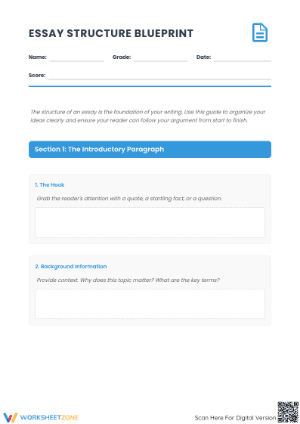
- Hook and introduction structure: Moving from a strong opening line through context to a thesis
- Topic sentences: Writing a sentence that both introduces and controls what the paragraph does
- Evidence and elaboration: Citing a detail and then explaining why it supports the claim
- Transitions: Connecting ideas within a paragraph and between paragraphs
- Conclusion writing: Closing an essay without simply repeating the introduction
- Revision checklists: Re-reading for focus, development, and coherence before editing
- Sentence-level editing: Conventions, punctuation, and grammar review applied in writing context
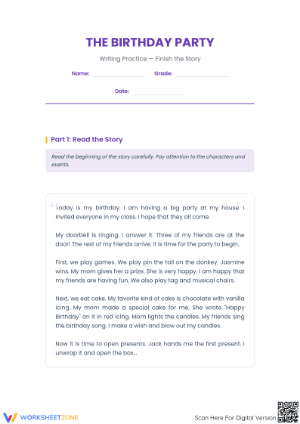
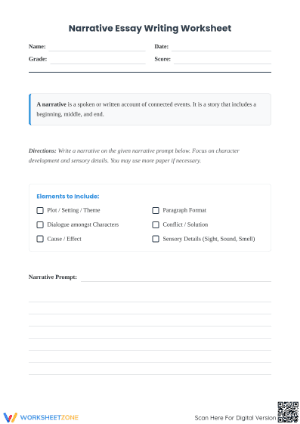
Opinion essays, informative essays, and narrative-based extended responses appear across the set. The core habits — planning before drafting, supporting claims with specific evidence, and revising with a clear goal — transfer across all three forms, so the worksheets reinforce consistent practices even as the essay type changes.
Mistakes Students Make That Teachers Should Anticipate and Correct
The most predictable sixth-grade error in essay introductions is the "Since the beginning of time" opener — a vague, sweeping claim that stalls before the thesis arrives. Students reach for it because they know they need a hook but haven't been taught what a hook actually does. A worksheet that asks students to draft three possible opening lines, label each by type (anecdote, statistic, bold claim, or question), and then choose the strongest one interrupts that habit quickly. After working through that exercise once, most students stop defaulting to the universal vague opener.
Conclusion errors are equally predictable. Students write "In conclusion, I think this essay showed that..." and stop. The problem isn't effort — it's that no one has made explicit that a conclusion should restate the thesis in new words and then push outward to a broader significance. A worksheet that asks students to write one sentence restating the claim differently, then one sentence answering "so what?", gives them a two-move structure they can actually follow on future essays without the worksheet in front of them.
In body paragraphs, the most consistent issue is missing commentary. A student quotes a source or names a detail and then moves on without explaining how it connects to the claim. The pattern looks like: topic sentence, evidence, more evidence, new topic. The analysis step disappears entirely. Worksheets that present a paragraph with the commentary removed and ask students to write that layer back in make the missing move visible in a way that abstract instruction rarely does.
How to Build These Worksheets Into the Writing Block
The most effective sequence is to run each worksheet at the stage it matches rather than assigning the full set at once. During the brainstorming phase, a prompt-analysis worksheet helps students break down what the question is actually asking before they commit to a direction. The Monday after students receive a new essay prompt, that worksheet fits naturally as a structured warm-up during the first ten minutes — it slows the rush to draft and usually produces better thesis ideas by Wednesday than an unguided start does.
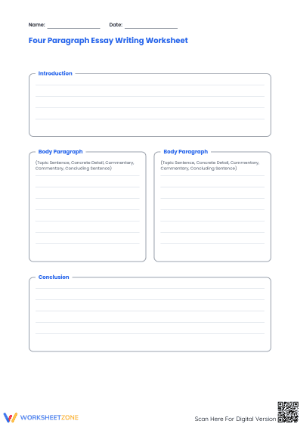
Drafting worksheets for introductions, body paragraphs, and conclusions work well mid-unit, after a brief model and class discussion. One approach that holds up in station rotation: one group uses a body paragraph frame while working through the drafting worksheet, another revises a weak paragraph using a transitions worksheet, and a third meets with the teacher to conference on outlines. Because each worksheet handles a single skill, switching groups doesn't require re-explaining the whole task to new students.
For homework, assigning one focused worksheet rather than a full draft keeps the work manageable and the feedback specific. Asking students to bring in a completed conclusion worksheet — three to five sentences, written independently — gives the teacher something concrete to address the next day without marking an entire essay. That targeted feedback loop, repeated across the writing process, builds more measurable growth than whole-essay feedback delivered once at the end of a unit. A practical addition: run the same essay topic across several worksheets over a few days. When students brainstorm, outline, and revise on the same familiar prompt, they spend less mental effort decoding new directions and more on improving the actual writing skill being practiced.
Essay pdf worksheets for 6th grade also work well as substitute-day materials because each task is self-contained. A sub can distribute a transitions worksheet, give two minutes of verbal direction, and have students working independently within five minutes — no prior classroom discussion required.
Standard Alignment
These worksheets align to Common Core State Standards for English Language Arts — specifically W.6.1, W.6.2, and W.6.3, which govern argument, informative, and narrative writing at the sixth-grade level. The process-focused worksheets (brainstorming, outlining, revision, editing) connect directly to W.6.5, the production and distribution standard requiring students to develop and strengthen writing through planning, revising, and editing. L.6.1 through L.6.3 cover the language conventions that editing worksheets reinforce.
In classroom terms, W.6.5 is the standard that justifies using process-based worksheets rather than one-and-done essay assignments. It explicitly names planning and revision as part of what sixth graders are assessed on, which means a brainstorming organizer or revision checklist isn't supplemental work — it's central to what the standard requires. That distinction matters when explaining to administrators or families why students are completing focused writing practice rather than turning in a full essay every week.
Adjusting the Set for Different Readiness Levels
Essay pdf worksheets for 6th grade lend themselves to tiered use because the core task — producing a specific part of an essay — stays the same across all levels, while the amount of guided support around it can change. For students who freeze when asked to write a thesis from scratch, a worksheet with three partial thesis statements to complete and rank is more productive than a blank prompt. It reduces blank-page anxiety while still requiring a real writing decision — which is the skill being practiced.
For multilingual learners building academic English alongside essay structure, sentence frames on body paragraph worksheets serve a genuine purpose: they let students focus on the reasoning inside the paragraph rather than spending all available effort on generating syntax. Those frames shouldn't stay in place indefinitely. As students grow more confident with the structure, teachers can use the same worksheet with the frames removed, so the support fades naturally without a jarring shift to a completely different task format. That gradual withdrawal keeps expectations high while reducing barriers at the right moments.
Students who are ready for more challenge benefit from extension prompts added to the same worksheet. After completing a conclusion worksheet, a stronger writer can be asked to draft a second version that pushes toward a broader implication — "what should readers do or think after reading this?" That question demands more sophisticated synthesis and can be added to the same worksheet without creating a separate resource. The honest tradeoff with any tiered approach is that it requires deliberate assignment decisions upfront. But deciding which version of the worksheet to hand each student takes far less planning time than writing three entirely separate lessons for three different groups.
Frequently Asked Questions
Do these worksheets cover all three major essay types sixth graders write?
Yes. A well-structured set of essay pdf worksheets for 6th grade covers opinion, informative, and narrative-based extended writing. Each type has its own conventions — argument essays need counterclaim work, narratives need sensory detail and pacing — but the process skills (brainstorming, outlining, revising, editing) apply consistently across all three. Teachers can assign the same revision checklist across essay types and adjust the focus verbally during instruction.
How many worksheets should students complete before writing a full draft?
Most sixth graders benefit from at least three process worksheets before drafting: something for planning (prompt analysis or idea organizer), something for structure (an outline or paragraph planner), and a drafting support for introductions. After the first full draft, revision and editing worksheets come in. Completing that sequence doesn't require weeks — a focused three-day progression can move students from prompt to polished draft at a reasonable pace while keeping each step clear.
Can these worksheets replace a writing curriculum?
No, and they shouldn't try to. These resources work best as targeted practice inside a larger writing unit. They handle the independent application layer — the part where students practice something the teacher has already modeled — but they don't replace direct instruction, writing conferences, or reading like a writer. Teachers who get the most from these worksheets use them to extend instruction, not substitute for it.
What is a practical way to use completed worksheets for assessment?
The strongest approach is formative. Collect completed worksheets during the writing process to see where each student is struggling before the full essay is due. A brainstorming worksheet shows whether a student has enough developed ideas to move forward. A body paragraph worksheet reveals whether evidence and commentary are both present or whether only one of them is showing up. These checkpoints let teachers intervene early rather than returning a finished essay with feedback that arrives too late to act on.















 Interactive Worksheet Maker
 Quiz Maker
 Word Search Maker
 Crossword Puzzle Maker
 Word Scramble Generator
 Sentence Scramble Generator
 Handwriting Worksheet Generator
 Name Tracing Generator
 Fill In The Blank Generator