


























Views
Downloads

The Importance of Trees Worksheet | Essential Grade 5 ELA
Paste this activity's link or code into your existing LMS (Google Classroom, Canvas, Teams, Schoology, Moodle, etc.).
Students can open and work on the activity right away, with no student login required.
You'll still be able to track student progress and results from your teacher account.
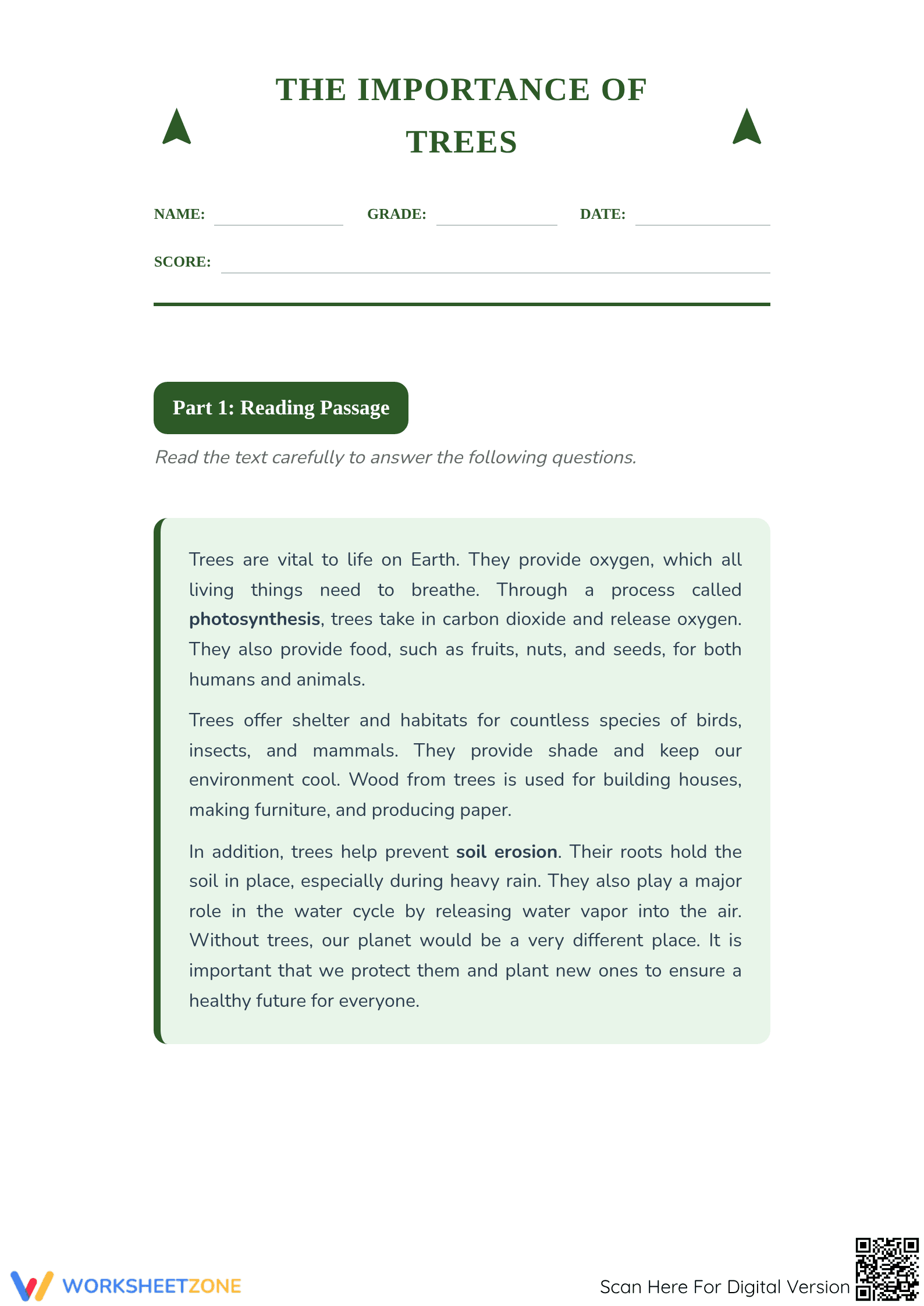
This Grade 5 ELA worksheet helps students analyze informational text through the lens of environmental science. By engaging with the passage titled "The Importance of Trees," learners practice extracting key details, defining domain-specific vocabulary, and synthesizing information into a cohesive written response. It provides a complete instructional cycle from reading to independent writing.
At a Glance
- Grade: 5 · Subject: English Language Arts
- Standard:
CCSS.ELA-LITERACY.RI.5.1— Quote accurately from a text when explaining what the text says explicitly- Skill Focus: Informational Text Analysis
- Format: 4 pages · 13 problems · Answer key included · PDF
- Best For: Independent practice or sub plans
- Time: 35–45 minutes
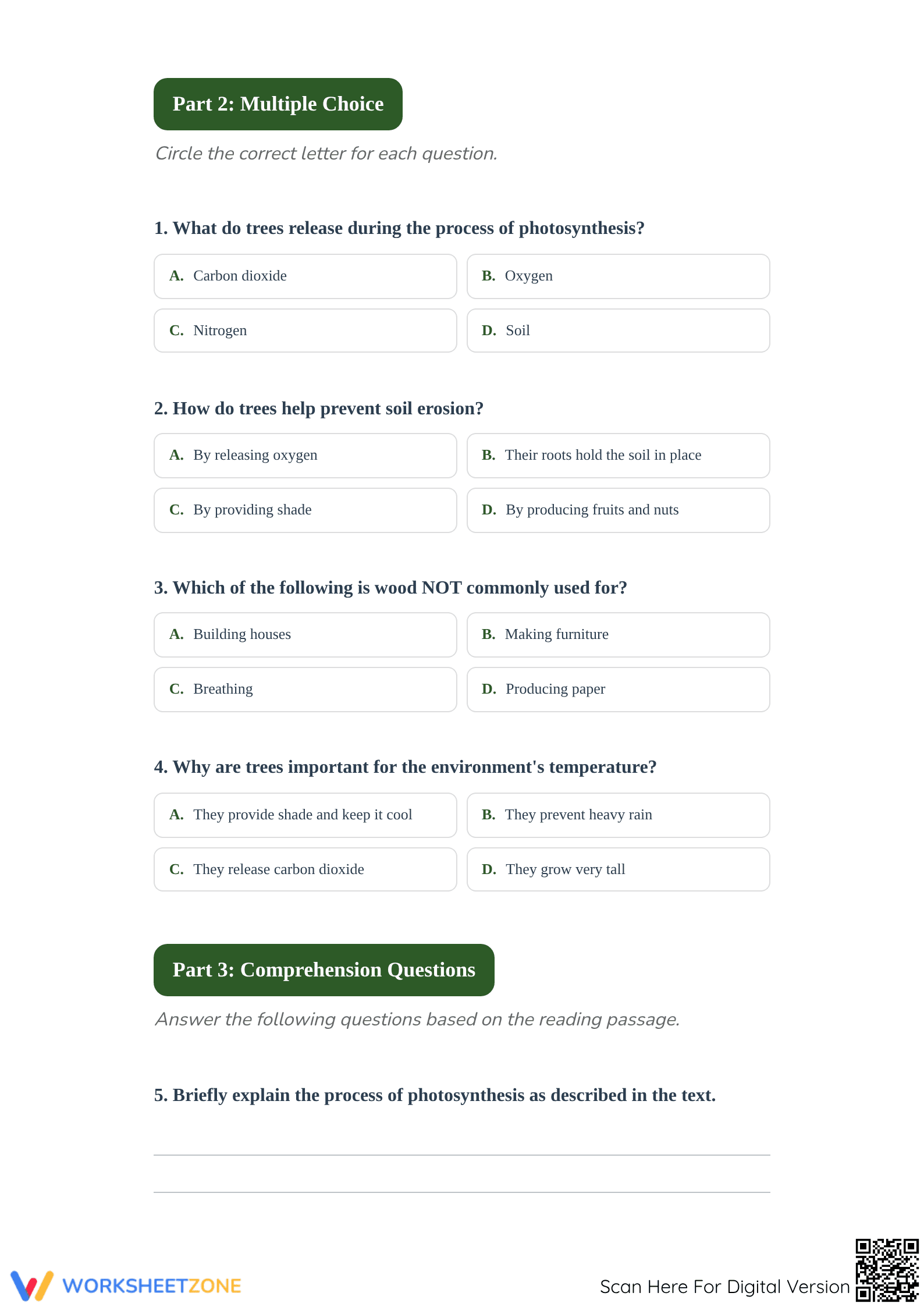
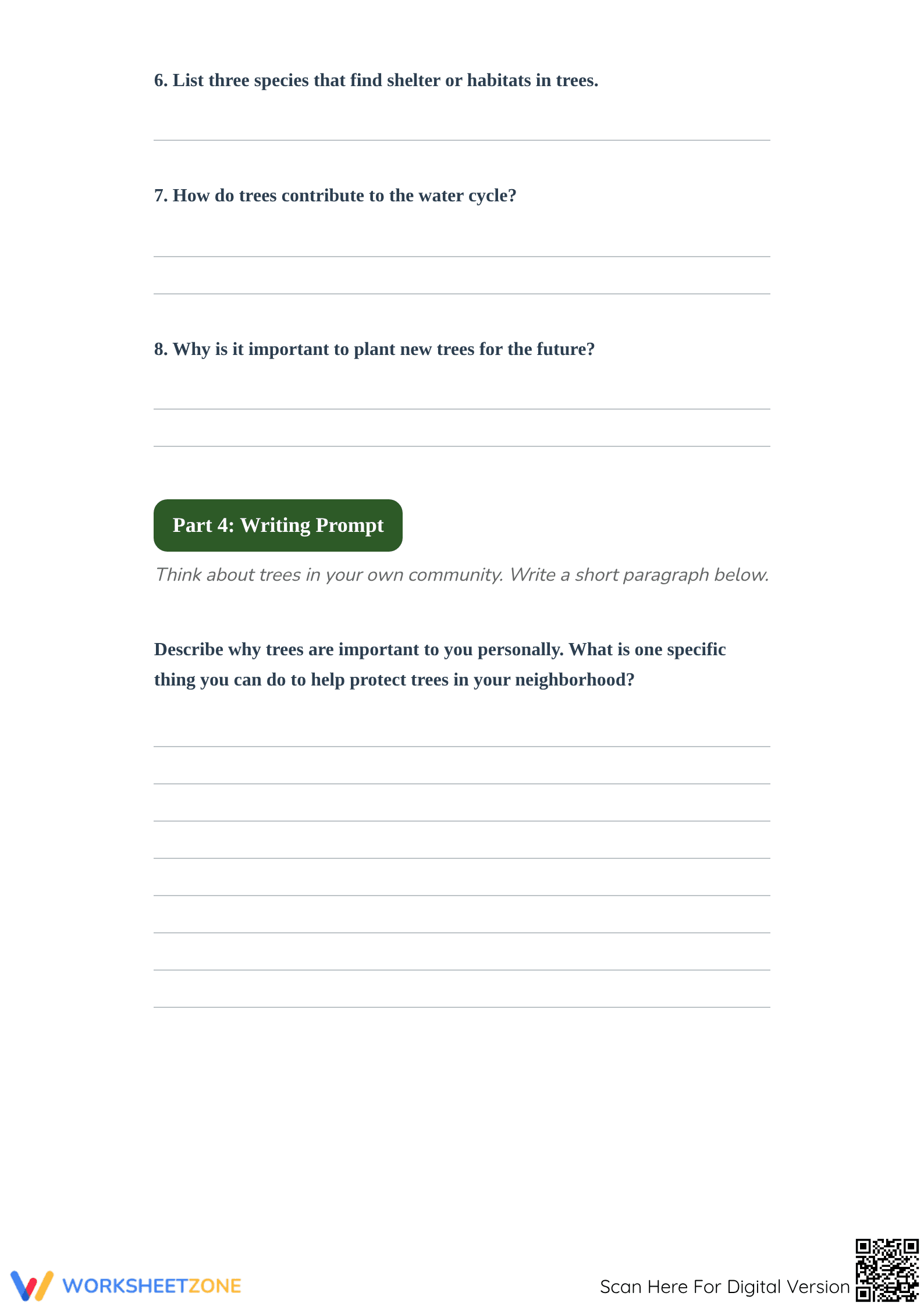
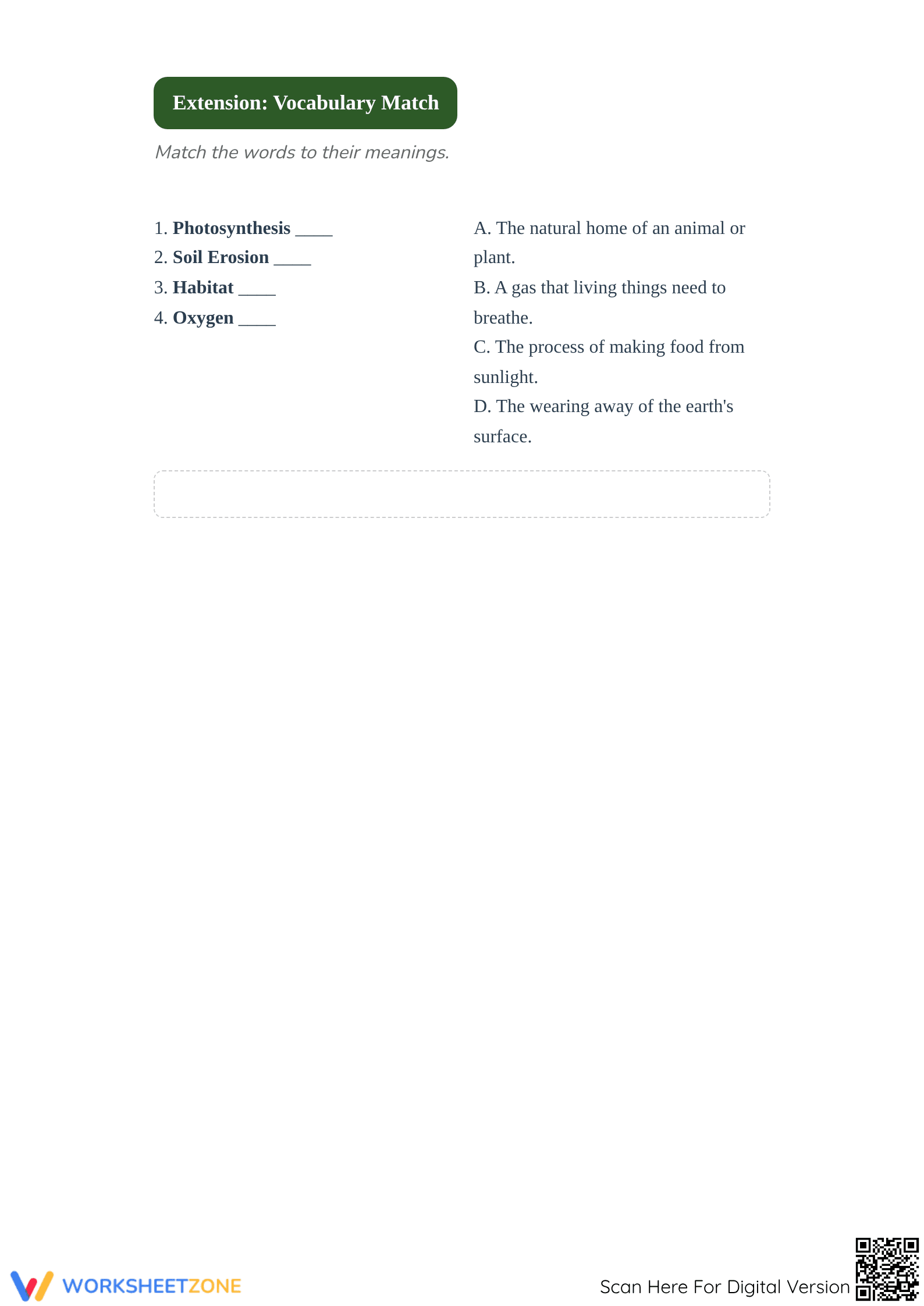
The packet contains four distinct sections designed to build literacy stamina. It begins with a focused reading passage on photosynthesis and ecology, followed by 4 multiple-choice questions and 4 open-ended comprehension tasks. The final pages include a personal writing prompt and a vocabulary matching extension to reinforce terms like soil erosion and habitat. A full answer key is provided for all 13 tasks.
Zero-Prep Workflow
- Print: Select the 4-page PDF and print enough copies for your class in approximately 30 seconds.
- Distribute: Hand out the packets as a bell-ringer, literacy center activity, or main lesson component.
- Review: Use the included answer key to grade or facilitate a peer-review session in under 5 minutes.
Total teacher preparation time is under 2 minutes, making this an ideal resource for emergency sub plans or busy instructional days.
This resource aligns primarily with CCSS.ELA-LITERACY.RI.5.1, requiring students to reference the text to support their answers. It also supports CCSS.ELA-LITERACY.W.5.2 through the expository writing prompt that asks students to describe the personal importance of conservation. Both standard codes can be copied directly into lesson plans, IEP goals, or district curriculum mapping tools.
Use this as a summative assessment after a unit on Earth science or as a standalone literacy block activity. For formative assessment, observe how students handle the "Extension: Vocabulary Match" to gauge their grasp of scientific terminology before moving to more complex texts. Expected completion typically takes 40 minutes for most fifth-grade learners.
This is designed for Grade 4–7 students, particularly those needing structured support in informational reading. It pairs naturally with an anchor chart on the water cycle or a direct instruction lesson on photosynthesis. The clear headings and spaced layout make it accessible for English Language Learners and students with IEP accommodations.
According to the Fisher & Frey (2014) framework for purposeful literacy, integrating reading comprehension with immediate writing application significantly improves student retention of complex informational concepts. This worksheet applies these principles by requiring students to move from literal identification to inferential reasoning and finally to personal synthesis. By anchoring all 13 tasks in the primary text, the resource ensures students meet the rigorous demands of CCSS.ELA-LITERACY.RI.5.1. Research from the NAEP indicates that students who regularly engage with multi-modal informational texts score higher on standardized assessments. This 4-page packet provides the necessary scaffolding to build these critical skills without requiring extensive teacher preparation, making it a reliable tool for diverse classroom environments.


