These 6th grade expository writing worksheets give teachers a focused set of printable resources built around the specific writing moves that 6th graders actually need to practice — not just a prompt and a blank page, but tasks that isolate one skill at a time and make the work of expository writing visible and teachable. Each worksheet targets a single component: planning, topic sentences, supporting details, transitions, revision, or conclusions.
What's Inside the Set
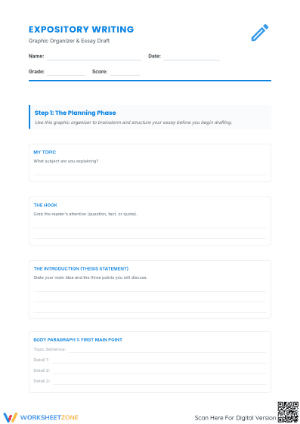
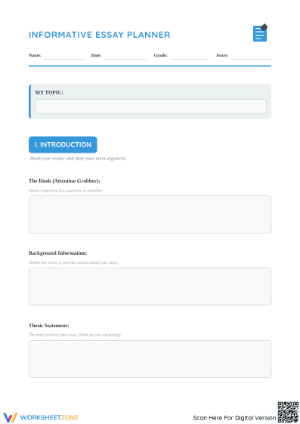
Across the full 6th grade expository writing worksheets, students encounter a range of task types that build toward independent informative writing. The set opens with planning organizers — structured boxes for a main idea, three categories of supporting details, and a conclusions note — so students think through a topic before writing a single sentence. From there, the worksheets move into paragraph-level work: writing and revising topic sentences, identifying which details belong in a paragraph and which drift off topic, and crafting conclusions that summarize without simply restating every sentence that came before.
Two worksheets focus on transitions specifically, which matters because 6th graders routinely use sequence words in paragraphs that aren't actually sequential. One task asks students to identify the logical relationship between two sentences before selecting a transition — turning what is usually a mechanical choice into a thinking move. The revision worksheets at the end of the set present paragraphs with specific, named weaknesses and ask students to rewrite them. That rewrite step is where most of the transfer happens.
Frequent Student Errors Worth Watching For
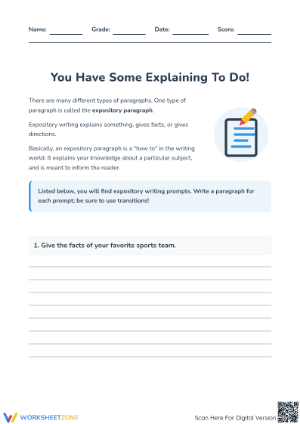
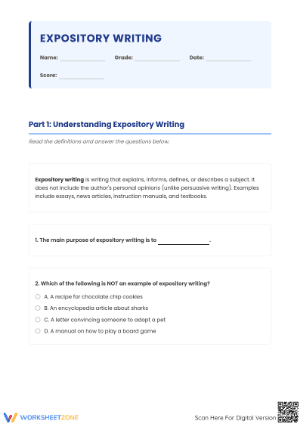
The single most common pattern in 6th grade expository writing is the paragraph that looks full but doesn't cohere. Students list several facts about a topic in separate sentences without ever explaining how those facts connect to the main idea. The paragraph technically has content, but it has no internal logic. A worksheet that asks students to label each sentence as main idea, supporting detail, or explanation — and then check whether they have all three — makes this problem visible in about five minutes.
Topic sentences cause consistent trouble in a specific way: students either write sentences too vague to anchor a paragraph ("There are many interesting things about the water cycle") or they copy the prompt word for word and call it a topic sentence. One task in this set asks students to rank six candidate topic sentences for a given topic from weakest to strongest, then rewrite the two weakest ones. That ranking task generates more genuine discussion than a definition lesson, because students have to argue for their rankings — and in doing so, they name what makes a topic sentence actually work.
Precision is also underdeveloped at this level. Students write "a lot of" and "very important" where they need specific language. This is partly developmental — many 6th graders are still writing the way they talk — and partly a matter of never having been asked to replace a vague word with a more exact one. The revision worksheets give students specific targets: replace every vague quantifier, tighten any sentence that uses "things" or "stuff," and verify that each factual claim is as specific as it can be.
How to Work These Worksheets Into Your Lesson Plans
The routine that works best: short direct instruction on one skill, followed immediately by one focused worksheet, followed by a brief partner discussion about what students noticed or disagreed on. That discussion step is worth protecting. Students who explain their choices to a partner catch their own errors more reliably than students who simply hand the paper to a teacher. After the worksheet and discussion, ask students to apply the same skill in one paragraph of their own writing before the period ends. The worksheet becomes an on-ramp to actual drafting rather than a standalone activity.
A second use worth building in: revisit each worksheet about a week after its initial lesson, without re-teaching first. Ask students to complete the same core task again — three or four minutes — and compare their answers to what they wrote the first time. The gap between what students can do right after a lesson and what they retain without fresh support tells you whether the skill actually transferred. That retrieval check takes almost no prep and surfaces the students who need a targeted follow-up before the class moves on.
For intervention groups, narrow the task. A student who writes paragraphs with no topic sentence doesn't need the full planning organizer — they need the worksheet that breaks a paragraph into three explicit components and asks them to write each part separately. That focused format produces cleaner diagnostic information than a longer task where weaknesses can hide inside complexity.
Standard Alignment
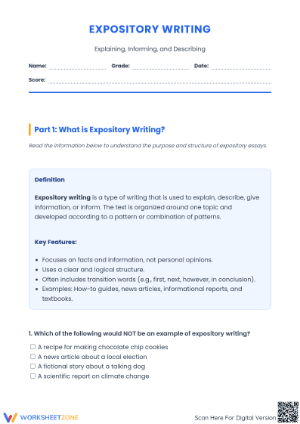
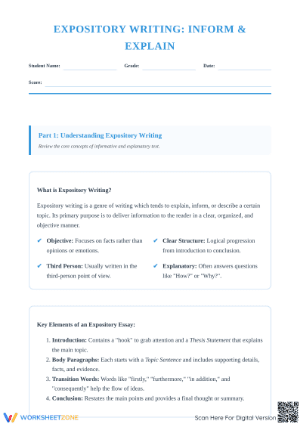
These worksheets align with CCSS.ELA-LITERACY.W.6.2, the informative and explanatory writing standard for 6th grade. That standard asks students to examine a topic, convey ideas using relevant facts and definitions, organize information clearly, use precise language, and provide a conclusion that follows from the explanation. Each worksheet maps directly to one of those sub-components. The revision worksheets also address W.6.5, which covers producing and revising writing over time through planning, rewriting, and editing. In the typical 6th grade ELA unit structure, W.6.2 anchors the informational writing unit and W.6.5 runs alongside it — so these worksheets fit into the core instructional sequence rather than functioning as supplemental add-ons.
Adjusting the Worksheets for a Range of Learners
In most 6th grade classrooms, the writing range runs wide. The 6th grade expository writing worksheets set handles this range without requiring teachers to create separate materials. The adjustments are light but meaningful.
For students who need more structured entry points, pair each worksheet with a sentence starter bank and model the first item as a class before releasing students to work independently. A partially completed graphic organizer — where one detail per category is already filled in — reduces the blank-page freeze so students can focus on the writing skill itself rather than on getting started. Students who receive reading support or language services benefit especially from keeping the task format consistent across worksheets, because the cognitive effort goes toward the writing work rather than toward figuring out new directions each time.
For students who move quickly, skip the modeled examples, ask them to complete the task independently, and then write a follow-up paragraph using the skill in an original piece. The revision worksheet works particularly well as an extension: instead of revising the provided sample, these students revise a paragraph from their own current draft and annotate every change they made. That annotation step turns revision into a reflective act rather than a mechanical one.
Frequently Asked Questions
Are these worksheets better used in class or assigned as homework?
Tasks that ask students to sort, rank, or make analytical judgments about sample writing work best in class the first time, especially before the skill has been modeled. Once a skill has been introduced and practiced with teacher support, a follow-up worksheet makes reasonable homework. Sending a worksheet home on a skill students haven't encountered yet tends to produce guessing or avoidance rather than genuine practice.
Can these support test preparation alongside regular writing instruction?
Most 6th grade writing assessments ask students to produce informational or explanatory responses to a passage or prompt — exactly the moves these worksheets build. Pairing a worksheet from this 6th grade expository writing worksheets with an informational passage and a writing task mirrors the structure of those assessment situations without turning every lesson into a test drill. The planning organizer and the topic sentence worksheet are especially transferable to timed writing conditions.
Do the worksheets include answer keys?
Yes. Each worksheet includes an answer key or model response. For tasks with ranked or evaluated answers — like the topic sentence ranking activity — the key includes brief explanations of the reasoning, which makes it possible to review answers with students as a class rather than just checking for correctness. Those explanations are worth spending a few minutes on, because the reasoning behind a ranking is often more instructionally useful than the ranking itself.















 Interactive Worksheet Maker
 Quiz Maker
 Word Search Maker
 Crossword Puzzle Maker
 Word Scramble Generator
 Sentence Scramble Generator
 Handwriting Worksheet Generator
 Name Tracing Generator
 Fill In The Blank Generator