




























Views
Downloads
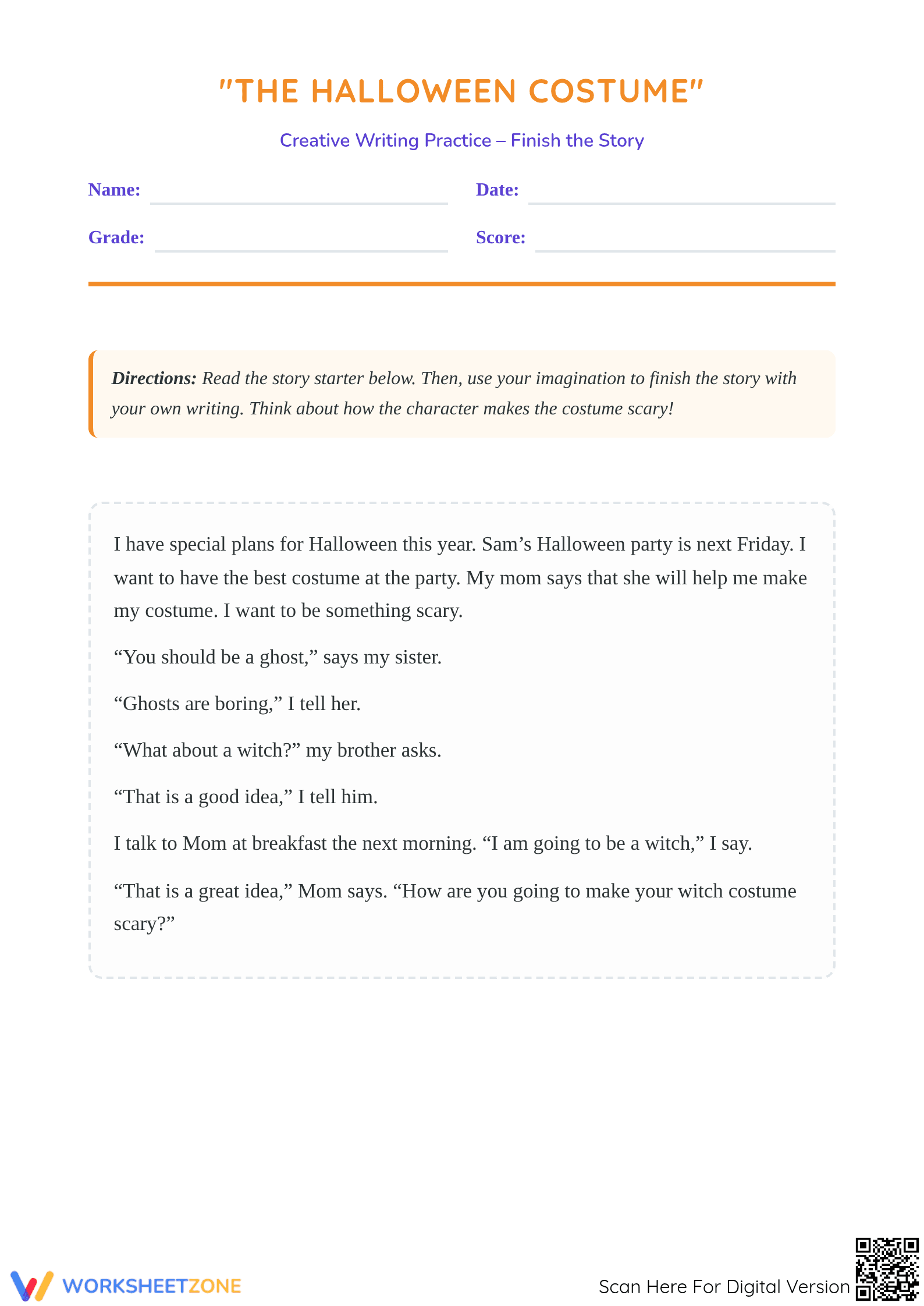



Halloween Narrative Writing | Grade 4-7 Printable

Paste this activity's link or code into your existing LMS (Google Classroom, Canvas, Teams, Schoology, Moodle, etc.).
Students can open and work on the activity right away, with no student login required.
You'll still be able to track student progress and results from your teacher account.
This Grade 4-7 creative writing worksheet helps students master narrative structure by completing a spooky Halloween-themed story. By engaging with a pre-written prompt, learners practice character development and descriptive language. It provides a structured framework for transitioning from reading comprehension to independent creative expression.
At a Glance
- Grade: 4-7 · Subject: ELA Writing
- Standard:
CCSS.ELA-LITERACY.W.4.3— Write narratives to develop imagined experiences using effective technique and descriptive details- Skill Focus: Narrative Completion & Descriptive Writing
- Format: 3 pages · 3 tasks · Open-ended · PDF
- Best For: Seasonal writing prompts and sub plans
- Time: 30–45 minutes
The resource consists of a three-page PDF designed for immediate classroom use. Page one features a high-interest story starter involving a Halloween party dilemma. Page two provides ample lined space for narrative continuation followed by a specific brainstorming section for sensory details. The final page includes a dedicated workspace for visual representation, allowing students to illustrate their character's costume.
Zero-Prep Workflow
- Print: Select the three-page packet and print for your class size (30 seconds).
- Distribute: Hand out materials and read the prompt aloud to ensure comprehension (2 minutes).
- Review: Evaluate student work using the descriptive detail list as a quick-check formative assessment (5 minutes).
Total teacher preparation time is under 2 minutes, making it an ideal emergency sub plan or seasonal bell-ringer.
Standards Alignment
This worksheet aligns with `CCSS.ELA-LITERACY.W.4.3`, which requires students to write narratives to develop real or imagined experiences or events using effective technique, descriptive details, and clear event sequences. It specifically addresses sub-standard W.4.3.D by encouraging the use of concrete words and phrases to convey experiences precisely. Both standard codes can be copied directly into lesson plans, IEP goals, or district curriculum mapping tools.
How to Use It
Use this as a mid-unit application task after teaching the "show, don't tell" technique. During the writing process, circulate and observe if students are incorporating the three "scary" details listed in Part 2 into their actual prose. This serves as a formative check for descriptive integration. Expect completion within 45 minutes, though it can be extended into a peer-editing workshop.
Who It's For
This resource is designed for upper elementary and middle school students who need practice with narrative pacing. It is particularly effective for reluctant writers who benefit from a pre-established hook. Pair this worksheet with a mentor text about suspense or a vocabulary anchor chart featuring spooky adjectives to further support language development.
Narrative writing remains a cornerstone of literacy development, as structured prompts help bridge the gap between basic sentence construction and complex storytelling. According to Fisher & Frey (2014), providing students with a clear "hook" reduces cognitive load, allowing them to focus on descriptive sensory details. This worksheet targets CCSS.ELA-LITERACY.W.4.3 by requiring students to synthesize a provided context into a unique conclusion. Research from the RAND AIRS 2024 report suggests that high-interest, seasonal content increases student engagement during independent writing blocks. By requiring a list of specific details before the final sketch, the resource enforces the planning phase of the writing process, leading to higher-quality output. This standalone resource is optimized for ELA classrooms seeking to improve narrative fluency and descriptive precision in grades 4 through 7.


