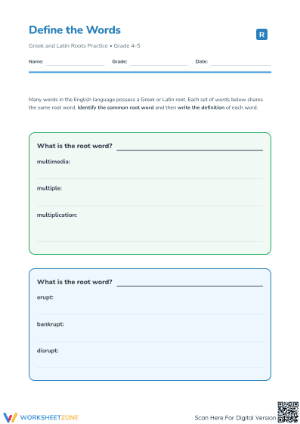
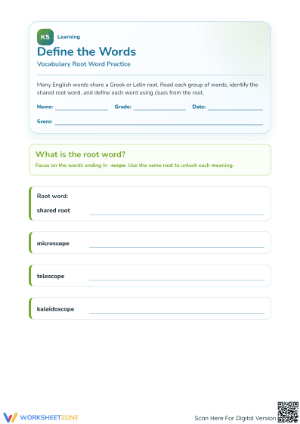
These greek and latin roots printable worksheets for 5th grade give students a working method for analyzing academic vocabulary—one that transfers to science, social studies, and literature rather than staying confined to a single ELA lesson. By fifth grade, the texts students encounter are thick with multi-syllable content words, and guessing from context alone has become unreliable. Root analysis adds a structural clue they can test against what the surrounding sentence actually says.
What Students Practice Across the Set
Each worksheet targets a small cluster of related roots rather than a sprawling list. Students start by connecting a root to its meaning, then move into tasks that require actual use: selecting the correct word to complete a sentence, explaining why one word fits and a related word does not, and sorting terms by shared root. The progression matters because recognition and application are not the same skill—a student who correctly identifies that struct means build may still write "the instructor restructed the lesson" without noticing anything wrong.
- Root-to-definition matching with grade-appropriate vocabulary: geo, tele, struct, port, aud, vis/vid, dict, scrib/script, phon, chron, and others students encounter across fifth-grade subjects
- Word sorting by shared root or meaning family
- Sentence-level inference: students use the root to choose between two plausible meanings and write out the reasoning
- Annotation tasks: underline the root, circle related words in a sentence, note what meaning carries across the word family
- Cross-content transfer: identifying the same root in science or social studies terms from current unit reading
Where Fifth Graders Consistently Go Wrong With Root Words
The most predictable error is what might be called prefix blindness: students lock onto the root meaning and ignore the prefix entirely. A student who knows port means carry will confidently say "import" and "export" both mean "to carry things"—which is approximately right but loses the directional distinction that matters in a sentence about trade routes or migration. These worksheets surface that error because they ask students to compare related words and explain the difference, not simply match each term to a generic root definition.
A second problem is overgeneralization based on spelling. Once students learn that graph relates to writing or drawing, some correctly flag "autograph" and "paragraph" but then mark "grapple" and "grateful" as graph-based words because the letter sequence looks familiar. The sorting tasks force students to test their reasoning against actual word meaning rather than pattern-match on spelling alone.
Standard Alignment
When teachers select greek and latin roots printable worksheets for 5th grade with a specific standard in view, the target is almost always CCSS.ELA-Literacy.L.5.4.b, which requires students to use common Greek and Latin affixes and roots as clues to word meaning. In classroom terms, that standard marks a shift from memorizing definitions to using word structure as active evidence during reading. Root practice belongs in any lesson block where that analytical habit is the instructional goal—close reading, vocabulary instruction, or written response work.
Building These Worksheets Into a Weekly Vocabulary Block
The most efficient use of the set is spaced practice across the week rather than one concentrated session. Monday works well for teacher-led introduction: present two or three words built from the same root, think aloud through the meaning, and have students annotate examples together. A matching or sorting worksheet runs on Tuesday as paired work—ten minutes is usually enough to complete and compare. Wednesday shifts to sentence-level inference. By Thursday, the same root reappears in a content-area context: geo in a geography passage, bio in a life science text. The Friday worksheet functions as a quick formative check you can scan in the last eight minutes before dismissal and know exactly which students still need work on that root family.
In small groups, hand out the worksheet after modeling one root with two examples—not before. Staying present while students work through the first item lets you hear the reasoning aloud and catch prefix blindness before it gets written down and reinforced.
Why This Skill Earns Time Beyond the ELA Block
Content-area vocabulary in fifth grade runs on Greek and Latin roots more than most students notice until someone points it out. A student who knows terr means land is already close to understanding "terrain," "terrestrial," and "Mediterranean" when those words appear in a social studies unit. The same student who meets chron in a chronology exercise can transfer that root to "synchronize" in a science lab without a separate lesson. Several tasks in the set make that transfer explicit by asking students to identify where a root reappears in science, social studies, or math language they already know.
For planning purposes, greek and latin roots printable worksheets for 5th grade work best when they run parallel to what students are reading in other subjects. If the class is midway through an ecosystems unit, a worksheet focused on bio, aqua, and terr feels immediate rather than abstract—students encounter the same roots in a science text that morning and again during ELA. That alignment is straightforward to arrange when you can pull specific worksheets from the set based on what the content block needs that week.
How to Differentiate Root Practice Without Rebuilding the Lesson
Students who are still working on basic decoding need the matching task before anything else. Presenting two or three familiar examples first—then revealing the full word list—keeps cognitive load manageable without lowering the skill target. Students who move through the tasks quickly can extend by writing original sentences that use one root in two related words, then explaining how the meaning shifts when the prefix changes. That extension requires nothing extra: a margin and a prompt on the board.
For multilingual learners, greek and latin roots printable worksheets for 5th grade carry a real instructional advantage worth naming directly. Many Spanish, French, Portuguese, and Italian words share the same roots used in English academic vocabulary. A student who already knows "geografía" has a genuine head start on geo. Naming that connection explicitly—rather than treating the home language as separate from the lesson—accelerates both root recognition and academic vocabulary development.
Frequently Asked Questions
Which roots are covered most often in 5th-grade root word worksheets?
The strongest sets focus on high-frequency roots that appear across subjects: geo, tele, bio, struct, port, dict, aud, vis/vid, scrib/script, graph, phon, chron, terr, and aqua. These appear in grade-level ELA texts and in common science and social studies vocabulary, so the practice transfers immediately without requiring separate review sessions for each subject.
How long does a root worksheet typically take to complete in class?
Most students finish in 10 to 15 minutes. Matching and sorting tasks move quickly; sentence-inference and written-explanation tasks take longer because students must commit reasoning to paper. As a warm-up, plan for 8 to 10 minutes. As the anchor of a small-group lesson with discussion built in around each item, the same worksheet can run 20 minutes without feeling stretched.
Can these worksheets be sent home before the teacher has introduced the root in class?
Each worksheet opens with the root, its meaning, and example words, so students have a reference point even without a prior lesson. That said, the sentence-inference tasks assume some exposure to the root—sending them home on the first day of a new root produces guessing more reliably than analysis. The matching and sorting worksheets travel home more safely early in a root unit and hold up better as independent practice without teacher explanation behind them.















 Interactive Worksheet Maker
 Quiz Maker
 Word Search Maker
 Crossword Puzzle Maker
 Word Scramble Generator
 Sentence Scramble Generator
 Handwriting Worksheet Generator
 Name Tracing Generator
 Fill In The Blank Generator