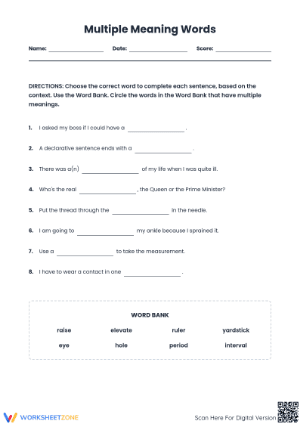
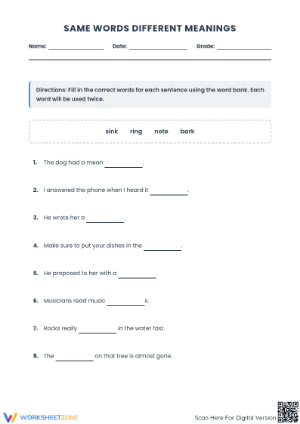
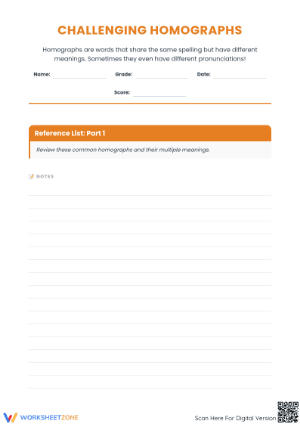
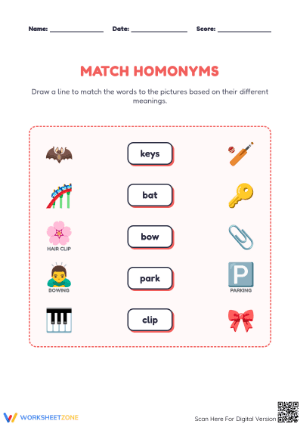
These multiple meaning words pdf worksheets for 5th grade ask students to do one specific thing well: read a sentence closely enough to decide which of a word's meanings actually fits, then name the proof. That is a harder task than it sounds at the upper elementary level, and it is exactly the reasoning that shows up in close reading, short constructed responses, and academic vocabulary work across content areas.
What Students Work Through in Each Worksheet
The core activity is simple to set up but genuinely demanding to complete. Students encounter a familiar word — something like draft, spring, or bank — used in two or more distinct sentence contexts. Their job is to select or write the meaning that fits each use, then identify the surrounding language that confirmed that choice. That second step separates these resources from a basic matching task.
- Reading the same word in two different sentence contexts and distinguishing between the meanings
- Using nearby nouns, verb phrases, or topic signals to identify the correct meaning
- Writing a brief explanation of which clue confirmed the answer
- Comparing homograph pairs where pronunciation shifts along with meaning
- Generating original sentences that demonstrate a word's alternate meaning
That last item — producing a new sentence — reveals something the multiple-choice format hides. A student who can choose the right definition from a list is not necessarily a student who understands how the word behaves in real text. Writing a sentence forces a different level of control, and fifth graders are at a developmental point where that gap shows up clearly. Upper elementary students are months away from middle school reading that will hit them with academic vocabulary in science, social studies, and literary analysis all at once. Building the habit of checking context before committing to a meaning is work worth starting now.
Student Mistakes Worth Anticipating Before You Distribute the Set
The most consistent error is not choosing the wrong meaning — it is choosing the familiar meaning without reading the sentence at all. A student who knows spring as a season will mark that definition even when the sentence reads "the coil compressed and the spring released with force." The words coil and compressed are right there. The student skipped them. That is a comprehension problem wearing a vocabulary costume, and these worksheets surface it quickly because the answer record shows you exactly which clue words should have been visible.
A second pattern involves ambiguity that students perceive as unfair. When two meanings of a word both feel plausible to a student — say, both readings of pitch seem to fit the sentence — the student often picks the first one rather than ruling one out through the surrounding text. When reviewing responses as a group, spending time on why the wrong meaning seemed tempting is where the real instructional payoff sits. Students who hear another student articulate the appeal of the wrong answer often recognize that same impulse in their own reading. Skipping that conversation to move quickly to the next item wastes the diagnostic value these resources provide.
Standard Alignment
These resources align to CCSS.ELA-LITERACY.L.5.4, which asks fifth graders to determine the meaning of unknown and multiple-meaning words using context clues, Greek and Latin affixes and roots, and reference tools. They also address CCSS.ELA-LITERACY.L.5.5c, which covers using the relationship between words — including homographs — to clarify and understand each word's meaning. In classroom terms, L.5.4 governs the initial decoding work: students read the sentence, notice clues, and land on a meaning. L.5.5c pushes deeper, asking students to recognize how word relationships and language patterns shape that meaning. Worksheet practice that combines both — read the context, then compare the meanings — gives students repeated experience with the full expectation the standard describes, rather than stopping at simple definition recall.
Building These Worksheets Into a Week of Vocabulary Instruction
The most effective use pattern is frequent and brief rather than occasional and extended. A single item used as a bell ringer — projected or printed — takes fewer than five minutes and still gives you a quick read on whether students are attending to context or guessing from memory. That is a better use of the first ten minutes than reviewing definitions students have already written down and promptly forgotten.
- Use one or two items as a warm-up immediately before a close reading lesson, so the habit of noticing word context is already active when students open the text
- Assign half a worksheet during small-group rotation while you pull a different group for guided reading
- Keep completed worksheets in intervention folders in sequence — returning to the same format after a few weeks functions as spaced retrieval practice without requiring any new materials
- Build a two-step discussion routine: the student names the correct meaning, then identifies the exact phrase that proved it
- Use two or three items as an exit ticket after a vocabulary lesson, then sort responses by whether students could name a specific clue or only named a general definition
The printable PDF format makes flexible scheduling straightforward — teachers who need materials for sub plans, homework packets, or intervention folders can print a class set without rewriting directions. For intervention folders specifically, keeping completed worksheets in order lets you compare how a student handled context clues in September versus late winter. That is one practical reason multiple meaning words pdf worksheets for 5th grade hold up across a full school year rather than functioning only as a sprint during test-prep season.
Adjusting the Work for Students at Different Levels
Differentiation here lives in the response demand, not the word list. Most fifth graders can handle the same target words; what differs is how much explanation is required and how much oral support surrounds the independent task.
For students who need more support, preview one word before the independent work begins. Think aloud briefly about what you notice in the sentence — not just the word itself, but the phrase around it. Then ask the student to complete the next item with a partner before moving to solo practice. That brief oral modeling step reduces the cognitive load on reading comprehension long enough for the vocabulary reasoning to surface. For on-level students, keep the task independent but add a short reflection prompt at the bottom: Which word was hardest, and what clue finally solved it? That one line reveals more about a student's process than the answer selections alone.
For students ready for extension, skip the answer-selection items entirely and require a written explanation for every response. A stronger next step is to ask students to sort completed items by the type of clue that helped most: a nearby synonym, a contrast phrase, a topic signal, or a verb context. That sorting task helps students recognize that context clues are not random — they follow patterns in how sentences are constructed, and naming those patterns transfers to independent reading in ways that circling answers alone does not.
Frequently Asked Questions
What counts as a multiple-meaning word at the fifth-grade level?
Any word that carries two or more distinct meanings and requires sentence-level reading to identify the correct one qualifies. At fifth grade, the focus shifts from simple concrete contrasts — bat as an animal versus a baseball bat — toward words where both meanings are abstract or content-specific, such as draft, current, or pitch. Students are expected to go beyond recognizing that two meanings exist and instead demonstrate which one fits a specific sentence and why.
How do these worksheets fit into a test-prep sequence?
Multiple meaning words pdf worksheets for 5th grade serve test prep most effectively when spread across several weeks rather than concentrated in a single review session. State ELA assessments aligned to CCSS regularly embed multiple-meaning items inside reading passages, which means students need to recognize and apply the skill mid-text — not just in isolation. Consistent short practice throughout the year builds the automatic habit of checking context first, which is exactly what high-stakes reading comprehension demands.
Can these resources work in a literacy center rotation?
Yes. Each worksheet functions well as a center task because the directions are self-contained and the response format does not depend on prior class discussion. For center use, add a brief accountability step — a response card where students write their hardest item and the clue that solved it — so the work produces something you can review quickly rather than checking every item during the rotation.
What is the difference between multiple-meaning words and homographs?
Multiple-meaning words include any word with more than one meaning, whether or not the pronunciation changes. Homographs are a subset: words spelled identically but sometimes pronounced differently depending on meaning, such as wind (moving air) versus wind (to coil). These multiple meaning words pdf worksheets for 5th grade address both, since the Grade 5 language standard explicitly names homographs alongside the broader multiple-meaning expectation — and students benefit from seeing the two concepts connected rather than taught in separate units.















 Interactive Worksheet Maker
 Quiz Maker
 Word Search Maker
 Crossword Puzzle Maker
 Word Scramble Generator
 Sentence Scramble Generator
 Handwriting Worksheet Generator
 Name Tracing Generator
 Fill In The Blank Generator