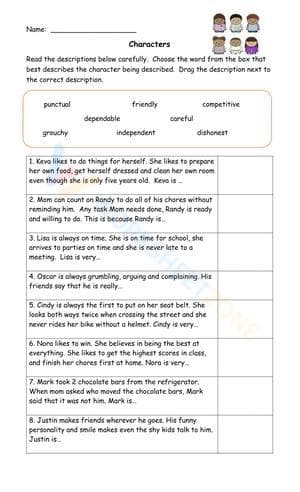
5th grade literary elements worksheets give teachers a compact, text-anchored practice tool for the instructional shift from identifying story parts to explaining how they interact. The set covers theme with evidence, character motivation, conflict, point of view, and cross-text comparison — the cluster of skills that defines Grade 5 literature work in most ELA programs. Each worksheet requires students to read, pull a specific detail, and write an explanation, not circle an answer from a word bank.
The Specific Skills Each Worksheet Targets
Grade 5 literary analysis works best when elements are taught in combination rather than in isolation. A student who can write a correct definition of "theme" will still struggle when asked to connect a character's decision to the author's message — because definition knowledge and interpretive thinking are different demands. The worksheets address that gap by pairing identification tasks with evidence-based explanation from the start.
- Theme with evidence: Students name a theme and cite at least one specific detail — not a plot summary — that supports the interpretation.
- Character traits and motivation: Students trace what a character does across two or more events and explain what that pattern reveals about the character's values or goals.
- Conflict identification and analysis: Students name the conflict type, locate it in the plot, and explain how it drives character action forward.
- Point of view: Students identify the narrator's position and describe what perspective the narration foregrounds — and what it leaves out.
- Cross-text and cross-scene comparison: Students place two characters, themes, or structural choices side by side and produce parallel evidence for each observation.
The comparison tasks deserve a separate note because they expose a different kind of weakness than single-passage tasks do. Students need to hold two texts or two scenes in working memory simultaneously and build parallel evidence — a demand that often reveals gaps in reading stamina and note-taking that shorter exercises won't surface.
Frequent Student Errors Worth Catching Before Assessment
The most consistent pattern in Grade 5 literary analysis work is identifying an element correctly, then stopping. A student writes "the theme is perseverance" and considers the question answered. No quoted text, no connected character action, no explanation of why that claim holds. That response tells a teacher almost nothing useful for planning the next lesson. The worksheets push a second step — "support your answer with a detail from the text" — which forces that connection into the open before it becomes a graded assessment problem.
Point of view produces a different, equally predictable error. Students who understand first-person narration will frequently treat the narrator's interpretation as objective fact when they write. Asked what the narrator notices about another character, a student writes "the other character is jealous" rather than "the narrator describes the other character as jealous, which tells the reader that the narrator sees that character as a rival." The difference matters because the second version shows understanding of how narration shapes meaning. Worksheets that ask students to explain what the narrator's position causes the reader to believe — rather than simply identify the point-of-view label — surface that conflation quickly enough to address it before a unit assessment.
Building These Worksheets Into Your Reading Block
Used well, 5th grade literary elements worksheets earn their place most reliably at the mini-lesson release point. After modeling how to trace a character's motivation through two scenes, a teacher hands off a worksheet with a short passage and asks students to repeat the move independently. That 12-to-15-minute window is exactly where these fit — students have a worked example in front of them and need to apply the thinking without guided support before the lesson closes.
Small-group reteach is the other high-value use. When four or five students are still naming elements without explanation after whole-class instruction, pulling them to the kidney table with a focused response sheet — point of view only, or conflict only — lets you narrow the task scope while keeping the analytical demand. The worksheet gives the group a shared anchor and keeps the session from becoming a second lecture on vocabulary they technically already know.
- Bell ringers: One story-element question tied to the previous day's read-aloud, answered in 6 to 8 minutes before the lesson opens.
- Exit tickets: A single theme question with an evidence prompt — fast to assign, fast to read, and informative without being a formal quiz.
- Literacy stations: Graphic organizers and story maps work here because students can start independently without needing teacher direction.
- Novel study chapters: Character motivation sheets and conflict-analysis response sheets apply just as well to a chapter from a class novel as to a standalone passage.
Standard Alignment
The skills in these 5th grade literary elements worksheets align directly to the Common Core State Standards for English Language Arts at Grade 5. RL.5.1 asks students to quote accurately from a text and explain both explicit information and inferences — the foundation of every evidence-based task in the set. RL.5.2 addresses determining theme and summarizing, RL.5.3 targets character, setting, and event relationships, and RL.5.6 asks students to describe how a narrator's or speaker's point of view influences the presentation of events.
In practical instructional terms, these worksheets belong in the middle of a fiction unit — after direct instruction on each standard but before students are expected to produce independent literary analysis. They are not replacement assessments. They are the practice layer between initial instruction and demonstrated mastery.
Differentiating the Set Across Student Levels
The core structure of each worksheet — read a passage, identify an element, explain with text evidence — holds for on-level students without modification. For students who need more support, the adjustment is not reducing the intellectual demand but decreasing the obstacles around it. A shorter passage (one paragraph rather than three), a sentence frame for the evidence step ("In the text, it says ___, which shows that ___"), or a partially completed graphic organizer keeps the analytical thinking intact while reducing the cognitive load that stops some students before they reach the actual question.
Advanced fifth graders who move through the core task quickly can extend by identifying a second piece of evidence, arguing an alternative interpretation, or comparing the element they analyzed to a different story they have read. Neither direction requires a separate worksheet — just a different expectation for what counts as a complete response. That range means the same set of materials can run across a heterogeneous class without separate planning for each level.
Frequently Asked Questions
Which literary elements should fifth graders be working with most?
Theme, character motivation, conflict, setting, plot structure, and point of view are the core skills at this grade. Comparative analysis — comparing characters or themes across two texts — is also a Grade 5 expectation that students often don't get enough practice with. Theme with evidence and point of view are the skills most teachers return to repeatedly because they are both heavily assessed and genuinely difficult for students to explain in writing.
Can these worksheets be used alongside a class novel, not just standalone passages?
The 5th grade literary elements worksheets in this set are built around skills rather than specific texts, so story maps, character motivation sheets, and conflict-analysis response sheets work just as well when students are writing about a chapter from a class novel as when they are responding to a printed passage. No modification is needed to move from one context to the other.
What is the difference between a story map and a short-response worksheet for these skills?
A story map asks students to sort and label — characters here, setting there, conflict in this box. It is useful early in a unit when students need a structure to organize what they read before they can write about it. A short-response sheet asks students to explain and support with evidence, which is closer to what assessments and independent writing tasks actually require. Both belong in a fiction unit, but at different points in the instructional sequence: story maps earlier, response sheets once students are moving toward written analysis.
Do these work for intervention and reteach, or only for on-level practice?
They work well for both. In an intervention setting, the typical adjustment is reducing the passage length and using a graphic organizer before the written response, so students are not navigating two unfamiliar demands at once. The skill being practiced — explaining a story element with evidence — stays the same. That consistency matters for students who need to build the same analytical habits as their peers, even when the text they are working with is shorter or more accessible.















 Interactive Worksheet Maker
 Quiz Maker
 Word Search Maker
 Crossword Puzzle Maker
 Word Scramble Generator
 Sentence Scramble Generator
 Handwriting Worksheet Generator
 Name Tracing Generator
 Fill In The Blank Generator