Printable Homonyms Practice for 5th Grade ELA
✦These 5th grade homonyms pdf worksheets give upper elementary teachers a printable set built for repeated use throughout a vocabulary unit — not a single-lesson event. Each worksheet focuses on words that share a spelling or pronunciation but carry different meanings, with one consistent task across every exercise: use the surrounding sentence to decide which meaning applies. That context-based decision is exactly what fifth graders need to build, and it transfers directly into how they handle content-area reading and written responses.
The Specific Skills in Each Worksheet
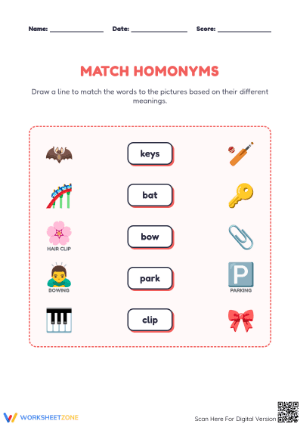
The exercises in these 5th grade homonyms pdf worksheets move students from noticing that a word carries multiple meanings toward explaining, in writing, why one meaning fits a specific sentence. Early items ask students to match a homonym to two distinct definitions — clear enough that students can start independently. Later items raise the demand: choose the correct meaning from context, mark the clue that supports the choice, or write sentence pairs that demonstrate both meanings in use.
- Matching a homonym to two distinct definitions
- Selecting the correct meaning based on sentence context
- Underlining or circling the context clue that supports the answer
- Writing original sentence pairs that demonstrate both meanings of the same word
- Revising sentences where the intended meaning is ambiguous
- Sorting examples as true homonyms, homophones, or homographs
That sorting task earns its place in the set. Students in fifth grade often conflate these three terms, and the confusion shows up in their writing. When a worksheet places bat — same spelling, same pronunciation, two meanings — alongside there/their/they're — same sound, different spellings — the distinction becomes visible rather than definitional. Students stop trying to memorize a rule and start checking the word against the evidence in the sentence.
The Error Patterns These Worksheets Are Built to Catch
The most consistent mistake is also the most automatic: students retrieve the first meaning they know and stop reading. A student who recognizes park as a noun will select "a green space" almost every time, even when the sentence reads, "She tried to park between two trucks." Vocabulary retrieval happens faster than syntax checking. Because these worksheets require students to mark a context clue or write both meanings explicitly, the automatic shortcut gets interrupted. Teachers can then see in the written response whether the issue is narrow vocabulary knowledge, inattention to sentence structure, or a habit of not rereading.
A second pattern surfaces with words that have one familiar meaning and one academic meaning. Matter, state, and current are reliable examples — words students have met in conversation and will immediately assign the casual meaning, regardless of context. Fifth graders encounter those academic uses regularly in science and social studies passages, which means the gap costs them in other subjects if it goes unaddressed during ELA vocabulary practice.
There is also a writing-task workaround worth watching for. When students write original sentence pairs, some produce nearly identical sentences with only a small word swap, avoiding the actual cognitive work. A simple constraint closes this: require students to use the target word in two different grammatical roles, or ask them to underline the phrase in each sentence that makes the meaning clear. That keeps the extension task genuinely demanding rather than performative.
Building These Worksheets Into Your Weekly Routine
A single worksheet works well as a five-minute warm-up before independent reading — three or four items reactivate the prior lesson and quickly surface who is still guessing. A different worksheet runs during a center rotation while the teacher pulls a small group for reteaching. A third serves as a Friday formative check before the weekend. That Monday–Wednesday–Friday pattern takes advantage of spaced retrieval: students revisit the skill in short bursts rather than drilling it in one long block, and the errors that resurface mid-week are still correctable before the unit ends.
When a student picks the wrong meaning but explains the clue they noticed — even a wrong clue — that is more useful information than a correct answer chosen by guessing. Running a two-minute partner share after the warm-up, where students name their answer and the word or phrase that led them there, makes the reasoning audible without extending the block. These 5th grade homonyms pdf worksheets are compact enough to allow that kind of debrief and still leave time for the main lesson.
Standard Alignment
The set aligns most directly to CCSS.ELA-Literacy.L.5.4, which asks students to determine or clarify the meaning of unknown and multiple-meaning words using context clues and other strategies. The subsection L.5.4a — using context as a clue to the meaning of a word or phrase — maps onto nearly every item in the set. The revision and sentence-writing tasks also connect to CCSS.ELA-Literacy.L.5.5c, which addresses how words similar in meaning differ in connotation, relevant when students must explain why one meaning fits a sentence better than another.
In most fifth grade classrooms, L.5.4 surfaces mid-year, woven into close reading and vocabulary units. Teachers introduce multiple-meaning words during whole-group instruction and then need follow-up practice students can handle without direct teacher support. These 5th grade homonyms pdf worksheets fill that gap — structured independent practice that extends the lesson without requiring the teacher to re-explain the task from the front of the room.
Adapting the Set for Different Points of Entry
For students who need more support, simplify the sentence around the target word while keeping the meaning decision intact. A student reading below grade level can still answer "Does ring in this sentence mean jewelry or a sound?" as long as the surrounding sentence is unambiguous. Reducing syntactic complexity removes noise around the skill without removing the skill itself. The goal is to isolate the vocabulary decision, not eliminate it.
Students who move through the base items quickly are ready for extensions that demand more precision. One useful constraint: ask them to write sentence pairs using a target word where the meaning difference depends on something subtle — surrounding word choice, grammatical role, or sentence tone — rather than an obvious giveaway. A prompt like "Write two sentences using light so the reader knows which meaning you intend, without using words like 'lamp,' 'color,' or 'heavy'" pushes vocabulary work into genuine sentence-level craft. For intervention groups, revisiting two or three missed items from a prior worksheet as brief oral practice — asking students to name the clue that would have helped — is more efficient than reteaching the concept from scratch.
Frequently Asked Questions
What exactly is a homonym, and how is it different from a homophone or homograph?
A homophone sounds identical to another word but has a different spelling and meaning — there and their, for instance. A homograph shares a spelling with another word and may be pronounced differently depending on meaning — lead the metal versus lead the verb. A homonym overlaps with one or both categories: it is any word that shares a spelling or pronunciation with another word while carrying a different meaning. For classroom practice, the distinction matters most when students are sorting examples. For most comprehension tasks, the question is the same regardless of category: what does this word mean in this sentence?
Are these worksheets appropriate for ELL students?
With some adjustment, yes. ELL students often have solid recognition of the high-frequency meaning of a word but have not encountered its secondary or academic sense. Adding a brief definition note or example sentence beside less familiar meanings reduces the chance that the barrier is vocabulary breadth rather than the context-clue skill itself. Keeping early sentence structures simple also helps — the task should require meaning selection, not sentence decoding.
How many items per worksheet is enough to get usable classroom data?
Eight to ten items produces enough evidence to identify error patterns without generating fatigue-driven guessing toward the end. Fewer than six items rarely gives a clear picture of whether a student has internalized the skill or got lucky on a couple of answers. More than twelve tends to produce diminishing returns as attention flags, making the final items less reliable as evidence than the opening ones.
Can these be used for test preparation?
Yes, directly. Multiple-meaning word items appear on most state ELA assessments at the fifth grade level, typically embedded in a reading passage where students select the correct definition from answer choices. The context-selection tasks in these worksheets mirror that item format closely enough to serve as practical pre-assessment review without requiring a separate test-prep resource.
Clear All