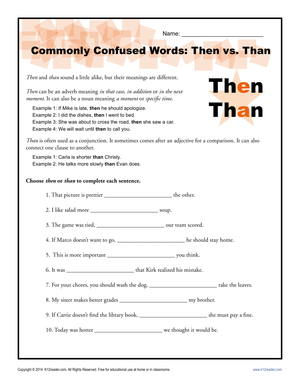
Then vs. Than Printables That Make Grade 5 Grammar Review Stick
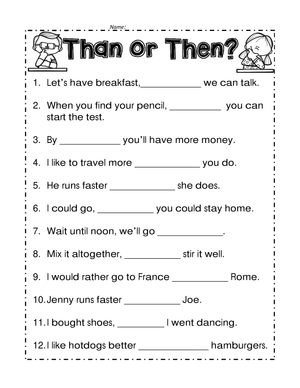
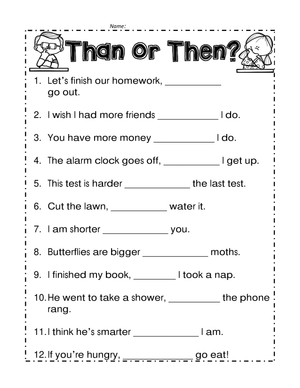
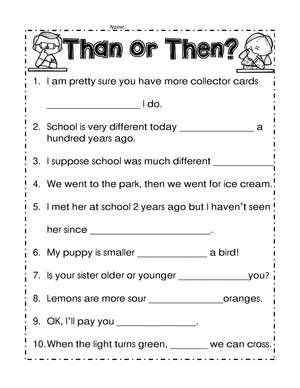
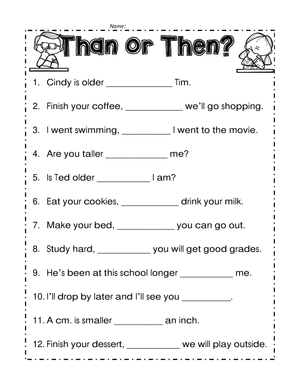
These then vs than printable worksheets for 5th grade target one of the most persistent word-choice errors in upper elementary writing — the kind that survives self-editing passes and appears in otherwise strong student work. The set gives teachers a focused, ready-to-use resource for grammar review without pulling a full lesson period away from reading or writing instruction.
What's Inside the Set
Each worksheet moves students through at least two task types rather than repeating a single format across every item. That range matters because the confusion between then and than has different roots depending on the task — recognizing the wrong word in a sentence is a different cognitive act from producing the correct word in an original sentence, and both matter at Grade 5.
- Fill-in-the-blank sentences where the surrounding context provides a clear sequence or comparison signal students must identify before answering.
- Error-correction items that ask students to replace the wrong word and name the sentence clue that drove the correction.
- Short editing passages mixing both words in realistic, multi-sentence context so students cannot rely on pattern recognition alone.
- Sentence-writing prompts asking students to produce one original sentence with then and one with than, used correctly.
The rule itself fits in a single sentence: then marks time, sequence, or what follows next, while than introduces a comparison. Every item on every worksheet asks students to apply that rule rather than recall a definition in the abstract. When students must decide what a sentence means before they select a word, the skill transfers to their own writing more reliably than when they work from memorization alone.
Frequent Student Errors Worth Watching For
The dominant Grade 5 mistake is not a spelling problem — it is a syntax problem. A student writes "She ran faster then anyone" not because she forgot what than looks like, but because she did not read the sentence as a comparison before she filled in the blank. She moved through the sentence quickly and grabbed the word that sounded familiar. That pattern explains why circle-the-answer formats miss part of the picture: they catch the error after it happens, but they do not build the habit of reading for sentence structure before making a word choice.
A subtler problem surfaces in sentences that hold both time language and comparison language in proximity. Something like "She finished sooner then/than the rest of the group expected" trips students up because finished feels like a sequence signal and expected implies a standard of comparison. Students who are choosing by feel, rather than by structure, will hesitate or guess wrong. The then vs than printable worksheets for 5th grade in this set include a deliberate handful of those harder boundary items, not as tricks, but as diagnostic opportunities — they reveal which students have the conceptual distinction and which are still working by sound.
Fitting These Worksheets Into Your Lesson Planning
The most efficient classroom use is a five-minute opener before a writing period. Project two or three items, ask students to name the sentence signal that drove their answer — sequence or comparison — and then release the class to finish the rest independently. That structure keeps the routine brief while making sure students verbalize their reasoning at least once before they work alone. Guessing drops off quickly when students know they will have to say why.
For literacy centers, a two-step routine works well: students first sort a set of example sentences into a then column and a than column, then open the worksheet. The sort primes the decision-making before the formal practice starts. Another option is to pair the worksheet with a colored-pencil routine — students underline the comparison or sequence clue in each sentence before writing the answer, making their reasoning visible on the page for easy teacher review during a walkthrough.
- Monday warm-up: work through one worksheet and spend three minutes on the two or three items where students disagreed — disagreement is usually the most instructive moment.
- Mid-unit assignment: send a mixed-context worksheet home when students are actively drafting comparison paragraphs, so the practice connects directly to work in progress.
- Small-group reteach: pull four to six students and have each one explain every choice aloud before writing it; 10 minutes of this surfaces the conceptual gap faster than retesting on paper alone.
- Exit ticket: use one sentence-completion item at the close of a grammar mini-lesson as a quick check on who is applying the rule and who is still choosing by sound.
Standard Alignment
This set addresses CCSS.ELA-LITERACY.L.4.1.g, which requires students to correctly use frequently confused words. That standard is formally introduced at Grade 4, but it carries forward into Grade 5 under the broader language convention expectations of L.5.1, which calls for students to demonstrate command of standard English grammar and usage in their own writing. In classroom terms, that means Grade 5 teachers are expected to address word-choice confusions inside real writing tasks, not in isolation — which is why worksheets that combine editing passages and sentence-writing prompts are more instructionally aligned to that standard than fill-in-the-blank-only practice.
Adapting the Set for a Range of Learners
For students who need additional support, the fill-in-the-blank and sentence-completion items make the best entry point. Teachers can also provide a two-question reference card that students consult before answering each item: "Am I comparing two things?" and "Am I showing what comes next or happened afterward?" That small, structured prompt removes the guessing reflex without removing the thinking. The then vs than printable worksheets for 5th grade in this set offer enough variety that students get repeated decision-making practice even when that reference card is sitting beside them.
For students ready for a challenge, the sentence-writing prompts become the primary task rather than a brief closing activity. Ask them to write four original sentences with then and four with than, then exchange papers with a partner and mark each other's comparison or sequence clues. A further extension is a real-text search: students scan their current independent reading book for one example of each word used correctly in context and bring those sentences to the next discussion. Students consistently find this harder than expected — then appears for sequence far more often in narrative texts than they anticipate — and it connects the grammar work to actual reading in a way that stays concrete.
Frequently Asked Questions
What is the clearest way to explain the difference between then and than to a fifth grader?
Keep it to two roles. Then belongs in sentences about time, order, or what happens next. Than belongs in sentences that compare two people, things, or ideas. A quick editing test students can run independently: try swapping in the word next. If the sentence still makes sense, they likely need then. If the sentence breaks, they need than.
How many worksheets from this set should I use before expecting mastery?
Two or three spread across a week work better than one long sitting. Start with direct instruction and use one worksheet as guided practice. Follow up with a second worksheet as independent practice a day or two later. Close the cycle with a short editing passage as a check. That spacing — aligned with how spaced retrieval practice moves grammar rules from short-term recall into actual writing habits — gives a cleaner picture of mastery than a single worksheet used once and not revisited.
Can these worksheets double as formative assessment tools?
Yes, particularly the error-correction items. When students identify a wrong word and explain the sentence signal they used to correct it, teachers see conceptual understanding, not just answer accuracy. A student who consistently swaps words in every comparison sentence has a different reteach need than a student who misread one item on a rushed afternoon. That distinction shows up clearly on a marked worksheet without requiring a separate assessment task.
Are these worksheets appropriate for intervention or pull-out groups?
The narrow focus makes them easy to work through in a 10–15 minute intervention session. Small groups benefit most from talking through each item before writing — discussion reveals where the reasoning breaks down in ways silent independent practice does not. Teachers can also split one worksheet across two short sessions, addressing sequence items in the first session and comparison items in the second, if students need the concepts separated before they can handle them together. The then vs than printable worksheets for 5th grade format holds up across that kind of pacing adjustment without losing the coherence of the practice.
Clear All