


























Views
Downloads

Animal Adaptations Printable Worksheet | Grade 4 Science
Paste this activity's link or code into your existing LMS (Google Classroom, Canvas, Teams, Schoology, Moodle, etc.).
Students can open and work on the activity right away, with no student login required.
You'll still be able to track student progress and results from your teacher account.
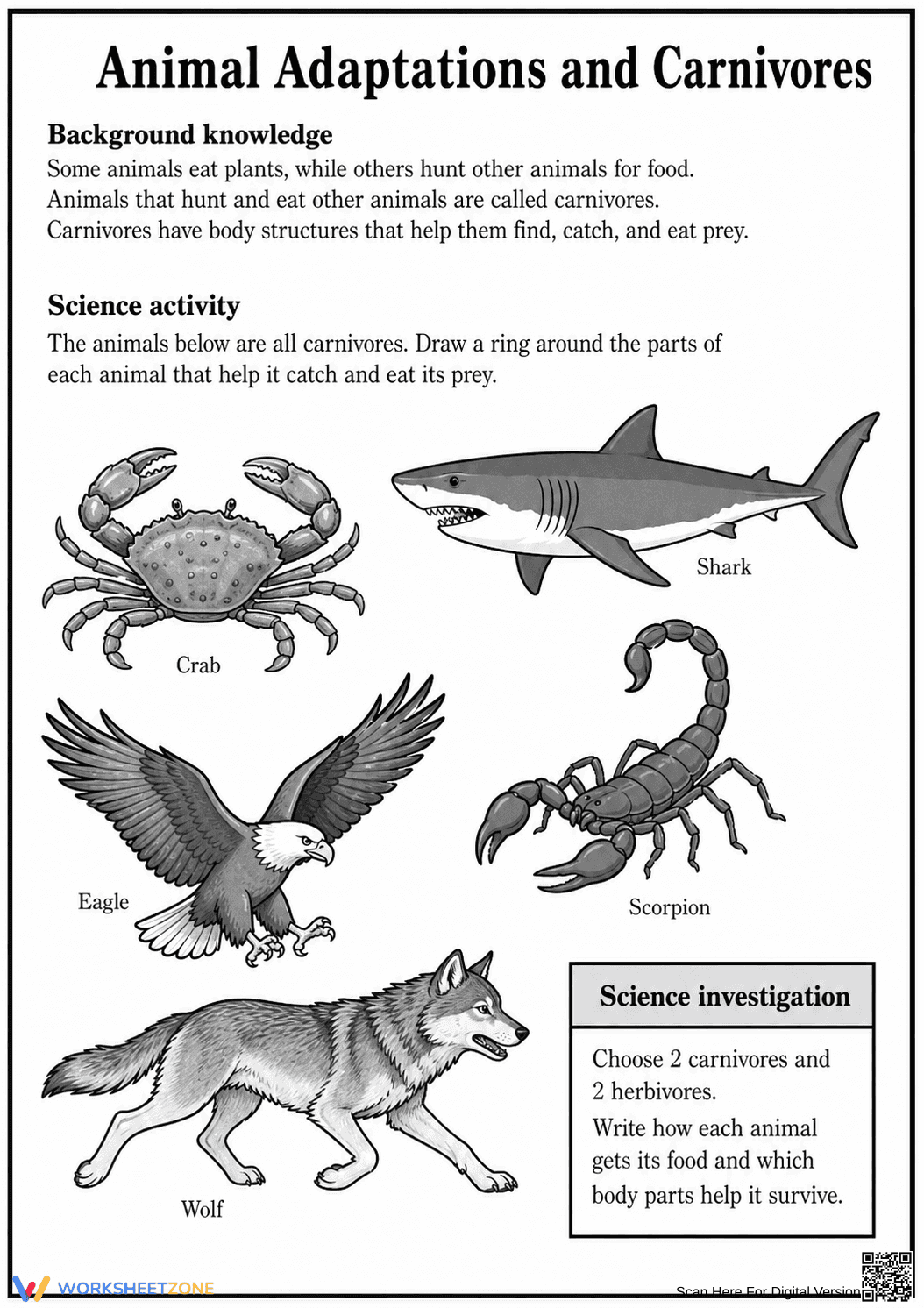
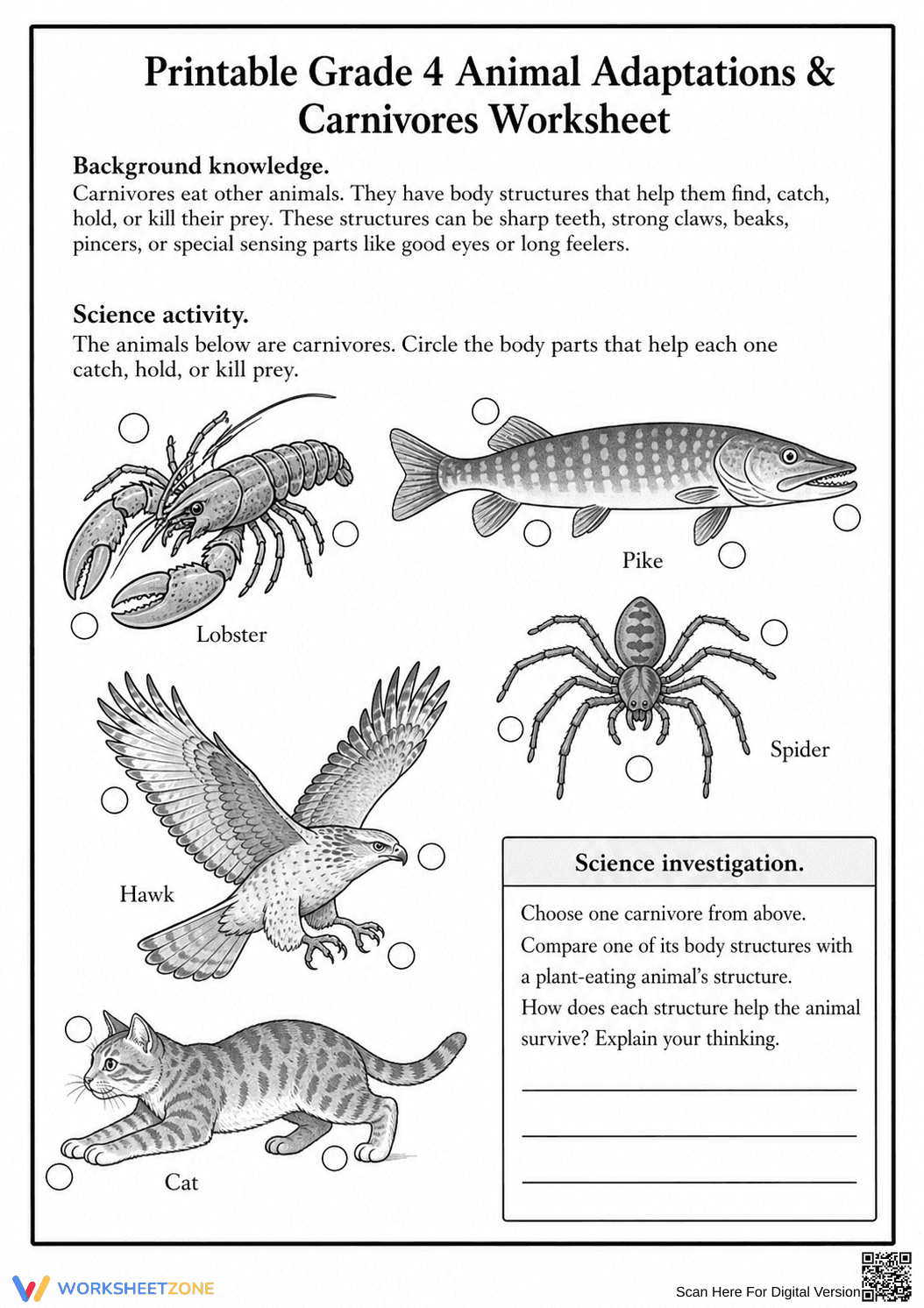
This Grade 4 science worksheet helps students identify specific physical adaptations that carnivores use to survive. By examining various animals and circling the structures used to catch prey, learners connect physical traits to biological functions. This activity reinforces foundational life science concepts regarding predator-prey dynamics and survival strategies.
At a Glance
- Grade: 4 · Subject: Science
- Standard:
4-LS1-1— Identify physical structures that support animal survival- Skill Focus: Animal Adaptations
- Format: 2 pages · 12 problems · PDF
- Best For: Independent practice
- Time: 15–20 minutes
What's Inside
This two-page PDF features ten visual identification tasks and two short-answer science investigations. Students read brief background knowledge about carnivores before analyzing detailed illustrations of animals like sharks, eagles, and scorpions. They must circle the specific body parts—such as claws, beaks, or teeth—that help each creature catch and eat its prey. The investigation sections prompt students to compare these structures to those of herbivores, encouraging deeper critical thinking.
Zero-Prep Workflow
- Print: Generate copies of this two-page activity in seconds.
- Distribute: Hand out to students for immediate engagement with the self-explanatory instructions.
- Review: Check student responses quickly during independent work time or as a whole class.
With under two minutes of total teacher prep time, this resource is highly suitable for emergency sub plans, morning work, or quick transitions during your science block.
Standards Alignment
This resource is aligned to 4-LS1-1: Construct an argument that plants and animals have internal and external structures that function to support survival, growth, behavior, and reproduction. By isolating specific external anatomy like pincers and talons, students gather the observational evidence required to understand biological systems. Both standard codes can be copied directly into lesson plans, IEP goals, or district curriculum mapping tools.
How to Use It
Deploy this worksheet during the independent practice phase of a lesson on ecosystems or animal life cycles. As a formative assessment, observe whether students correctly distinguish between structures used for movement versus those specifically adapted for hunting and feeding. The activity is designed to be completed within a 15 to 20-minute timeframe, making it an excellent choice for science station rotations or focused homework assignments.
Who It's For
This activity is primarily designed for Grade 4 students, though it serves as a strong review for Grade 5 learners. The clear, high-quality illustrations make it particularly accessible for visual learners and English Language Learners who might struggle with text-heavy science materials. Pair this worksheet with a classroom anchor chart detailing common predator adaptations or a short non-fiction reading passage about local food webs.
Aligning instructional materials with 4-LS1-1 requires students to explicitly identify physical structures that support animal survival in their natural habitats. Research by Fisher & Frey (2014) demonstrates that providing students with clear, visual models before asking them to synthesize information significantly improves the retention of complex scientific concepts during the elementary years. By having learners first circle specific adaptations on detailed illustrations of carnivores, this worksheet reduces cognitive load and builds essential foundational knowledge. Students then apply this understanding in the short-answer investigation section, bridging the gap between simple visual identification and rigorous scientific reasoning. This structured, evidence-based approach ensures that young learners can confidently articulate how specific anatomical traits, such as a hawk's sharp beak or a scorpion's venomous stinger, function within an ecosystem to facilitate critical survival and feeding behaviors.


