


























Views
Downloads
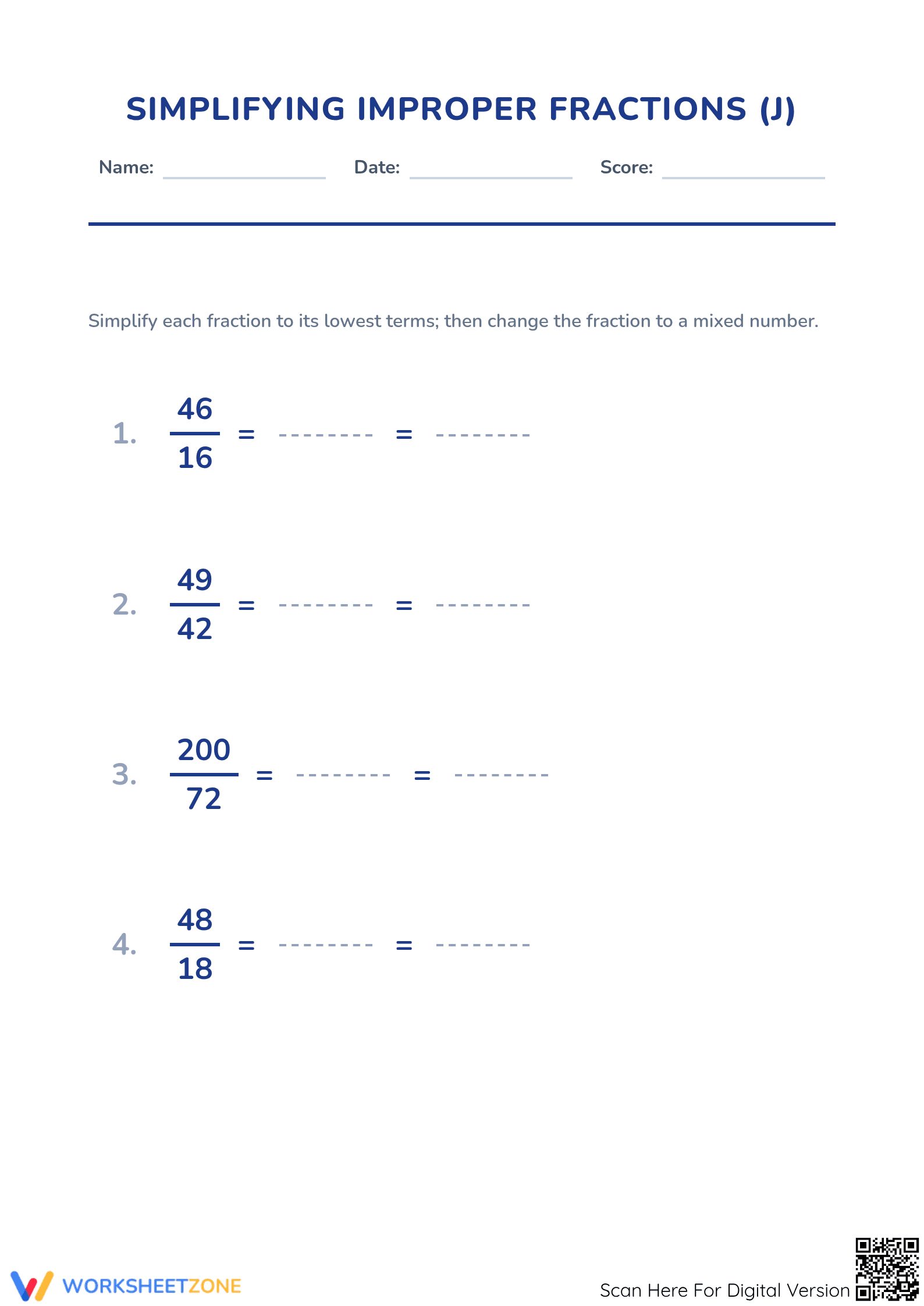
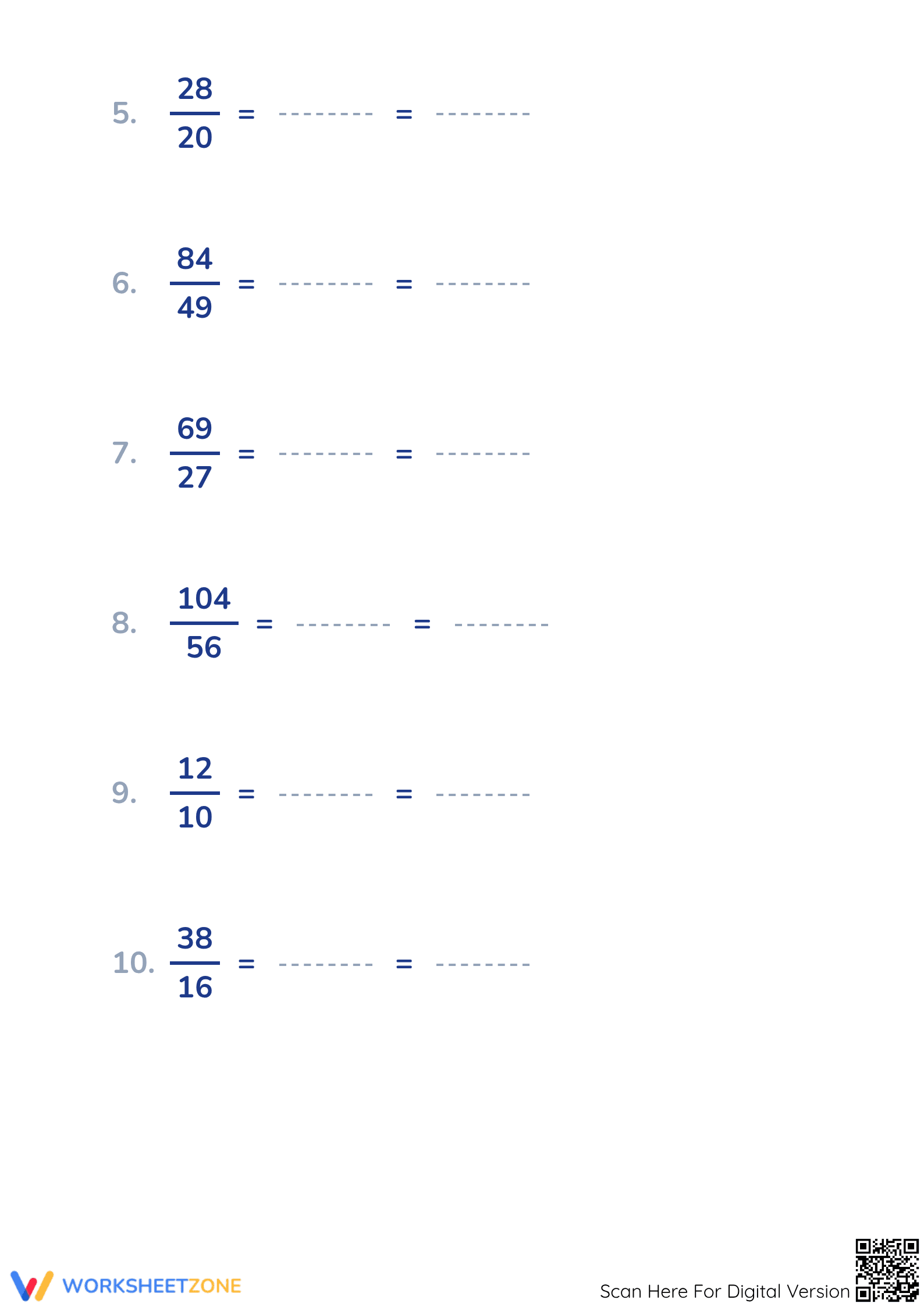
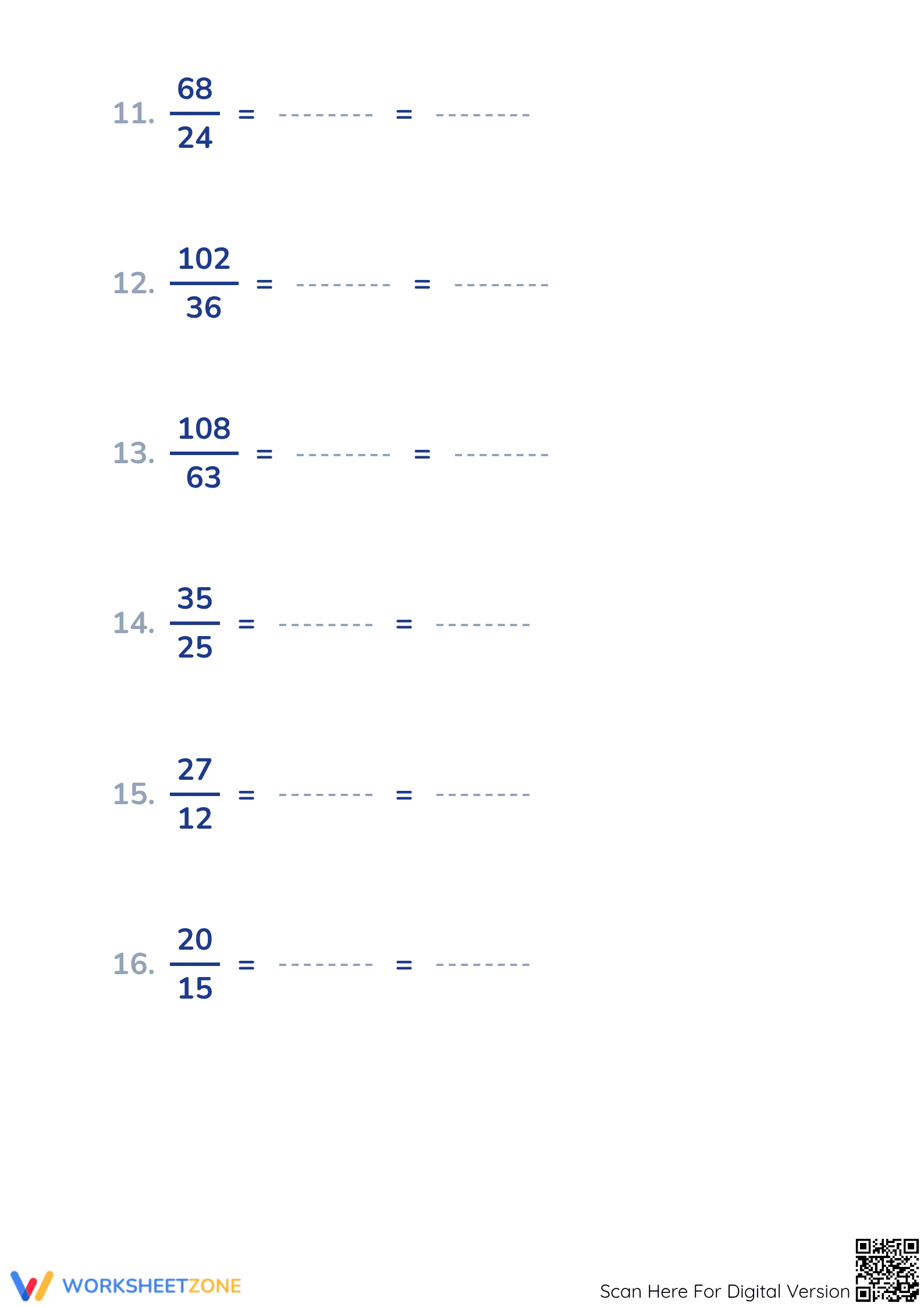
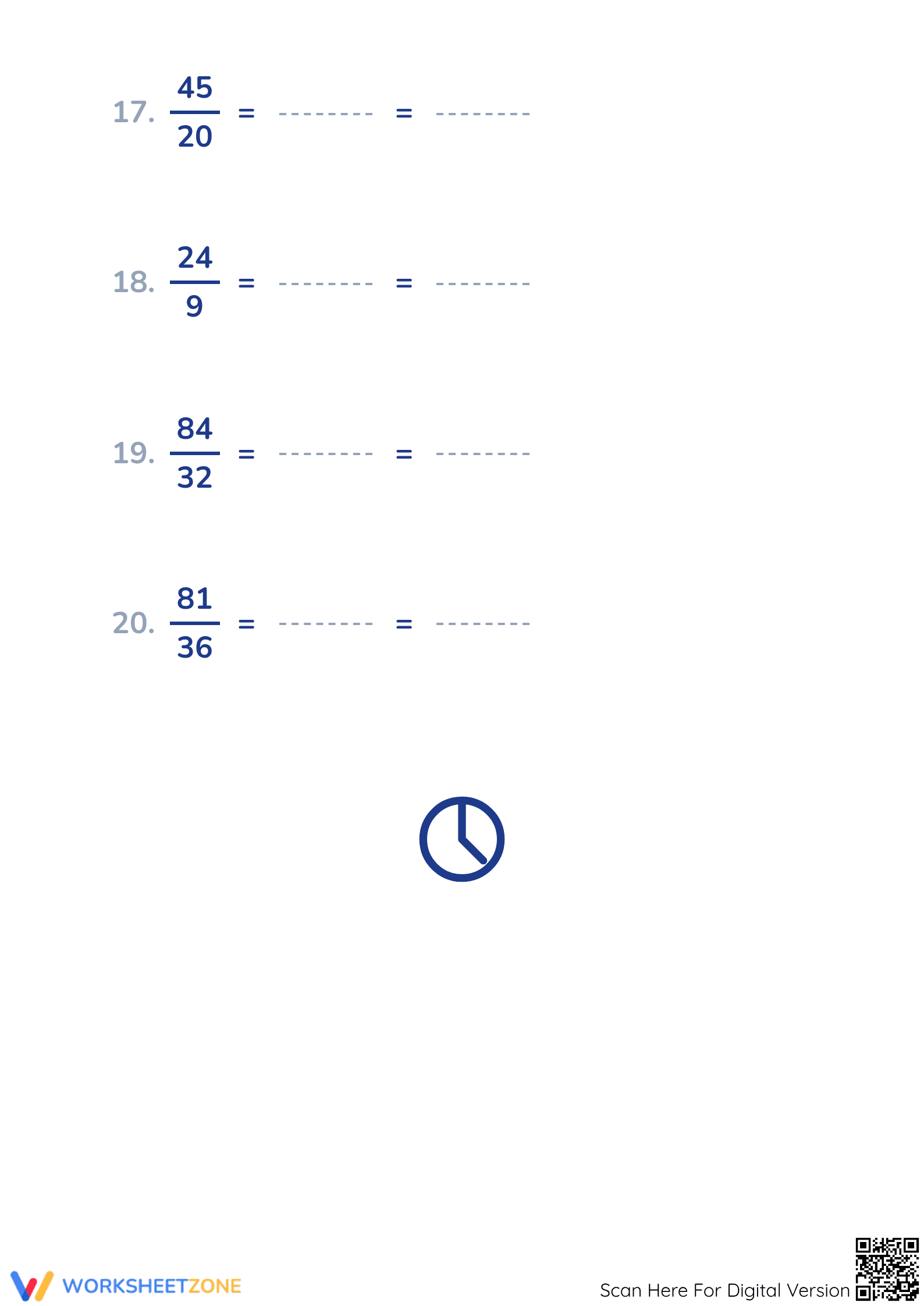

Printable Simplifying Improper Fractions Worksheet | Grade 4
Paste this activity's link or code into your existing LMS (Google Classroom, Canvas, Teams, Schoology, Moodle, etc.).
Students can open and work on the activity right away, with no student login required.
You'll still be able to track student progress and results from your teacher account.
This essential Grade 4 math worksheet focuses on simplifying improper fractions and converting them into mixed numbers. Mastery of this competency builds the computational fluency necessary for complex operations with rational numbers. This resource provides structured practice ensuring students can reduce fractions to simplest forms and understand their values as mixed numerals.
At a Glance
- Grade: 4 · Subject: Math
- Standard:
CCSS.MATH.CONTENT.4.NF.B.3.C— Add and subtract mixed numbers with like denominators by replacing each with an equivalent fraction- Skill Focus: Improper Fraction Simplification
- Format: 5 pages · 22 problems · Answer key included · PDF
- Best For: Independent practice and fraction fluency drills
- Time: 25–35 minutes
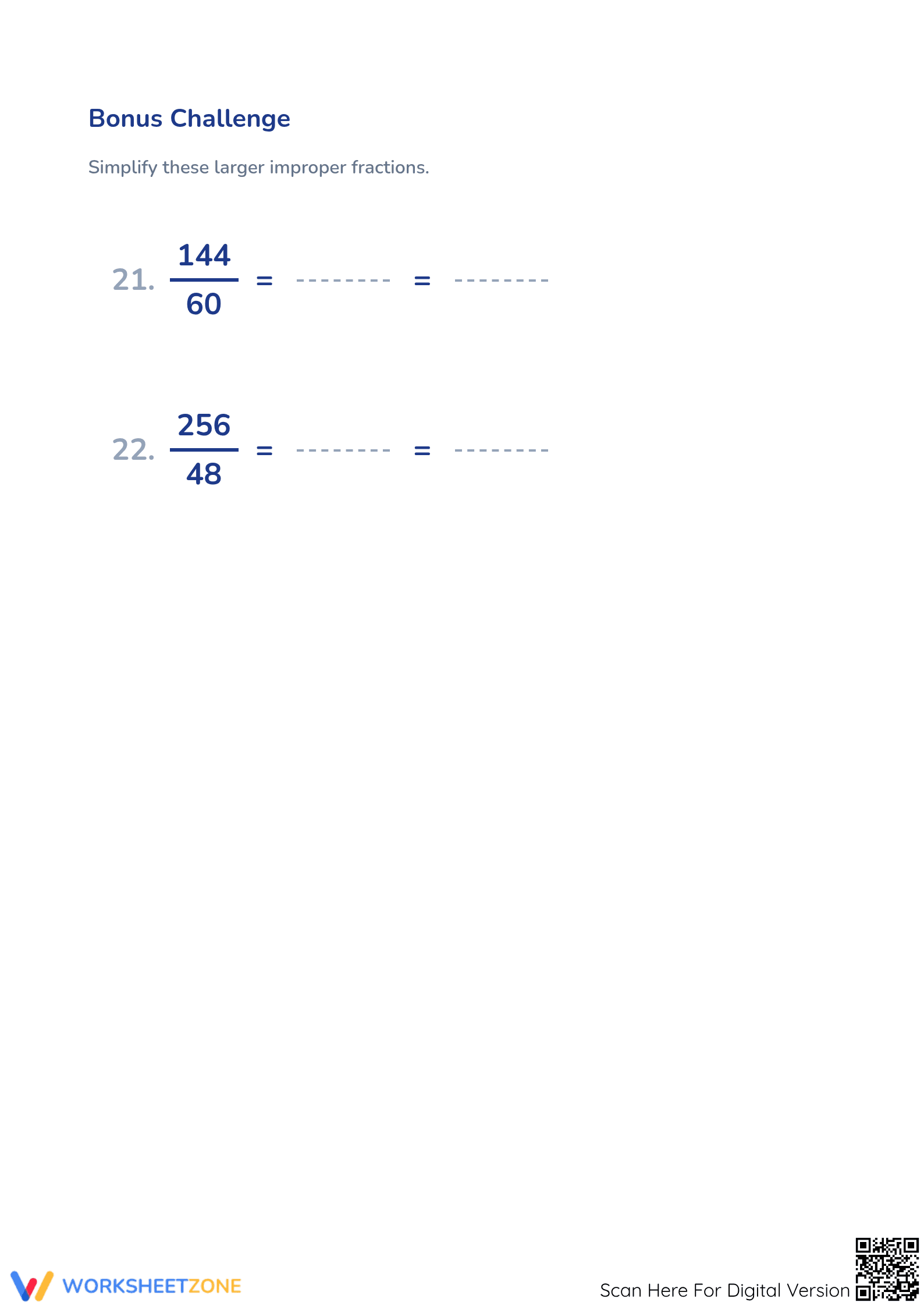
This five-page PDF includes 22 unique problems designed to strengthen fraction manipulation skills. Each page contains four to six equations, culminating in a bonus challenge involving larger numerators. A complete answer key is provided for immediate grading, ensuring that students receive timely feedback on their simplification accuracy and conversion logic.
- Guided Practice: Problems 1–10 establish basic routines for finding common factors and identifying whole components within smaller improper fractions.
- Supported Practice: Items 11–20 introduce triple-digit numerators, requiring students to maintain procedural accuracy as they simplify more complex fractional values.
- Independent Mastery: The bonus challenge removes all scaffolding, testing whether students can independently simplify and convert large fractions to mixed numbers.
This worksheet is primary aligned to `CCSS.MATH.CONTENT.4.NF.B.3.C`, which requires students to add and subtract mixed numbers with like denominators by replacing each mixed number with an equivalent fraction. Additionally, it supports `CCSS.MATH.CONTENT.4.NF.A.1` by emphasizing the creation of equivalent fractions in their simplest terms. Both standard codes can be copied directly into lesson plans, IEP goals, or district curriculum mapping tools.
Teachers can utilize this worksheet as a post-instructional activity to reinforce fraction concepts or as a formative assessment during a unit on rational numbers. While students work, observe if they are identifying the greatest common factor or simply dividing by two repeatedly. Completion typically takes 30 minutes, making it an ideal choice for center rotations or independent seatwork.
This resource is ideal for Grade 4 and 5 students who require focused practice on mixed numbers. It serves as an excellent intervention tool for learners struggling with fraction concepts or as an enrichment activity for younger students. Pair this with a fraction wall anchor chart to provide visual support during the conversion process.
According to the EdReports 2024 analysis of high-quality mathematics instructional materials, developing a deep conceptual understanding of improper fractions is a fundamental prerequisite for success in middle school algebraic thinking. Research indicates that when students can fluently transition between improper fractions and mixed numbers, their cognitive load is significantly reduced during the solving of complex multi-step word problems. The `CCSS.MATH.CONTENT.4.NF.B.3.C` standard emphasizes this procedural fluency as a gateway to understanding fractional parts of a whole. This worksheet addresses these needs by providing 22 targeted tasks that move from basic simplification to advanced mixed number conversion. By isolating the conversion skill, educators can identify specific misconceptions before they impact higher-order operations. This targeted approach aligns with the ScienceDirect TpT Analysis findings, which highlight the efficacy of skill-specific worksheets in improving long-term retention of mathematical procedures across diverse student populations.


