


























Views
Downloads


Printable Simplifying Improper Fractions Worksheet | Grade 4
Paste this activity's link or code into your existing LMS (Google Classroom, Canvas, Teams, Schoology, Moodle, etc.).
Students can open and work on the activity right away, with no student login required.
You'll still be able to track student progress and results from your teacher account.
Strengthen fractional fluency with this focused Grade 4 practice set. This worksheet guides students through simplifying improper fractions to their lowest terms before converting them into mixed numbers. Mastering these conversions builds the computational speed and conceptual accuracy required for advanced operations with unlike denominators in higher grade levels.
At a Glance
- Grade: 4 · Subject: Math
- Standard:
4.NF.B.3— Understand a fraction as a sum of unit fractions and convert between equivalent forms- Skill Focus: Improper Fraction Simplification and Conversion
- Format: 5 pages · 23 problems · Answer key included · PDF
- Best For: Independent practice or small group intervention
- Time: 25–35 minutes
What's Inside
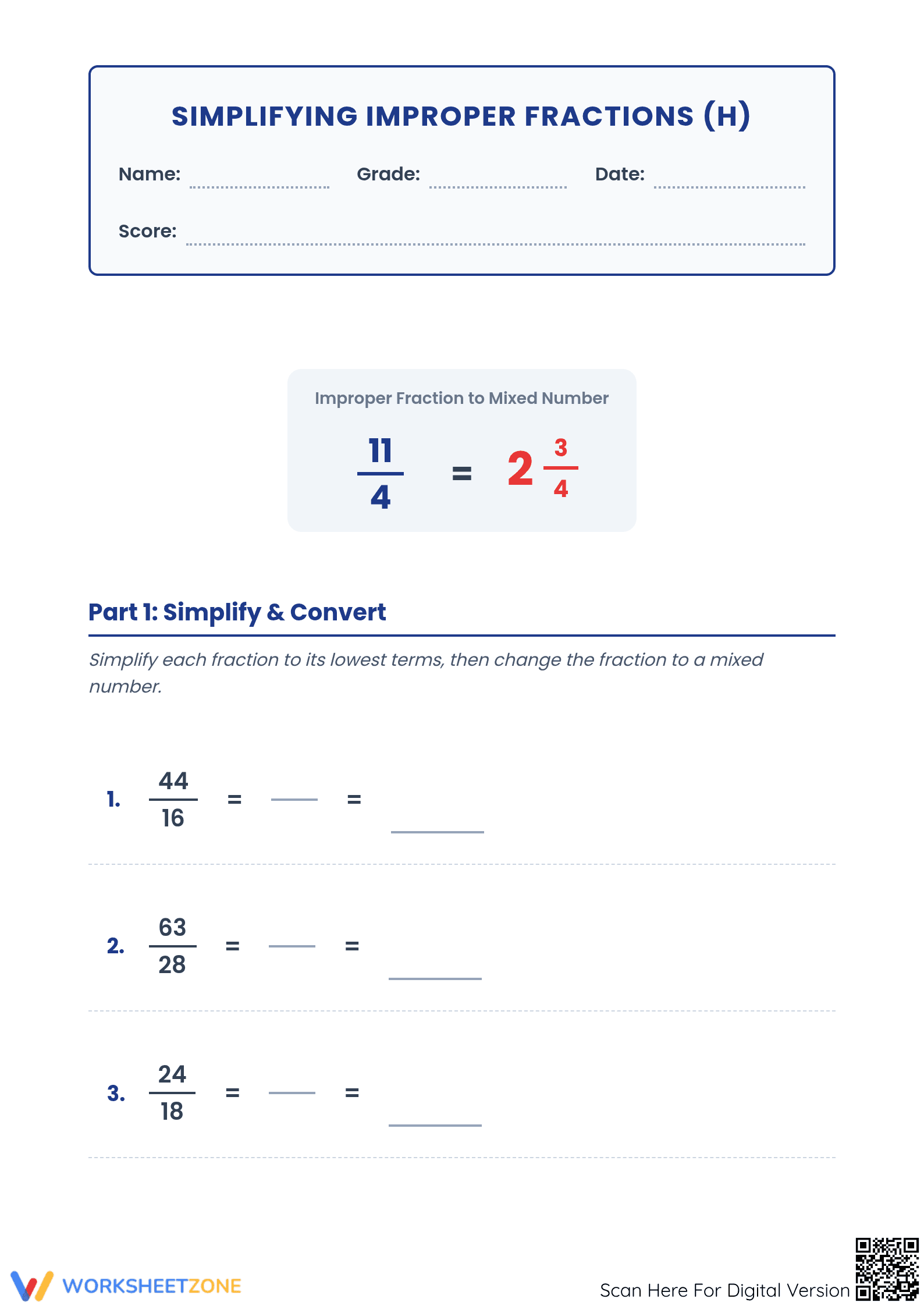
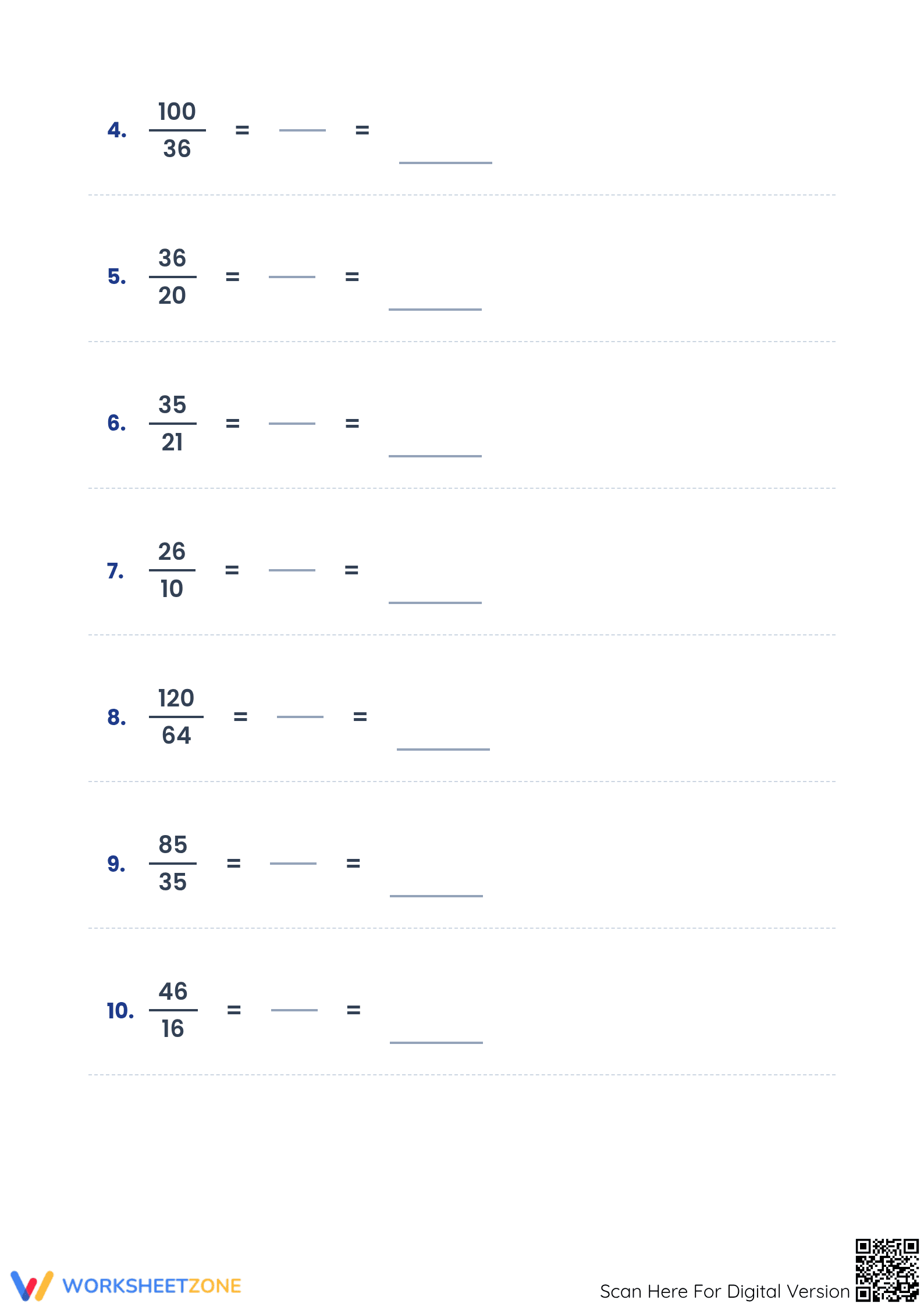
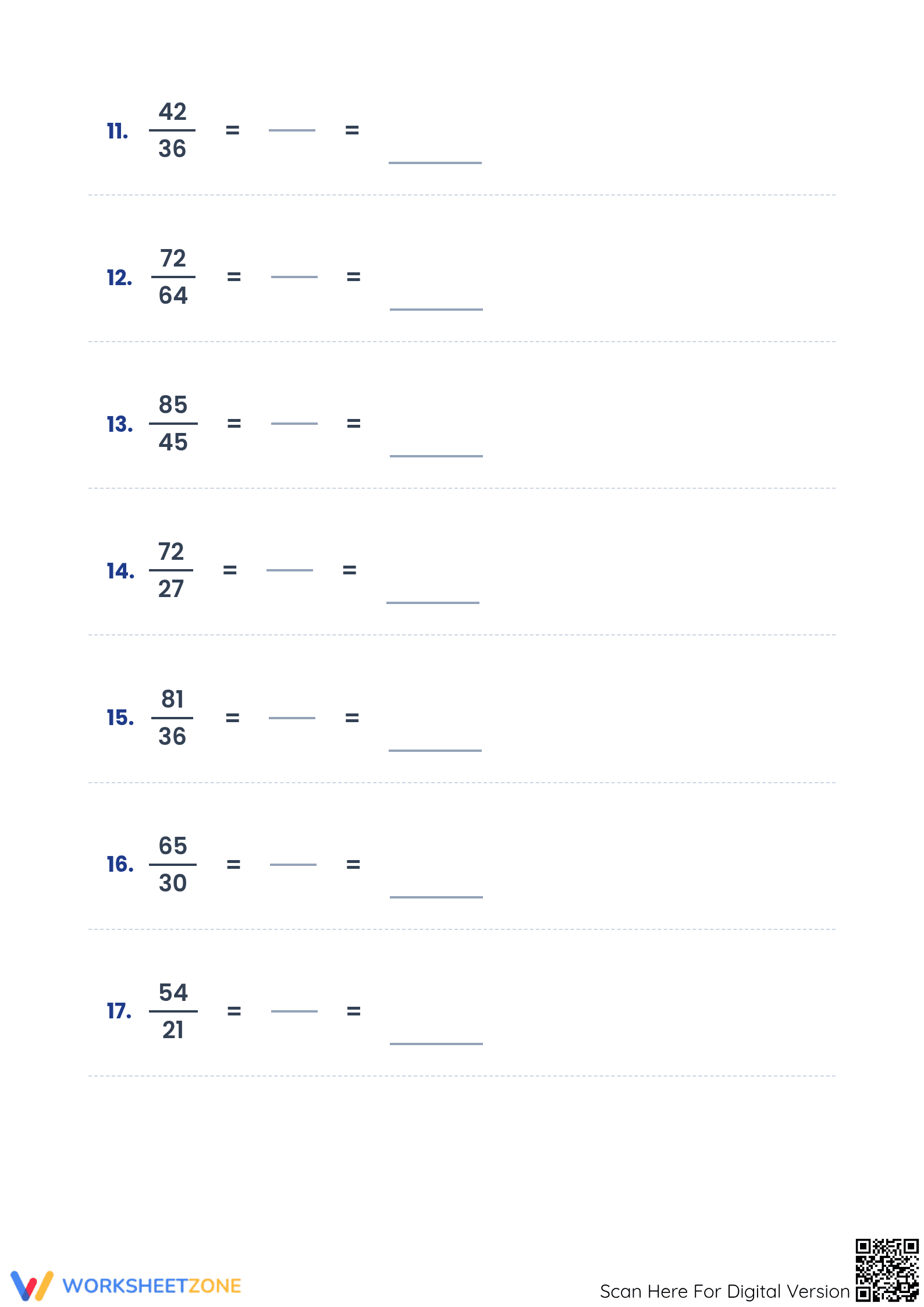
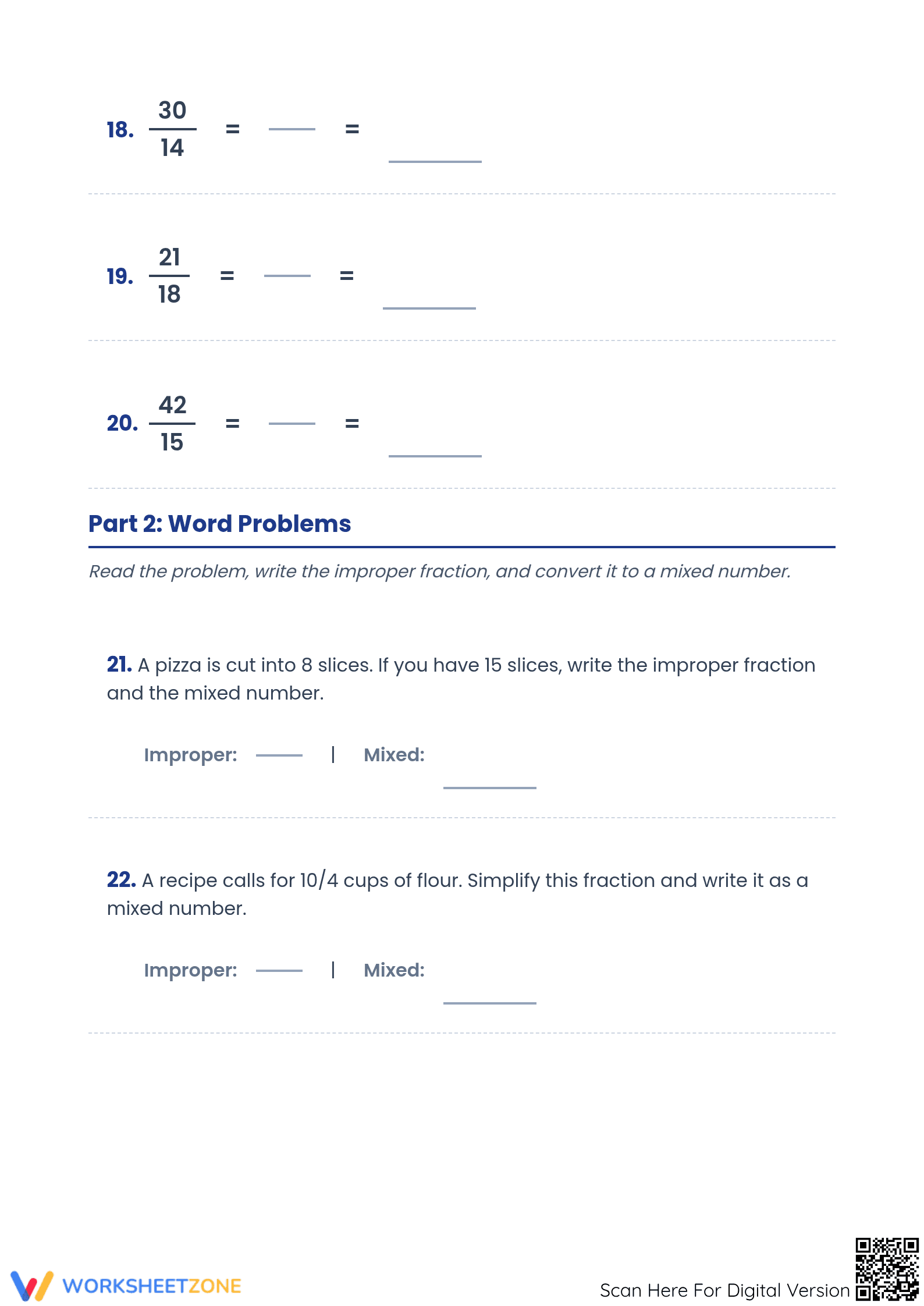
The packet contains five pages of structured tasks. Students will find 20 computational problems in Part 1 that provide workspace for simplifying and converting fractions. Part 2 features three word problems requiring learners to apply skills to practical scenarios involving recipes, distance, and shared food. A complete answer key is included for immediate grading.
Skill Progression
- Guided Practice: A worked example showing 11/4 becoming 2 3/4 provides a visual model for the conversion process.
- Supported Practice: Problems 1 through 10 provide whitespace for students to show work while simplifying numerators into proper forms.
- Independent Practice: The final pages challenge students to interpret word problems and determine the correct improper fraction before conversion.
This gradual-release approach ensures students move confidently from modeling to independent mastery of fractional equivalents.
Standards Alignment
This resource aligns with standard `4.NF.B.3`, which requires students to understand addition and subtraction of fractions as joining and separating parts referring to the same whole. Specifically, it addresses the sub-skill of replacing improper fractions with equivalent mixed numbers. This standard code can be copied directly into lesson plans, IEP goals, or district curriculum mapping tools.
How to Use It
Assign this worksheet during a math workshop as a rotation station for students who have already received direct instruction on fraction equivalence. Teachers can also use the three word problems on the final page as a ticket out the door formative assessment. Observe whether students simplify the fraction first or convert immediately to identify those needing support.
Who It's For
This resource is designed for Grade 4 students but serves as an effective remedial tool for Grade 5 or 6 learners who struggle with fraction sense. It naturally pairs with visual fraction tiles or number lines to help students see the relationship between the parts and the whole during the conversion process.
The transition from improper fractions to mixed numbers represents a foundational milestone in numerical literacy. According to the RAND AIRS 2024 report on mathematical instructional materials, high-quality practice sets that integrate both computational drill and context-based word problems significantly improve student retention of fraction equivalence concepts. Fisher & Frey (2014) emphasize that the gradual release of responsibility—moving from the worked examples on page one to the independent application in the final word problems—is essential for developing cognitive independence in young mathematicians. By solving these 23 targeted problems, students engage with common denominator structures that appear frequently in middle school algebra and statistics. This worksheet provides the repeated exposure necessary to move these processes from laborious calculation toward procedural automaticity. Educators can cite 4.NF.B.3 and the plain-English skill of improper fraction conversion when documenting student progress toward state-mandated arithmetic standards in Grade 4 curriculum reports.


