


























Views
Downloads



Printable Types of Fractions Worksheet | Grade 4 Math
Paste this activity's link or code into your existing LMS (Google Classroom, Canvas, Teams, Schoology, Moodle, etc.).
Students can open and work on the activity right away, with no student login required.
You'll still be able to track student progress and results from your teacher account.
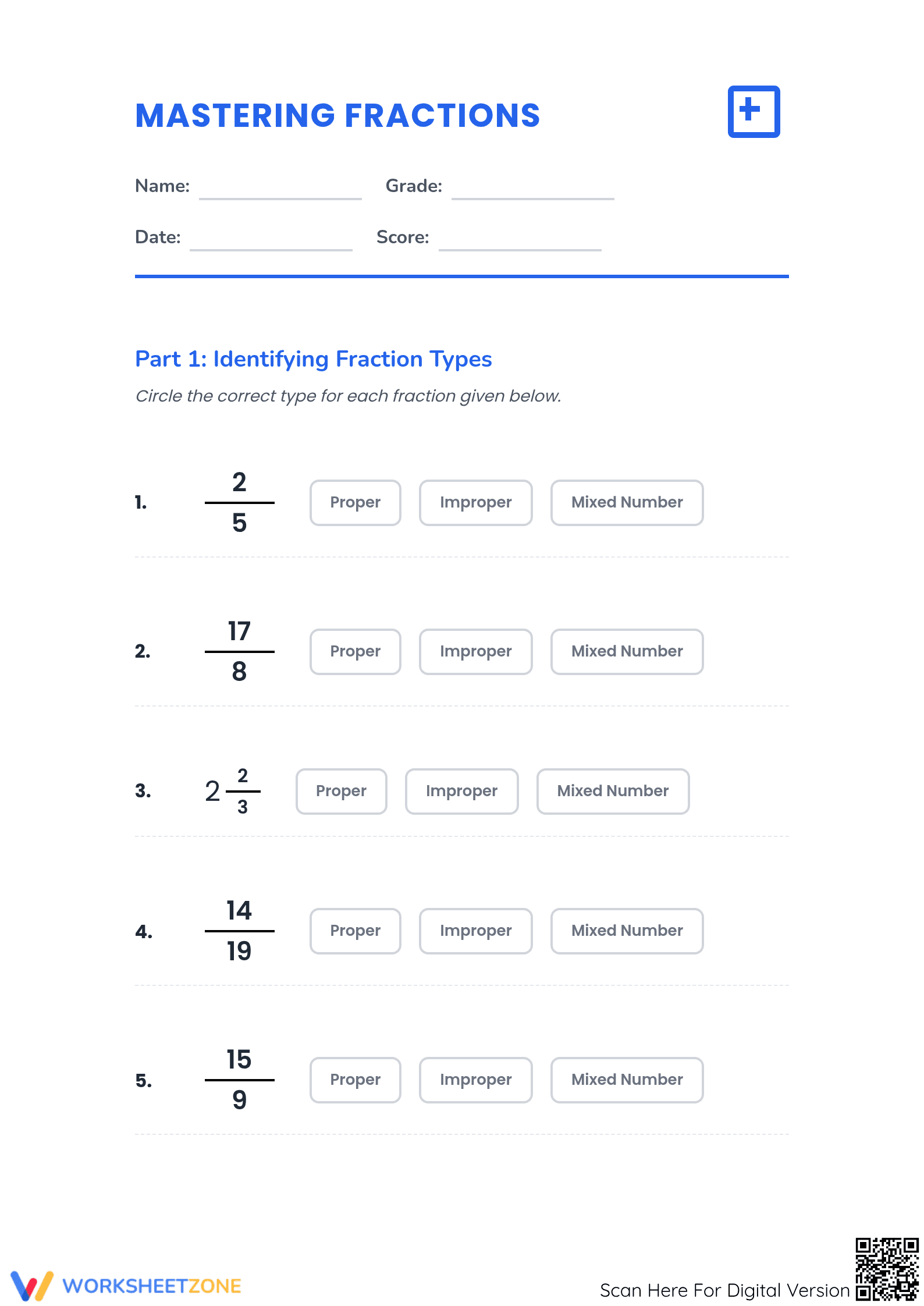
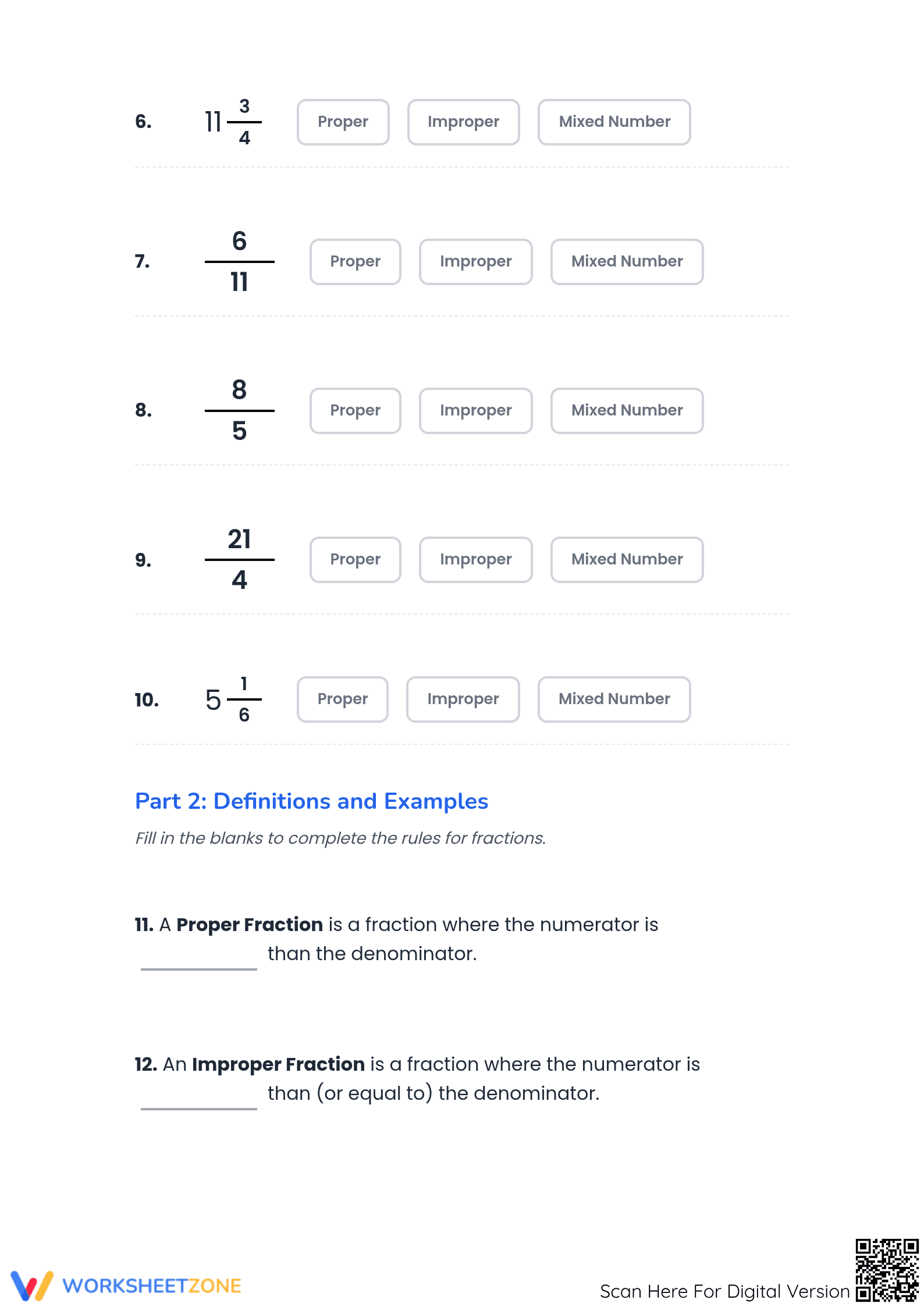
This worksheet provides essential practice for students learning to distinguish between proper, improper, and mixed fractions. Through 50 problems, learners will build fluency in classifying different fraction types, a foundational skill for complex fraction operations. It's a straightforward tool for targeted reinforcement.
At a Glance
- Grade: 3–5 · Subject: Math
- Standard:
CCSS.MATH.CONTENT.4.NF.B.3— Understand a fraction a/b with a > 1 as a sum of fractions 1/b.- Skill Focus: Classifying fraction types (proper, improper, mixed)
- Format: 5 pages · 50 problems · Answer key included · PDF
- Best For: Independent practice, homework, or review
- Time: 20–30 minutes
What's Inside
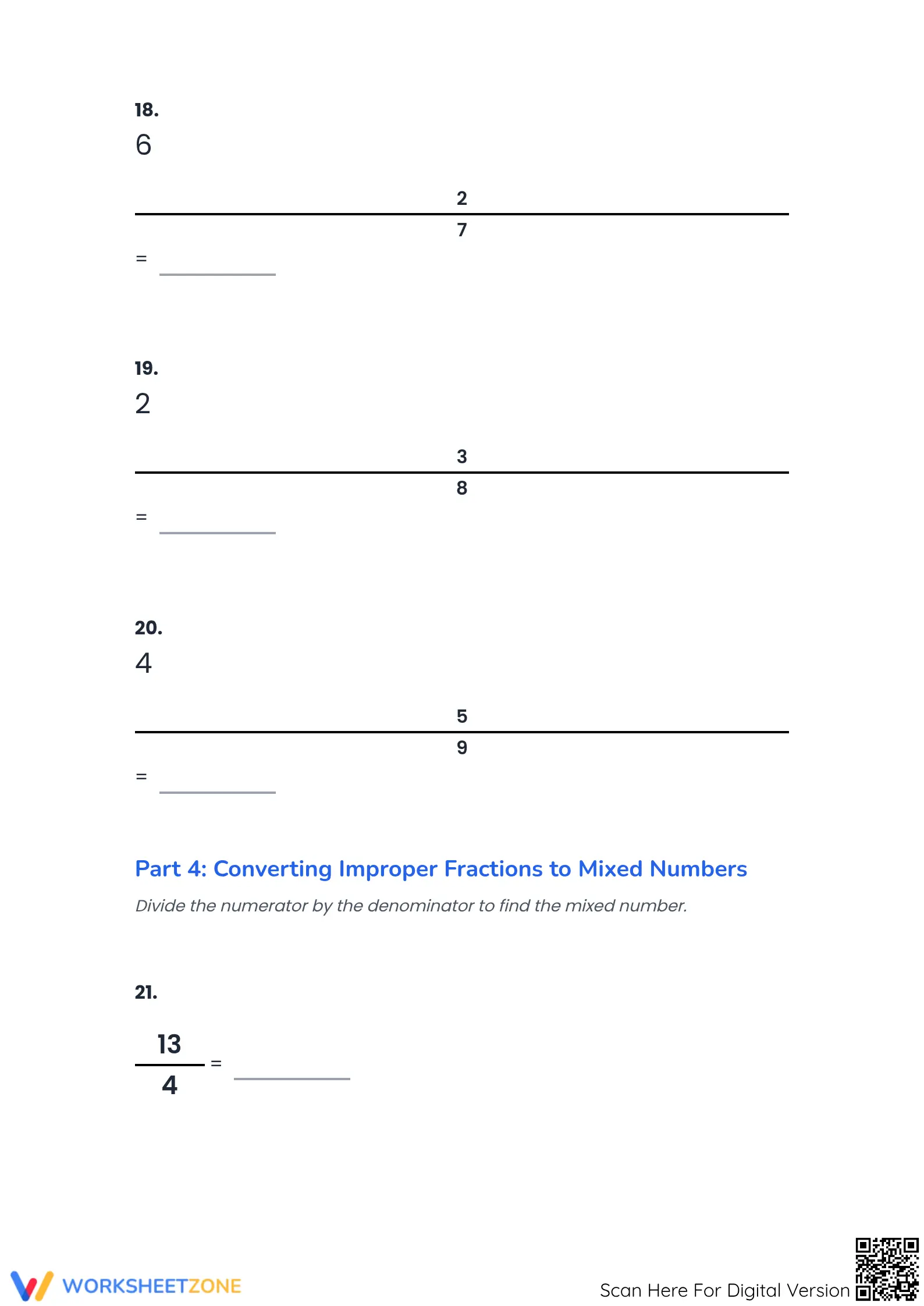
This resource contains a five-page worksheet with 50 fraction classification problems. Students identify if a fraction is proper, improper, or mixed. A complete answer key is provided on separate pages for easy grading. The clean layout ensures students can focus on the task.
Skill Progression
This worksheet uses repetition to build fluency.
- Guided Practice: Clear definitions and examples on the first page serve as a constant reference.
- Supported Practice: The first 20 problems allow students to apply the rules while the aids are fresh. Teachers can monitor this phase to catch initial misunderstandings.
- Independent Practice: The remaining 30 problems are for students to complete on their own, demonstrating mastery. The consistent format builds confidence through the set, following a gradual-release model.
Standards Alignment
This worksheet supports CCSS.MATH.CONTENT.4.NF.B.3, which involves understanding mixed numbers and their relationship to improper fractions. Identifying the *type* of fraction is a critical prerequisite for performing those operations. Students must recognize an improper fraction before converting it.
How to Use It
Use this worksheet for independent practice after a direct instruction lesson. It is also effective as a skills-based homework assignment. For formative assessment, a teacher can quickly scan the first 10 responses to spot confusion. Expect students to complete the worksheet in 20 to 30 minutes.
Who It's For
This resource is for students in grades 3-5 reviewing fraction types. Its repetitive structure is accessible for learners needing extra reinforcement. It pairs well with a visual anchor chart displaying fraction definitions and examples, providing classroom support.
This worksheet provides targeted practice aligned with CCSS.MATH.CONTENT.4.NF.B.3, focusing on the foundational skill of classifying proper, improper, and mixed fractions. Fluency in this area is a key predictor of success in more advanced fraction arithmetic. Research emphasizes that procedural fluency and conceptual understanding are intertwined; repeated practice with tasks like this helps automate the recognition of fraction structures, freeing up cognitive resources for more complex problem-solving. A comprehensive analysis by RAND AIRS 2024 highlights that mastery of rational number concepts, including the ability to interpret and categorize different fraction forms, is essential for algebra readiness. This no-prep resource offers 50 opportunities for students to build that essential fluency, directly supporting evidence-based instructional practices for elementary mathematics by providing structured, repetitive skill work.


