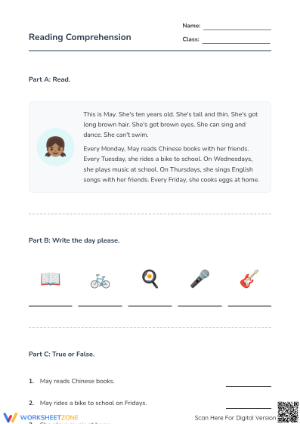
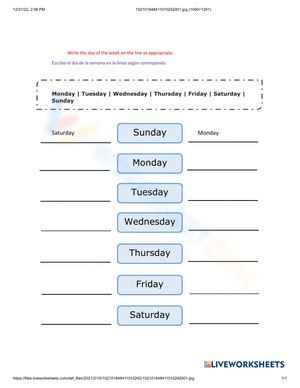
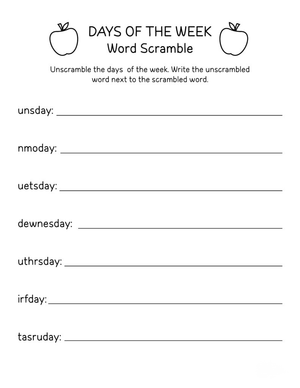
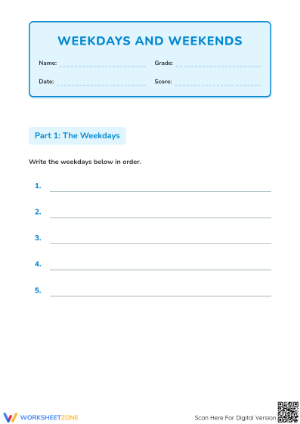
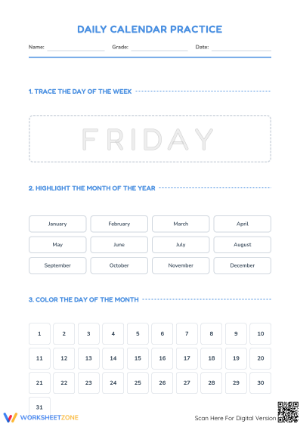
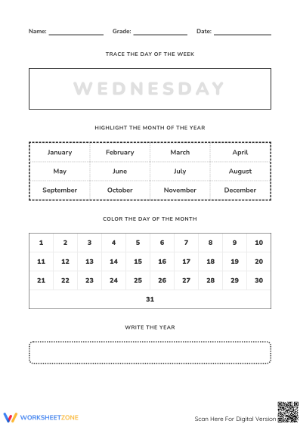
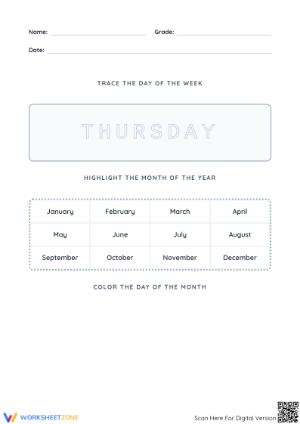
These 4th grade on weekdays printable worksheets give teachers a focused set of ELA resources built around one of the most naturally accessible contexts for nine- and ten-year-olds: the rhythm of the school week. Each worksheet targets a specific literacy skill — capitalization, narrative sequencing, reading comprehension, or vocabulary — while anchoring the content in what students already live. That familiarity is not decorative. It reduces the cognitive overhead of orienting to an unfamiliar scenario, which means students direct more mental energy toward the actual skill being practiced.
Skills Covered Across the Set
The worksheets address four main literacy domains:
- Reading comprehension: Passages feature characters managing typical and unusual weekday schedules. Students infer meaning, identify the main idea, and summarize events — practicing the same skills assessed on standardized tests, but in a context that invites genuine text-to-self connection. When a student reads about a character scrambling to finish homework before Wednesday soccer practice, they bring real background knowledge to the text rather than processing an unfamiliar setup.
- Grammar and mechanics: Capitalization of days of the week, temporal prepositions, and punctuation inside schedule-format sentences. The exercises include proofreading tasks, sentence rewrites, and error-correction work — not just fill-in-the-blank drills.
- Narrative sequencing: Students write and reorganize events in chronological order, using transition words to signal movement through time. Tying each writing task to a specific day constrains the scope usefully, which helps students who tend to meander in open-ended prompts.
- Vocabulary: Time and schedule terms — routine, prioritize, frequently, seldom, interval, schedule — are introduced in context and reinforced through cloze sentences, matching tasks, and original writing.
Where Students Consistently Stumble — And Why
The most consistent error pattern across this material is inconsistent capitalization of days mid-sentence. Students who correctly write "Monday" at the start of a sentence will write "on tuesday" two lines later. The reason is almost always the same: at the start of a sentence, capitalization fires as a general rule. In the middle of a sentence, the day of the week doesn't register as a proper noun — students treat it the way they'd treat "morning" or "afternoon." The proofreading exercises in these worksheets deliberately embed days mid-sentence and mid-clause, forcing that recognition repeatedly until it becomes habitual.
A second pattern appears in sequencing tasks. Fourth graders who have been told to use transition words often over-rely on "then" — four consecutive sentences each starting with "Then I..." The worksheets address this by providing a varied transition bank and prohibiting repetition within a single paragraph. That constraint frustrates some students initially, but it produces noticeably more varied sentence openings after just a few sessions.
Preposition errors are the third consistent issue. "In Monday" and "at Monday" appear often in student drafts. Getting the "on" preposition for named days to stick takes more repetition than most teachers expect. These worksheets build that repetition into sentence-level tasks before students encounter the decision point inside their own writing.
Where These Worksheets Fit in the Instructional Day
The most efficient placement for 4th grade on weekdays printable worksheets is the first eight to ten minutes of the ELA block as a warm-up task. Because the weekday theme is immediately recognizable, students can begin without a lengthy setup — they read the directions, understand the context, and get to work. That independent entry is genuinely useful during the transition from morning meeting to instruction, when the teacher is handling attendance and logistics.
Literacy centers are a natural second home for the set. A reading comprehension worksheet can anchor one station — short passage, four or five text-dependent questions, no teacher supervision required after the first rotation. A sequencing cut-and-paste task makes a clean second station, where students reorder the scrambled events of a weekday schedule and then write a brief explanation of their choices. Both run independently once students know the routine, which frees the teacher for small-group guided reading.
For homework, the writing prompts travel well. Asking a student to interview a family member about their Thursday evening routine and then write a short summary pulls in speaking, listening, and writing — and the family member can participate without needing to understand the lesson content.
Standard Alignment
The narrative sequencing and transition-word tasks address W.4.3, which asks students to write narratives using effective technique and clear event sequences. Grammar and mechanics exercises target L.4.2 (capitalization, punctuation, and spelling conventions) and L.4.1e (forming and using prepositional phrases). Reading comprehension passages address RI.4.3 or RL.4.3 depending on whether the text is informational or literary. In classroom terms, W.4.3 and L.4.2 are typically introduced in the first quarter and cycled through the rest of the year, which means 4th grade on weekdays printable worksheets fit comfortably into both an introductory unit and later review cycles without feeling out of place.
Adapting the Set Across Ability Levels
For students who need more support with narrative writing, sentence frames tied to a specific day work better than an open prompt. A frame like "On Thursday afternoon, the first thing I do is _____. After that, I _____. By the time evening arrives, I have already _____" provides a clear structural model without removing the cognitive work of generating actual content. Students still have to think; the frame just gives them a shape to fill instead of a blank slate.
Advanced writers benefit from constraints that raise the thinking level rather than simply add length. Requiring a student to write from the perspective of an inanimate weekday object — their alarm clock on Monday morning, their backpack on a Friday afternoon — brings voice, personification, and point-of-view work into what would otherwise be a straightforward sequencing task. That's a meaningful increase in complexity without changing the worksheet itself.
For English language learners, the vocabulary worksheets offer a productive entry point. Time and schedule terms are concrete enough to anchor meaning, and cloze-format exercises give repeated exposure to the same words across varied sentence contexts before students are expected to use those words independently. Pairing an ELL student with a reading comprehension worksheet matched to their reading level — rather than the grade-level passage — keeps the grammar and vocabulary work accessible without removing the challenge of the mechanics practice.
Frequently Asked Questions
Do these worksheets work as morning work, or are they better suited to guided practice?
Both, depending on the specific worksheet. Grammar correction and vocabulary tasks run cleanly as independent morning work — the weekday context is instantly familiar, so students don't need setup. The narrative writing prompts and reading comprehension worksheets tend to produce better results with a brief two-minute introduction first, even when students then work independently.
How do I handle students who finish quickly?
Each writing-based worksheet has natural extension built in. Students who finish early can rewrite the passage from a different day's perspective, expand their narrative by adding sensory details, or draft their own error-filled weekday schedule for a classmate to proofread. None of those extensions require the teacher to prepare additional materials.
My students already know the days of the week — why would they need to practice capitalizing them?
Knowing the days of the week and reliably capitalizing them in original writing are two separate skills, and students demonstrate this gap constantly. A student who can recite all seven days correctly in order will still write "on tuesday" in a sentence they drafted themselves. The proper-noun rule doesn't fire automatically mid-sentence at this age — it takes targeted repetition before it becomes consistent, which is exactly what these exercises are built to provide.
What about students who are working below grade level — can this set work for them?
Yes. 4th grade on weekdays printable worksheets include vocabulary and sentence-level grammar tasks that are accessible to students reading one to two years below grade level, particularly when paired with sentence frame support for the writing tasks. The reading comprehension passages sit at a fourth-grade Lexile range, so you may want to swap those out for a student significantly below level — but the grammar, vocabulary, and structured writing exercises hold up across a wider range of ability than the comprehension passages do.












 Interactive Worksheet Maker
 Quiz Maker
 Word Search Maker
 Crossword Puzzle Maker
 Word Scramble Generator
 Sentence Scramble Generator
 Handwriting Worksheet Generator
 Name Tracing Generator
 Fill In The Blank Generator




 BACK TOSCHOOL