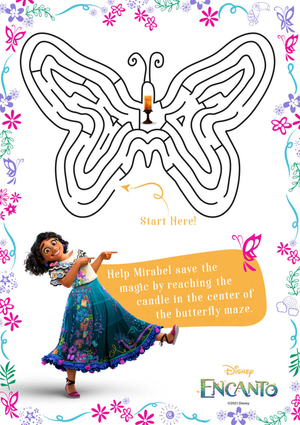
Encanto printable worksheets for 4th Grade
These encanto printable worksheets for 4th grade put the Madrigal family to work as a genuine literary text — giving students specific analytical tasks around character motivation, theme development, and symbolic detail rather than asking them to summarize what happened. The set targets skills 4th graders are expected to move toward this year: building evidence-based claims about characters, tracking how a theme grows across a narrative, and using context clues to decode unfamiliar language. Teachers who have run film-based reading units know the standard trap — students talk about the movie and mistake retelling for analysis — and these resources redirect that energy into the written and graphic work the standards actually demand.
What Students Practice Across the Set
Each worksheet isolates one analytical skill and ties it directly to the film's characters or structure. The tasks across the set include:
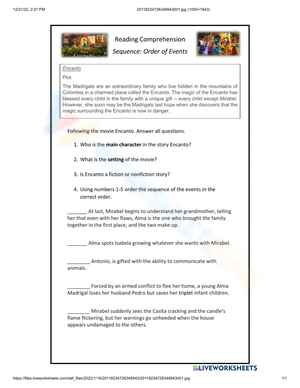
- Character description using evidence: Students identify Mirabel's traits and support each one with a specific scene, piece of dialogue, or song lyric — not a general impression of the character.
- Theme articulation: Students move from naming a topic ("family") to forming a complete theme statement, such as "the pressure to be perfect can damage the people a family most wants to protect."
- Symbol tracking: Students mark when cracks appear in the Casita and connect each instance to a specific family conflict — early work with how authors use setting to externalize internal tension.
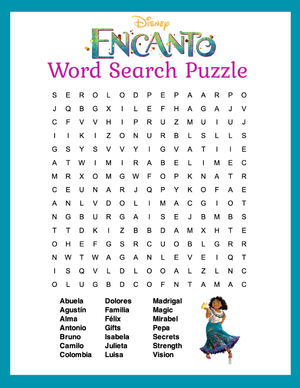
- Vocabulary in context: Spanish terms and cultural references woven into the film — arepa, the magic candle, the significance of the ceremony — become entry points for L.4.4 context-clue work.
- Character comparison: Side-by-side graphic organizers for Mirabel and Luisa show how two characters can share a core struggle — the need to feel valued — while expressing it in entirely different ways.
- Perspective shifts: Students examine how the same event reads differently depending on which family member they follow, building early work with point of view.
Encanto earns a place in 4th grade ELA specifically because fourth grade is the year the standards ask students to stop describing characters from the outside — what they do — and start explaining them from the inside — why they do it. That shift is genuinely difficult, and it requires source material where motivation is layered but accessible. When Luisa sings "Surface Pressure," her internal burden becomes explicit without being explained in prose. A student who struggles to infer a character's anxiety from a chapter of text can hear and see it directly — and each worksheet then asks them to translate that back into evidence-based writing. That move, from observed moment to written claim with support, is exactly what RL.4.3 requires.
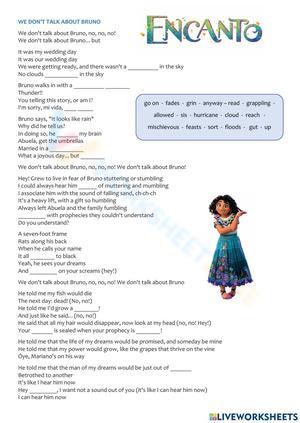
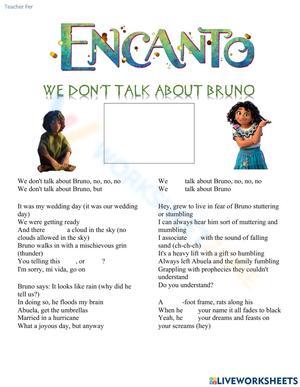
Bruno's arc provides a second productive entry point. His isolation and the family's collective distortion about him — the "we don't talk about Bruno" dynamic — show students how a group can hold a false belief about a person and what happens when that belief goes unchallenged. This kind of character-relationship analysis is what distinguishes a 4th grade reading response from a 3rd grade retelling.
Fitting These Into Your Planning Without Losing the Week
The most effective approach separates the viewing from the analysis. When students have already seen the film — at home or in a prior session — any worksheet from the encanto printable worksheets for 4th grade set runs cleanly in 15 to 20 minutes, making it appropriate for a Monday warm-up after a Friday viewing, a mid-unit skill check, or the first portion of a literacy block while you pull a small group. Combining the viewing and the analysis in the same sitting tends to collapse the thinking: students are still tracking plot when you need them tracking character motivation.
Short song clips work well as re-entry points. Playing the first 90 seconds of "What Else Can I Do?" before distributing the Isabela character worksheet focuses students on a specific scene without pulling them back into the full narrative. For the symbol-tracking worksheet, pausing the film at key crack moments and asking students to annotate in real time produces noticeably stronger written responses than asking them to recall those moments from memory.
Mistakes Students Make That These Worksheets Help You Catch
The most predictable error in character analysis at this grade is conflating a character's actions with their traits. A student who writes "Mirabel is sad" has made an observation about a single moment. What the worksheet pushes toward is something more specific: "Mirabel is determined but feels invisible," supported by the scene where she tries to help the Casita during Antonio's ceremony without being asked. Getting students to that second kind of claim requires direct instruction on the distinction before they write — not as feedback afterward when the work is already done.
Theme statements produce a different and persistent problem: students state the topic rather than the message. "Family" is not a theme. "Being overlooked by people who love you still causes real damage, even when their intentions are good" is a theme. This is a developmental challenge — 4th graders are concrete thinkers who find abstraction slippery — and the theme worksheets in the set build toward the full statement in stages, asking students first what happened, then what it meant to the character, and finally what the story seems to say about it more broadly. That three-step structure reduces the freezing response that happens when students are asked to jump straight to the abstract.
One more pattern worth watching: when students analyze song lyrics, they read them literally. Working through the "Surface Pressure" worksheet, students will note that Luisa "holds the sun and moon" or "moves mountains" and interpret those lines as magical tasks rather than metaphors for emotional weight. A brief whole-class discussion on figurative language before independent work prevents most of those responses.
Standard Alignment
The encanto printable worksheets for 4th grade set addresses three CCSS ELA standards directly. RL.4.3 — describing characters, settings, and events in depth using specific details — is the primary target, addressed through character maps, trait-evidence organizers, and the comparative Mirabel/Luisa activity. RL.4.2 — determining a theme and explaining how key details support it — drives the theme-development sequence and the Casita symbol-tracking worksheet. L.4.4a — using context clues to determine the meaning of unknown words — appears throughout the vocabulary section, where students work through Spanish terms and culturally specific references from the film. Instructionally, these three standards build on each other in most 4th grade ELA units: character analysis first, then the move from character behavior to theme, then precise language as students draft responses that require them to articulate abstract ideas in writing.
Adjusting the Worksheets for Different Student Levels
For students still developing the mechanics of evidence — finding it, quoting it accurately, tying it back to a claim — the character maps include sentence frames that model the structure: "In the scene where ___, Mirabel shows that she is ___ because ___." The frames provide the grammatical pattern without pre-filling the thinking, so the analysis remains the student's own work. Removing the frames for students who have already internalized the structure takes a few seconds before copying.
Students working above grade level get the most from the cross-character comparison tasks and the writing extensions. Asking them to draft a scene between Bruno and Isabela — one that never appears in the film but stays fully consistent with the traits and behaviors the story has established for each character — is a strong check of whether they genuinely understand characterization or are working from general impressions. That task draws on the same analytical skills as RL.4.3 but applies them generatively, which raises the cognitive demand considerably.
For ELL students, the film's Spanish vocabulary creates a natural bridge: students who speak Spanish at home often function as genuine content experts during vocabulary discussion, which shifts the classroom dynamic in productive ways. These encanto printable worksheets for 4th grade also work well in small-group settings. The symbol-tracking and theme-articulation worksheets benefit from teacher facilitation the first time through — running those as guided tasks before releasing students independently produces noticeably stronger written responses.
Frequently Asked Questions
Do students need to have watched the film recently, or can these tasks be used weeks after viewing?
Most tasks hold up well even when students viewed the film a few weeks earlier, because the analysis focuses on specific, memorable moments — Antonio's gift ceremony, the reveal of Bruno's tower, Luisa's breakdown on the bridge — rather than broad plot recall. For the symbol-tracking worksheet, showing brief clips of two or three key Casita moments sharpens the analysis considerably and takes under five minutes. If a student has never seen the film, run the vocabulary and point-of-view worksheets after a first viewing rather than before.
How do these activities support students who are still developing their writing fluency?
The graphic organizers on each worksheet separate the thinking from the writing. Students sort information — traits, evidence, connections — into visual structures before producing any prose. This means a student who freezes at the prospect of a paragraph can still complete the analytical work in the organizer and use it as a direct reference when writing. It also means teachers can assess the quality of a student's thinking separately from sentence-level fluency — a useful distinction at this grade.
Are there writing prompts that pair well with this set for a larger unit?
Several work well in sequence. A diary entry from Mirabel's perspective during the night of Antonio's ceremony — before the cracks appear — asks students to inhabit a character's emotional state using only established evidence from the film. A persuasive paragraph arguing which family member showed the most significant growth requires comparing character arcs and citing specific support. For students ready for a creative challenge, drafting a conversation between Isabela and Luisa that never appears in the film but stays true to both characters' established traits tests characterization in a way that is genuinely difficult to fake with surface-level knowledge.
Can these worksheets connect to a social studies or cultural awareness unit?
Yes. The vocabulary and setting worksheets pair naturally with a brief study of Colombian geography, musical traditions, and multigenerational family structures. The Casita's architecture, the characters' traditional clothing, and the role of the arepas de guayaba all offer concrete entry points for cultural discussion without requiring deep background knowledge from the teacher. The key is keeping the primary focus on ELA skills — cultural context enriches the analysis rather than replacing it.
Clear All