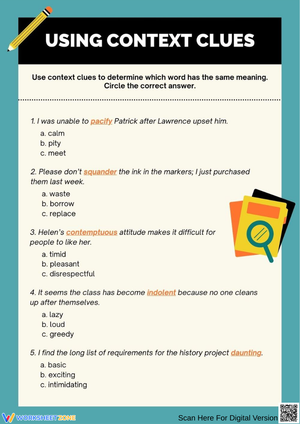
Fourth graders hit a vocabulary wall the moment content-area reading gets harder. A science passage about ecosystems or a social studies chapter on westward expansion drops in unfamiliar words with no glossary in sight, and students who have not been taught to lean on context tend to skip the word, guess randomly, or stall out entirely. Context clues worksheets give teachers a structured way to build the habit of stopping, scanning nearby sentences, and testing a meaning before moving on.
What CCSS L.4.4.a Asks Students to Do
CCSS.ELA-Literacy.L.4.4.a asks fourth graders to use context, including definitions, examples, or restatements in text, as a clue to the meaning of a word or phrase. This is one of three flexible vocabulary strategies grouped under L.4.4, alongside using Greek and Latin affixes and roots (L.4.4.b) and consulting reference materials such as dictionaries and glossaries (L.4.4.c). The standard is not asking students to memorize a list of clue types for a quiz. It is asking them to apply context as one tool among several whenever they hit an unfamiliar word in real text.
That distinction matters for how worksheets get used. A worksheet where students match a clue type to a definition in isolation checks recall, not the transferable skill. Worksheets that embed unknown words inside short, grade-appropriate passages and ask students to explain their reasoning come closer to what the standard is actually measuring.
The Five Context Clue Types Fourth Graders Need
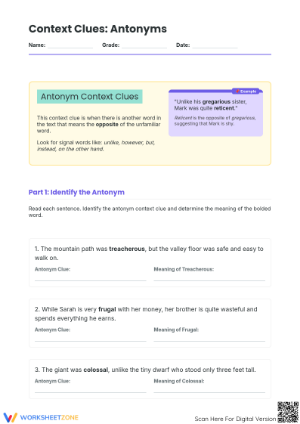
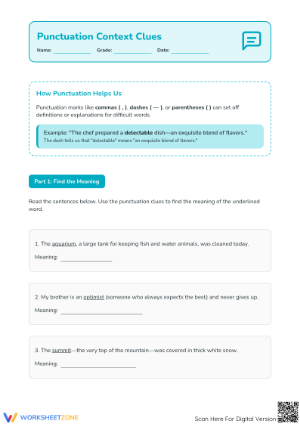
Most instructional models for this grade band teach five main clue types: definition, synonym, antonym, example, and inference (general) clues. Definition clues state the meaning directly, often set off by commas or the word 'or.' Synonym clues restate the word using a similar term nearby. Antonym clues contrast the word with its opposite. Example clues illustrate the word through a list of specific instances. Inference clues require the most reasoning, since the reader has to piece together meaning from the overall situation rather than a single nearby word or phrase.
Signal words help students recognize which clue type they are looking at. Synonym clues often use also, like, or similarly. Antonym clues use but, however, unlike, or although. Example clues use such as, for example, for instance, or including. Teaching these signal words explicitly, then giving students worksheets that isolate one clue type at a time, keeps early practice manageable before clue types get mixed together.
Formative Assessment and Exit Tickets
A short context clues worksheet works well as an exit ticket because it surfaces which clue type a student still struggles with in under five minutes. A single passage with three embedded vocabulary words, each relying on a different clue type, tells a teacher more than a worksheet with twenty isolated matching items. Track results by clue type across a class roster rather than by overall score, since two students who both score 70 percent may be missing entirely different skills.
This same short-cycle format supports quick regrouping. If an exit ticket shows six students consistently missing inference clues while the rest of the class has it, that is a clear signal to pull those six for a five-minute small-group reteach the next day rather than reteaching the whole class.
Classroom Implementation
A workable weekly rhythm for fourth grade context clues instruction looks like this: introduce one clue type with explicit modeling early in the week, use a guided worksheet in pairs or small groups midweek, and close with an independent worksheet or exit ticket by the end of the week. Rotate through the five clue types across five to six weeks, then revisit all of them together in mixed-type worksheets once each type has been taught individually.
For whole-class instruction, project a passage and complete the first item together, naming the clue type and the reasoning out loud before releasing students to finish independently. This keeps the worksheet from becoming a silent seatwork task disconnected from the thinking it is meant to build. For students who finish early, a bonus item asking them to write their own sentence using a target clue type extends the practice without adding new content.
Frequently Asked Questions
1. How should teachers use context clues worksheets to align with CCSS L.4.4.a?
Use worksheets that embed target words in short passages rather than isolated matching exercises, and require students to identify the specific clue type (definition, example, synonym, antonym, or inference) they used, since L.4.4.a asks students to use context, not memorize categories.
2. What are the main types of context clues 4th graders need to identify?
Most instructional models focus on five types: definition, synonym, antonym, example, and inference clues, moving from the most explicit (definition and example) to the most inferential.
3. How can teachers tell which context clue type a struggling reader needs more practice with?
Track exit ticket or worksheet results by clue type rather than by overall score, since a student may handle definition clues well but consistently miss inference clues, and that gap should shape the next small-group session.
4. How often should context clues practice happen in a 4th grade classroom?
A weekly rhythm works well: one clue type introduced with explicit modeling, guided practice midweek, and an independent worksheet or exit ticket by week's end, with all five clue types revisited together after each has been taught individually.
5. Can context clues worksheets be used for both whole-class instruction and small-group intervention?
Yes. Whole-class worksheets work well for introducing a clue type with modeling, while small-group intervention worksheets should narrow to just one or two clue types a specific student struggles with, using shorter passages and more teacher think-aloud support.












 Interactive Worksheet Maker
 Quiz Maker
 Word Search Maker
 Crossword Puzzle Maker
 Word Scramble Generator
 Sentence Scramble Generator
 Handwriting Worksheet Generator
 Name Tracing Generator
 Fill In The Blank Generator