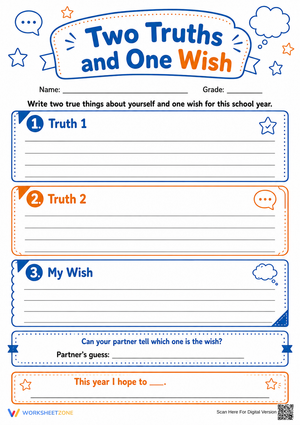
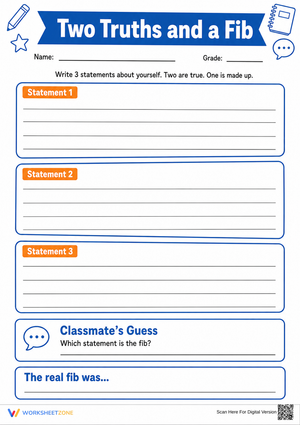
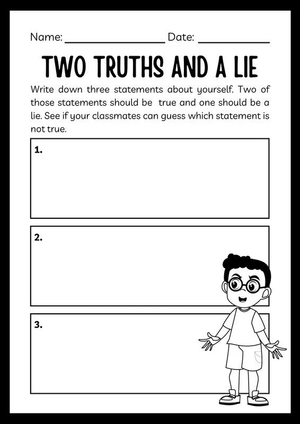
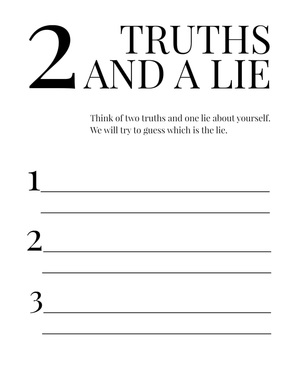
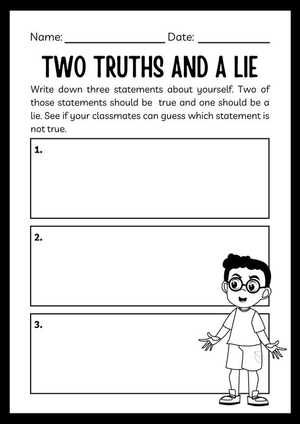
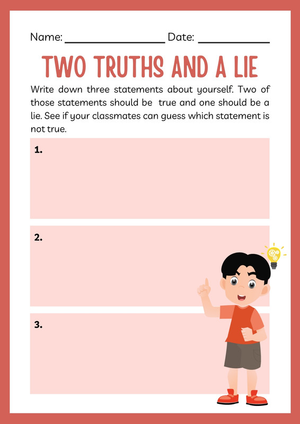
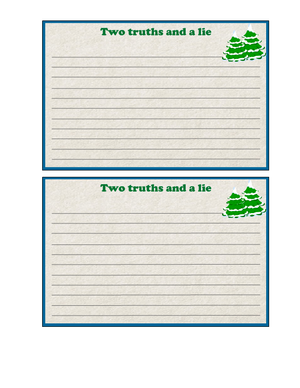
These 4th grade two truths and a lie pdf worksheets give teachers a ready structure for one of the most reliably engaging activities in elementary ELA — one that doubles as a writing lesson, a listening exercise, and a community-building moment all at once. Each worksheet walks students through drafting two factual personal statements and one plausible lie, then stages an oral reveal that turns the written work into a real class conversation. The format holds up as a first-week icebreaker, a mid-unit reset, and a content-area review tool.
What the Set Actually Builds
The core skill here is persuasive sentence construction — specifically, teaching students to make a false statement sound credible. That is a sophisticated writing move. When a student writes "I placed second in a state swimming competition" as their lie, they are making deliberate choices: a precise detail feels believable, a vague claim does not. That craft awareness transfers directly to informational reading, where students encounter the same tactics in texts written by adults. Students who work through this task come to analytical reading with a different lens — they have been on the other side of the trick.
The activity also makes active listening concrete. While peers present, students hold three competing statements in working memory, weigh details against each other, and decide which claim breaks down under scrutiny. That is genuine deductive reasoning, and it looks different from the passive listening most fourth graders drift into during class discussions. The oral presentation component builds speaking confidence in a format where social stakes stay low — the audience is focused on solving a riddle, not evaluating the speaker.
Mistakes Students Make That These Worksheets Help You Catch
The most predictable problem is a lie that is obviously impossible. A student writes "I have nineteen cats" next to "I have brown hair" and "I like soccer," and the game collapses before it starts. Before the class-wide reveal, have students read their three statements to a partner and note which one the partner identified in under three seconds. If the lie is instantly obvious, it needs revision — usually that means swapping a hyperbolic number or impossible detail for something a real nine-year-old might plausibly do or have.
A second consistent pattern: students write lies that are genuinely unverifiable, like "I have never eaten cheese." No one can evaluate that claim, and the audience knows it. Push students toward lies built on countable, observable facts — number of siblings, years playing a sport, states or countries visited — so classmates have something specific to reason against.
One thing worth anticipating with English Language Learners: a true statement about a student's home country or family culture may sound unfamiliar enough to American-born classmates that it gets voted as the lie. That stings, and it can make a student reluctant to share anything real again. A brief pre-activity conversation about why some true things surprise people — and what that reveals about different life experiences — turns a potentially awkward moment into a worthwhile discussion before it happens.
Lesson-Planning Strategies to Get the Most From These Worksheets
The most efficient approach to 4th grade two truths and a lie pdf worksheets is spreading the oral presentations across several days rather than running the whole class in one block. Feature three students per Morning Meeting over two weeks and the energy stays high — students who have not yet presented remain tuned in because they are still being surprised by classmates. A single thirty-minute session with every student presenting in sequence tends to drag by the halfway point, and the listening quality shows it.
For content-area use, swap personal facts for unit-specific ones. During an ecosystems unit, a student might write: "Decomposers break down dead matter into nutrients" (true), "Producers make their own food using sunlight" (true), "Herbivores can also digest meat when food is scarce" (lie). This version functions as formative assessment — if a student's "truth" is actually a misconception, it surfaces immediately, before the summative assessment, and gives a clean intervention target. Running the personal version first pays off because students already know the format when the content version arrives and can focus on the facts rather than figuring out the rules.
Adjusting the Task for a Range of Learners
Students who struggle with sentence construction benefit from a sentence-starter strip paired with the worksheet: "I have ___," "I once ___," "My family ___." These frames hold the syntactic structure in place so the cognitive work stays on content rather than grammar. The resulting statements also end up grammatically parallel, which makes the oral reveal cleaner and more natural.
Fluent writers can work with an added constraint: require that the lie include a specific number, date, or proper noun. "I have visited four national parks" is a harder lie to detect than "I travel a lot." That precision requirement raises the challenge without changing the format or the output type. For students who find whole-class presentation genuinely difficult — not reluctant but anxious — small groups of four reduce the social exposure enough that most participate fully. The full-class format can come later in the year once the classroom community is more established.
When these worksheets are used for content-area review, 4th grade two truths and a lie pdf worksheets can be adjusted by limiting the topic and providing a vocabulary list or notes reference. That keeps the task from becoming a memory test and shifts the focus to applying knowledge rather than recalling it under pressure — a meaningful distinction for students who know the material but blank under retrieval conditions.
Standard Alignment
The written drafting component aligns with CCSS.ELA-LITERACY.W.4.3, which asks students to use narrative techniques and specific details in their writing. Constructing a believable lie is a direct application of that standard — students choose details strategically rather than randomly, and they consider how specificity shapes a reader's or listener's response. The oral presentation and peer-discussion component aligns with CCSS.ELA-LITERACY.SL.4.1 (engaging in a range of collaborative discussions) and CCSS.ELA-LITERACY.SL.4.4 (presenting information or recounting an experience in an organized, clear manner). In instructional terms, the activity sits at the intersection of writing process and speaking and listening, which is why it fits naturally just before or just after a formal writing unit — it reconnects language craft to spoken communication at a moment when students often treat the two as entirely separate.
Frequently Asked Questions
How do I stop students from writing an obvious lie just to get a laugh?
Model the revision process explicitly. Write three statements on the board — including one ridiculous lie — and talk through why the lie fails: "If I write 'I have a pet elephant,' no one has to think. But if I write 'I placed second in a regional spelling bee,' now you actually have to consider it." Then revise the lie in front of the class. After students draft their own, build in a partner-check step before the class reveal: the partner marks which statement they identified immediately. If it was the lie, the student revises. That one peer-feedback round produces noticeably better lies across the whole class, and it takes less than three minutes.
Can I use these worksheets for content review rather than personal sharing?
Yes, and it is one of the strongest ways to use the set. Assigning the content version during the final days of a unit turns review into something students approach carefully, because they want to stump their classmates. It also forces closer engagement with notes — a student cannot write a plausible lie about the water cycle without knowing what is actually true. The 4th grade two truths and a lie pdf worksheets require no format changes for science, social studies, or math concept review beyond specifying the topic at the top of the worksheet.
How long should drafting take, and is homework a reasonable option?
In-class drafting with a ten-to-twelve minute window works better than homework for most classes. When students draft at home, quality is inconsistent — some arrive with polished sentences, others with three words written in the car. Drafting in class also means the partner-check step can happen before anyone presents. If class time is genuinely tight, sending the blank worksheet home the night before and using the first five minutes of class for partner review is a workable middle ground — students come in with ideas, and the in-class step catches the obvious lies before they hit the whole group.
What should I do if a student's "truth" turns out to be factually wrong?
Handle it the way you would handle any public factual error: acknowledge what the student shared, note that it is worth checking, and address it without singling the student out as wrong in front of peers. For the content-area version, these moments are genuinely useful data. When three students list the same misconception as a truth, that is real formative information — pull a small group the following day and address the concept directly. The low-stakes format of the game encourages students to put their thinking on the table rather than hide it, which means their errors are visible and addressable rather than buried until the test.












 Interactive Worksheet Maker
 Quiz Maker
 Word Search Maker
 Crossword Puzzle Maker
 Word Scramble Generator
 Sentence Scramble Generator
 Handwriting Worksheet Generator
 Name Tracing Generator
 Fill In The Blank Generator