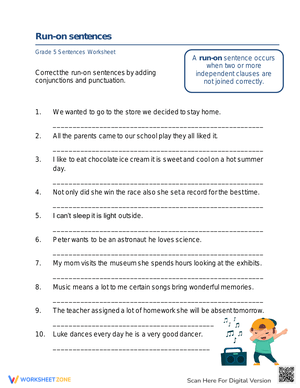
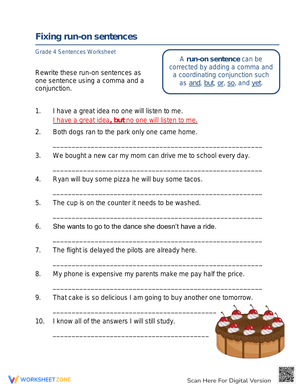
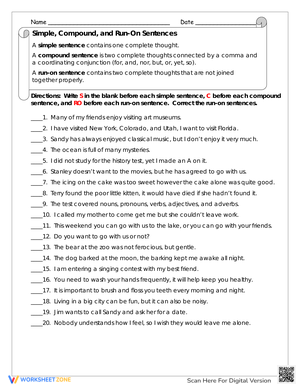
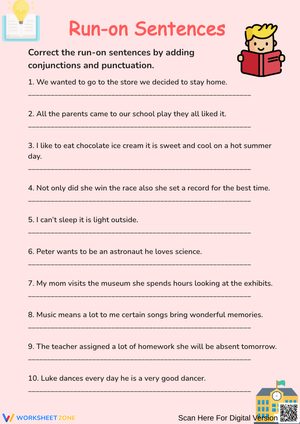
These run on sentences worksheets for 4th grade give teachers a targeted set of resources for one of the most persistent errors in fourth-grade writing—two complete thoughts crammed into one sentence with no punctuation between them, or held together by a comma that isn't strong enough to do the job alone. The set covers identification and correction as separate tasks, which matters because spotting a run-on in someone else's sentence and avoiding one in your own draft are different cognitive demands. Each worksheet isolates a specific piece of the skill so students build fluency with each part before applying the full editing process.
What's Behind This Error at Fourth Grade
Fourth grade is when students start writing longer, more ambitious text—narratives that run across multiple days, multi-paragraph informational pieces, compare-and-contrast structures. Managing new content and unfamiliar text forms takes most of a student's working attention, which means sentence mechanics often slip. Students write the way they think: in continuous streams, each new idea rolling into the last without a stop. The student who drafts "We got to the park it started raining we ran back to the car" is holding three clear ideas—the sequence is there, the boundary markers aren't. This isn't carelessness; it's a developmental stage, and consistent correction practice is what moves students through it.
Two distinct error types appear in fourth-grade work. Fused sentences place two independent clauses side by side with no punctuation at all: "The sun was hot we went swimming." Comma splices use a comma where a period or conjunction is needed: "The dog barked, the cat ran away." Students who write comma splices are often closer to a correct sentence than students writing fused sentences—they sense a pause is needed—but they haven't yet learned that a comma alone can't hold two full thoughts together. These two error types require different instructional responses, and the worksheets treat them separately before asking students to work with both at once.
Skills These Worksheets Build
The worksheets move students through a sequence that starts with recognition and ends with flexible, context-sensitive correction. That order matters: students who are taught correction strategies before they can reliably identify run-ons tend to apply those strategies randomly rather than purposefully.
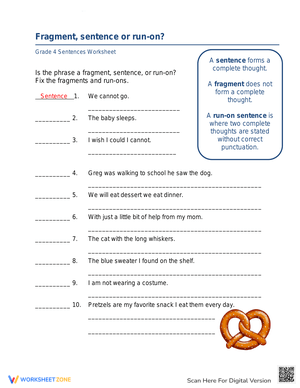
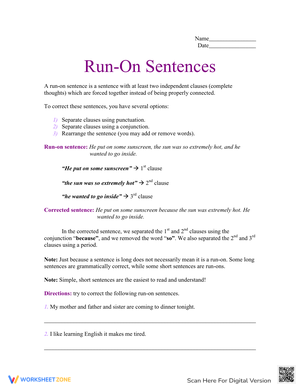
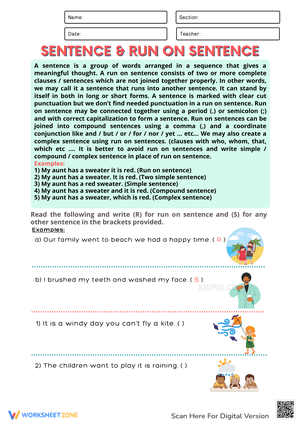
- Reading sentences and classifying them as complete, fragmented, or run-on
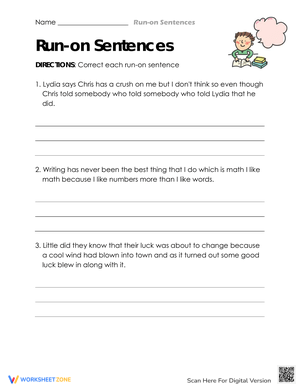
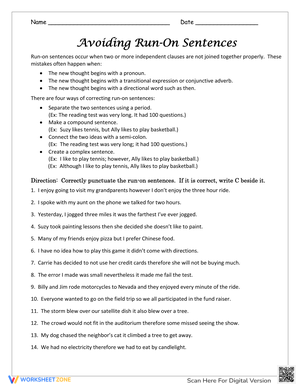
- Finding the boundary point inside a fused sentence and splitting it with a period and capital letter
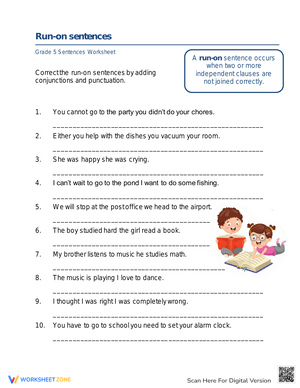
- Identifying comma splices and deciding whether to separate the clauses or join them with a conjunction
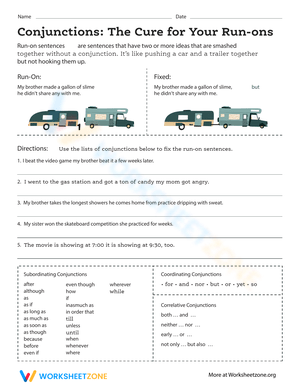
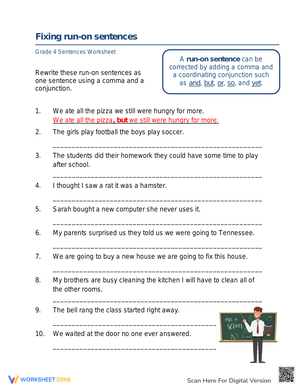
- Applying FANBOYS (for, and, nor, but, or, yet, so) to create correct compound sentences
- Rewriting the same run-on three different ways to practice choosing among correction options
- Editing a short paragraph where run-ons appear in context rather than in isolation
Semicolons appear in a few of the more advanced worksheets as an additional correction method, but they are not introduced as a primary strategy. Most fourth graders need consistent fluency with the period-split and FANBOYS methods before a semicolon is useful rather than confusing. Those worksheets are distinguishable from the core set so teachers can assign them selectively.
How to Work These Worksheets Into Your Lesson Plans
The most reliable placement is the week after initial direct instruction on run-ons—not the same day. Assigning a worksheet the afternoon of a grammar lesson tends to produce correct answers that disappear from student writing within a few days. Spreading practice across a week or two, and especially returning to a correction worksheet after students have produced a draft where run-ons appear, yields more lasting results. This is spaced retrieval applied to a grammar skill, and it works here the same way it works in vocabulary and math fact practice.
For Monday warm-ups, pulling exercises from a run on sentences worksheets for 4th grade makes a clean ten-minute opener: students settle in, correct four or five sentences, and compare answers before the main lesson begins. The paragraph-level worksheets—where students edit a full passage rather than isolated sentences—work best mid-unit, once students can correct individual sentences reliably. Giving students the paragraph worksheet too early turns the activity into guessing; they can't find the errors independently, so they make random changes and call it done.
One technique that reliably improves transfer: after students finish a correction worksheet, ask them to read the first two paragraphs of their current draft aloud, pausing only where they have placed punctuation. If they find themselves wanting to pause before a punctuation mark exists, they've found a run-on. This "breath test" bridges the gap between grammar practice and actual writing in a way that abstract prompts like "check your sentences" rarely do.
Errors Teachers Should Anticipate and Address
The most stubborn misconception is that sentence length determines whether a run-on exists. Students regularly circle a sentence like "The enormous old oak tree at the far edge of the field fell during the storm last night" as an error because it feels long—but it contains one independent clause and is completely correct. These worksheets address this directly by mixing intentionally long correct sentences in with actual run-ons, so students have to read for structure rather than count words.
Comma splices are harder to correct than fused sentences because students who write them already have a working mental model—they believe the comma is doing real grammatical work. Telling them the comma is wrong without explaining what it can and cannot do tends to produce overcorrection: students start omitting commas before conjunctions in compound sentences, even when those commas are required. A clear explanation of what commas actually do (separate list items, set off introductory phrases, work alongside conjunctions—never join two independent clauses on their own) prevents this secondary error from replacing the original one.
Watch for students who fix run-ons by deleting content rather than restructuring. When given "The game was exciting the crowd cheered loudly," some students write "The game was exciting" and stop—technically no longer a run-on, but now an incomplete thought. The correction exercises in this set ask students to keep both ideas in every rewrite, which forces real sentence revision rather than the shortcut of trimming.
Standard Alignment
ELA-Literacy.L.4.1.f requires fourth graders to produce complete sentences and recognize and correct inappropriate fragments and run-on sentences. This standard sits within the Conventions of Standard English strand and, at fourth grade, carries an expectation that students will apply these skills not just to isolated sentences during a grammar exercise but to their own extended writing. The worksheets are structured to address both dimensions: earlier exercises present individual sentences for identification and correction, while later ones embed errors inside short paragraphs that more closely approximate what students encounter when editing their own drafts. The standard's placement at fourth grade reflects the writing demands of the year—students are producing multi-paragraph texts regularly, and run-ons become a pattern rather than an occasional slip.
Adjusting the Work for Different Learners
Students who are still working on basic sentence identification should start with the fused-sentence worksheets rather than comma-splice work. Fused sentences are structurally simpler: the fix is unambiguous (insert a period, capitalize the next word), and there's only one error type to process at a time. Moving to FANBOYS worksheets before a student can reliably locate independent clause boundaries produces surface-level answers—students insert "and" or "but" without understanding what they're connecting.
For students ready to go further, the run on sentences worksheets for 4th grade that ask for multiple correction methods applied to a single sentence are the most demanding exercises in the set. These worksheets present one run-on and require students to fix it three ways—period split, FANBOYS compound, and combining the ideas into a single complex structure. This version of the task builds genuine grammatical flexibility, which shows up in student writing as variety rather than the monotony of students who have learned one correction strategy and apply it to everything.
Students writing well above grade level who are already producing correct compound sentences consistently may not need run-on correction practice at all. For them, time spent on subordinating conjunctions and deliberate sentence-length variation is usually more productive. Correction practice on a skill that's already internalized adds very little.
Frequently Asked Questions
Is there a difference between a run-on sentence and a long sentence?
Yes, and it's worth stating directly to students more than once. A run-on is a structural problem—two independent clauses joined without the right punctuation or conjunction. Sentence length has nothing to do with it. A forty-word sentence with proper connectives is correct; a six-word sentence with two clauses and no punctuation is a run-on. These worksheets include long, correct sentences alongside actual errors specifically so students practice reading for structure, not word count.
My students fix run-ons on worksheets but still write them in their drafts. What's happening?
This is the most common frustration teachers report with grammar instruction, and it's a transfer problem rather than a knowledge problem. Students learn to apply a rule to clearly labeled sentences in a controlled exercise, but when they're writing their own drafts, attention is on ideas and narrative momentum—not mechanics. Two things close this gap: spacing practice over several weeks rather than front-loading it in one grammar unit, and giving explicit transfer prompts that ask students to apply the correction skill to their own writing immediately after completing a worksheet, while the skill is still active.
Should I introduce the semicolon as a correction strategy in fourth grade?
For most students, not as a first or primary option. Students who haven't internalized period-splitting and FANBOYS often begin using semicolons wherever they're uncertain, which produces a different category of error rather than eliminating the original one. Reserve semicolon work for students who have demonstrated reliable correction with the other methods. The run on sentences worksheets for 4th grade that include semicolons are clearly distinguishable from the core set, so they can be assigned selectively without routing every student through them.
How many worksheets should a student complete before moving on?
The check that matters is what appears in student drafts, not how many worksheets they've finished. If run-ons have decreased in actual writing, students are ready to move on. If correct worksheet answers haven't translated to drafts, more spaced practice helps—particularly the paragraph-editing worksheets, which function as an informal formative check. A student who can find and correct errors inside an unfamiliar paragraph is ready to move forward; a student who corrects isolated sentences accurately but misses errors in a paragraph still needs more practice working in context.












 Interactive Worksheet Maker
 Quiz Maker
 Word Search Maker
 Crossword Puzzle Maker
 Word Scramble Generator
 Sentence Scramble Generator
 Handwriting Worksheet Generator
 Name Tracing Generator
 Fill In The Blank Generator