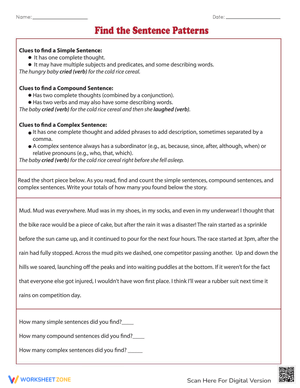
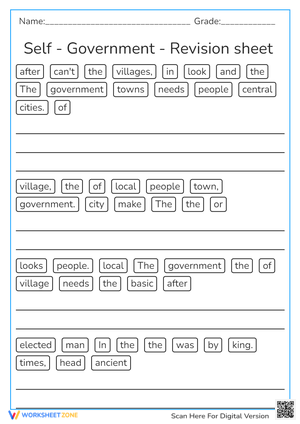
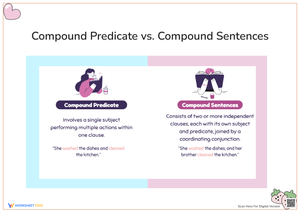
These 4th grade simple compound and complex sentences printable worksheets give teachers a direct path into one of the trickiest grammar transitions in upper elementary — moving students from loosely connected ideas to controlled clause relationships on the page. The set covers all three sentence types with exercises that progress from identification into active construction and revision.
What These Worksheets Have Students Do
Across the set, students work through a range of tasks that build toward fluent, accurate sentence writing. The progression starts with recognition and moves into production:
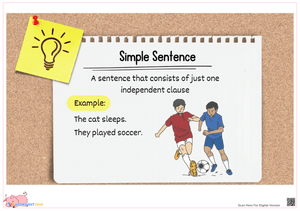
- Underline the subject once and the predicate twice in simple sentences, including longer ones with compound subjects or appended phrases
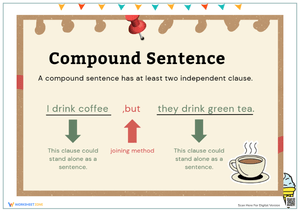
- Identify the coordinating conjunction in a compound sentence and insert missing commas before it
- Mark the subordinating conjunction in a complex sentence and decide whether the sentence requires a comma
- Match dependent clauses to independent clauses to form logical, grammatically correct complex sentences
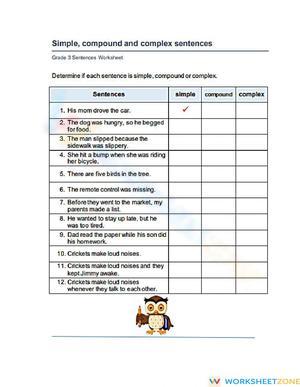
- Sort a mixed list of sentences by type: simple, compound, or complex
- Rewrite sentence fragments — particularly stranded dependent clauses — as complete sentences
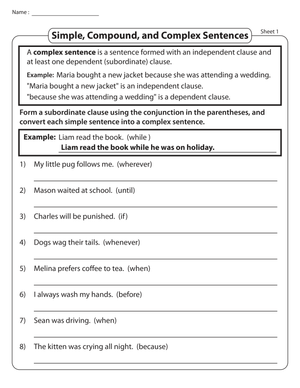
- Transform a simple sentence into a compound version and then a complex version using a given conjunction
The transformation task is worth singling out. Students who can accurately classify all three structures often still write exclusively in simple sentences during independent drafting. Asking them to take "The dog barked" and turn it into a compound sentence with but, then a complex sentence with although, forces them to transfer classification knowledge into actual writing behavior — which is where the real instructional goal sits.
Mistakes Students Make That Are Worth Catching Early
The most persistent comma error at this level is not forgetting the comma entirely — it is placing it after the coordinating conjunction instead of before it. Students write "The dog barked, but the cat ignored him" correctly, then write "We wanted to go outside but, it was raining" on the next line. Because lessons typically emphasize "comma plus conjunction," some students hear the order reversed and flip it. The punctuation patrol exercises surface this error within the first few minutes of seat work.
Complex sentence punctuation produces a different, highly predictable mistake. When the dependent clause opens the sentence — "Because it was raining, we stayed inside" — most fourth graders learn the comma rule without much trouble. What they miss is that a dependent clause standing alone is a fragment. "Because it was raining." ends up punctuated as a complete sentence in student essays with surprising regularity, especially in narrative writing where the rhythm feels intentional to the student. The clause-matching exercises require students to attach every dependent clause to an independent one, which makes the incompleteness of a lone dependent clause concrete rather than abstract.
A third error worth watching: students who understand FANBOYS will sometimes use it to identify compound sentences but also misclassify "The dog and the cat sat on the porch" as compound. They see two nouns connected by and and assume two clauses. Underscoring that a compound sentence needs two full independent clauses — two subjects, two verbs, two complete thoughts — is a recurring correction the subject-and-predicate identification tasks in the set make visible.
Building These Worksheets Into Your Weekly Rotation
The most natural entry point is immediately after the initial mini-lesson on one sentence type. Use the corresponding worksheet that same day as guided practice while you circulate and catch live errors before they solidify. For compound sentences, that means the lesson on FANBOYS and comma placement followed directly by the punctuation exercise worksheet while students are still in instruction mode and misconceptions haven't hardened yet.
For centers, the sorting worksheet — where students classify a mixed list of sentences — works well laminated with dry-erase markers. Students can work through it three or four times across a week, going faster as pattern recognition becomes automatic. The sorting format also runs cleanly as a five-minute warm-up at the start of writing workshop: put three sentences on the board pulled directly from the worksheet, ask students to classify and justify aloud, then release them to draft. That kind of repeated low-stakes exposure is what moves the grammar work from worksheet performance into daily writing.
These 4th grade simple compound and complex sentences printable worksheets also serve a clear assessment function. A completed identification worksheet at the end of a unit shows quickly which sentence type a student still conflates with another — compound versus complex is the most common confusion at this stage — and tells you whether the small group you're pulling Thursday needs more conjunction work or more clause-boundary work.
Standard Alignment
These worksheets address CCSS ELA-Literacy L.4.1.f, which requires students to produce complete sentences and recognize and correct inappropriate fragments and run-ons. The instructional placement matters here: L.4.1.f sits inside the Language strand alongside comma use with coordinating conjunctions (L.4.2.c), which means compound sentence work is simultaneously a grammar standard and a punctuation standard at this grade level. A well-executed compound sentence worksheet that addresses comma placement before the coordinating conjunction legitimately counts toward both standards and gives teachers two points of evidence from a single classroom task.
Adjusting the Work for Students at Different Levels
For students who are still shaky on subject and predicate, start with the simple sentence worksheets only and hold compound and complex work until the clause concept is stable. Moving into FANBOYS before a student can reliably identify where one clause ends is a fast way to produce confusion rather than understanding. The simple sentence exercises in the set are substantial enough to carry a full week of instruction on their own without feeling thin.
Advanced students who move through the classification tasks quickly can be pushed into revision work: give them a paragraph written entirely in simple sentences and ask them to rewrite it using a combination of all three types. A color-coding step — yellow highlighter for simple, blue for compound, green for complex — makes the sentence-type distribution visible immediately and shows students where they are over-relying on one structure. Students are often genuinely surprised to find that their "varied" writing is almost entirely yellow.
For English language learners, the clause-matching format is particularly useful because it reduces production demands while keeping the grammar work intact. Students connect halves rather than generating sentences from scratch, which directs their attention toward what makes a dependent clause dependent rather than toward fluency. Once the matching tasks are solid, 4th grade simple compound and complex sentences printable worksheets that require original sentence writing become far more accessible because the underlying structure is already familiar.
Frequently Asked Questions
How do students reliably tell a compound sentence from a complex one?
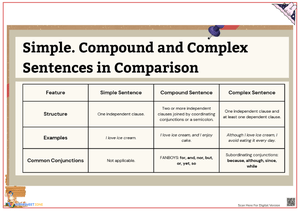
The fastest classroom method is the conjunction check. Compound sentences use coordinating conjunctions — FANBOYS — to join two independent clauses that could each stand alone as complete sentences. Complex sentences use subordinating conjunctions (because, although, since, when, if, while) to attach a dependent clause that cannot stand alone. Teaching students to ask "could both halves work as their own sentence?" gives them a self-check that holds up independently of memorizing lists, especially in the middle of editing a draft.
Which subordinating conjunctions should fourth graders know?
At this grade level, because, since, although, when, if, while, and after cover the vast majority of what students encounter and produce in narrative and informational writing. These seven carry cause-and-effect, time, and condition relationships — the clause relationships that appear most often in grade-level writing tasks. Extending the list past these before students are fluent with the core group tends to slow instruction rather than deepen it.
When is a comma required in a complex sentence?
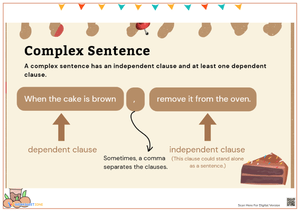
When the dependent clause opens the sentence — "Although she was tired, she finished the assignment" — a comma follows the dependent clause. When the independent clause comes first — "She finished the assignment although she was tired" — no comma is used. The shorthand that holds up in fourth grade is: if the subordinating conjunction comes first, there is a comma; if it falls in the middle, there is not. This front-load rule handles nearly every complex sentence students write at this level without requiring them to parse the grammar formally each time.
Do these worksheets address run-on sentences?
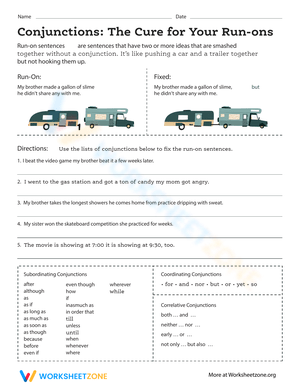
Yes, indirectly but effectively. Run-ons almost always occur when students join two independent clauses with only a comma — the comma splice — or with no punctuation at all. Practicing compound sentence construction teaches students that two independent clauses need a coordinating conjunction plus a comma, not just a comma. Students who work through the 4th grade simple compound and complex sentences printable worksheets and produce accurate compound sentences consistently stop writing comma splices, because the correct structure has become the automatic default rather than something they have to consciously remember during editing.












 Interactive Worksheet Maker
 Quiz Maker
 Word Search Maker
 Crossword Puzzle Maker
 Word Scramble Generator
 Sentence Scramble Generator
 Handwriting Worksheet Generator
 Name Tracing Generator
 Fill In The Blank Generator