




























Views
Downloads

Active and Passive Voice Printable Worksheet | Grade 8

Paste this activity's link or code into your existing LMS (Google Classroom, Canvas, Teams, Schoology, Moodle, etc.).
Students can open and work on the activity right away, with no student login required.
You'll still be able to track student progress and results from your teacher account.
This comprehensive grammar worksheet helps middle school students master the difference between active and passive voice. By identifying verb voices and rewriting sentences, learners develop stronger writing skills. This resource provides clear examples and structured practice to ensure students confidently control sentence dynamics.
At a Glance
- Grade: 8 · Subject: ELA
- Standard:
CCSS.ELA-LITERACY.L.8.1.B— Form and use verbs in the active and passive voice.- Skill Focus: Identifying and transforming active and passive voice
- Format: 3 pages · 17 problems · Answer key included · PDF
- Best For: Independent practice and grammar review
- Time: 20–30 minutes
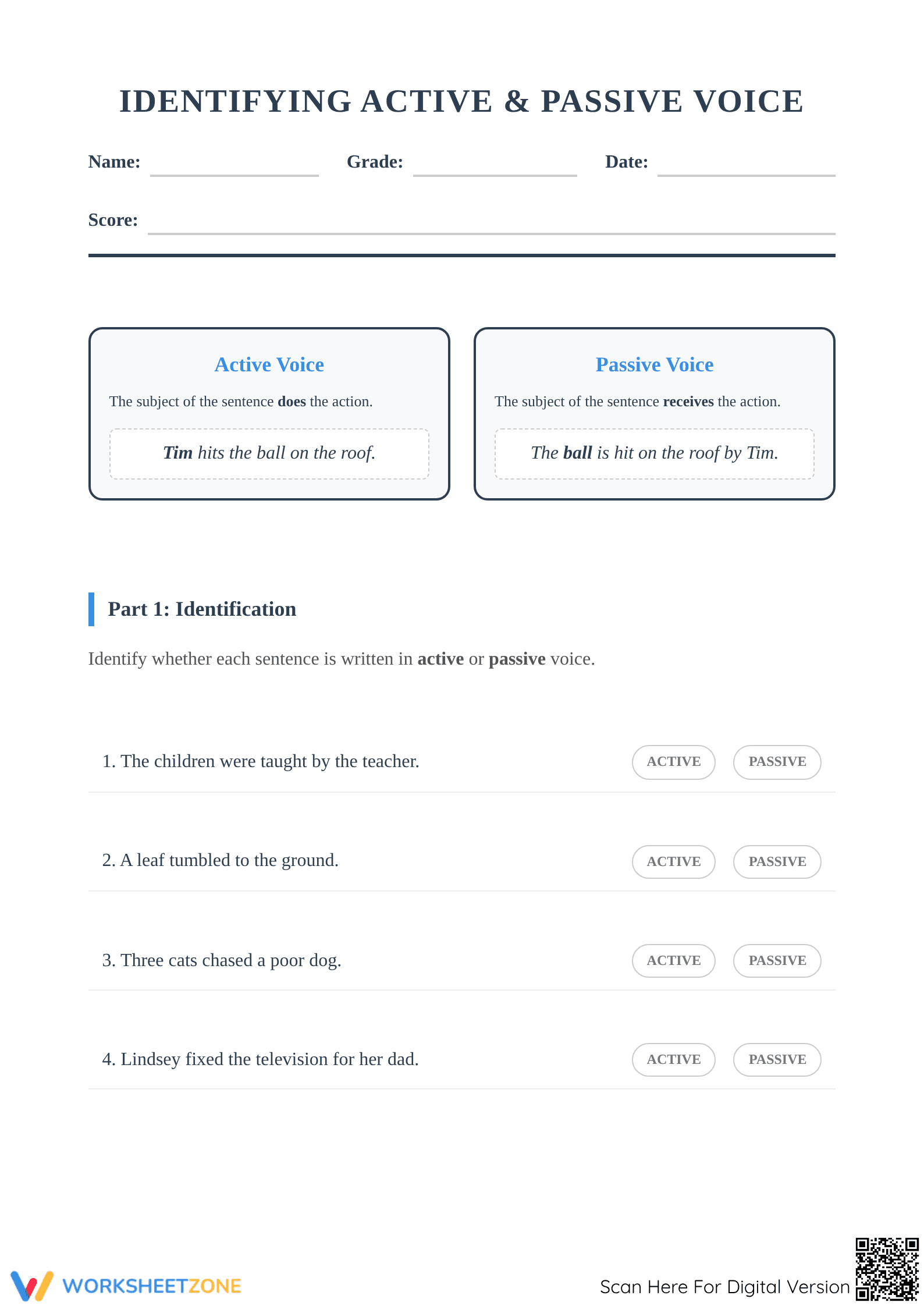
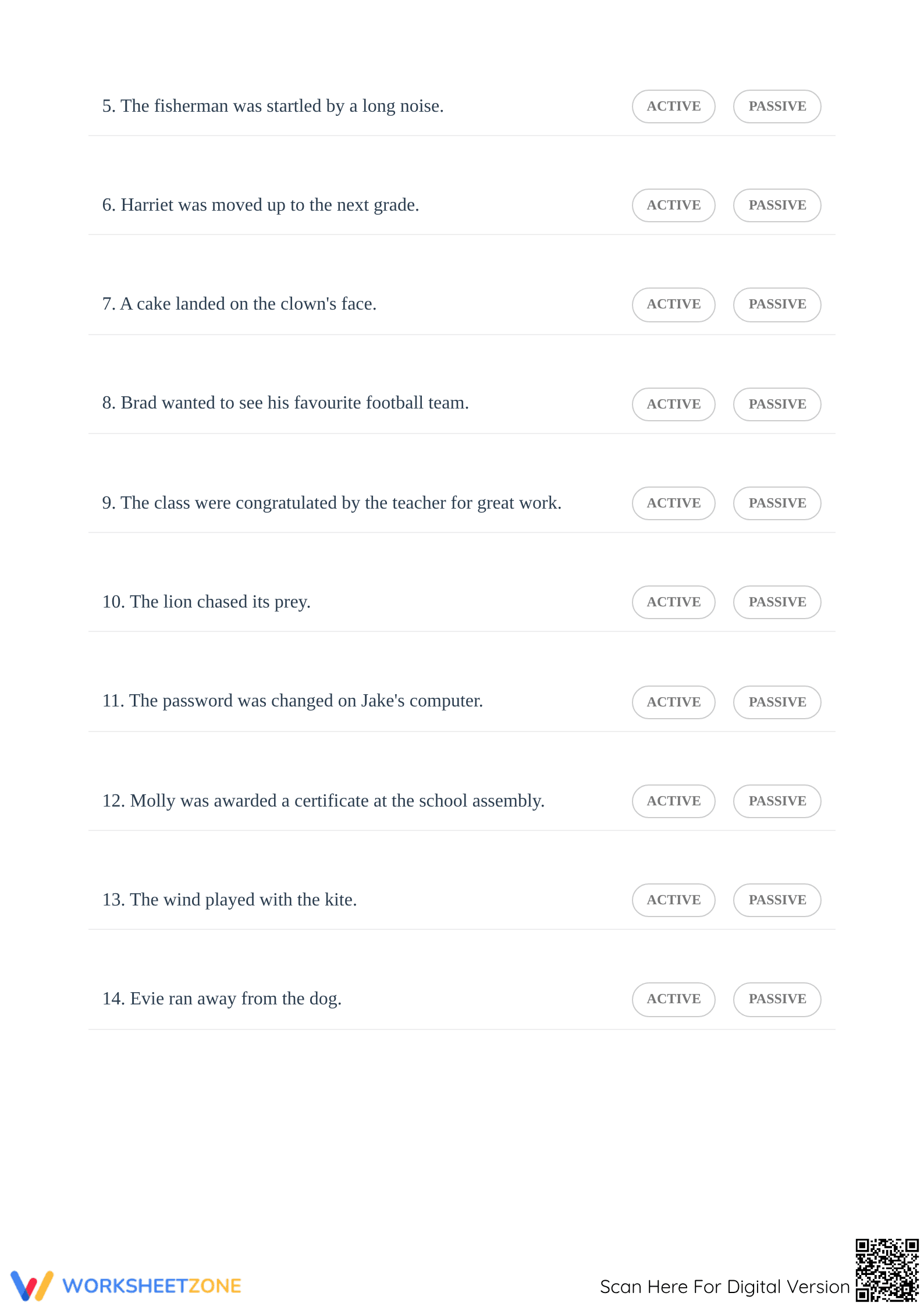
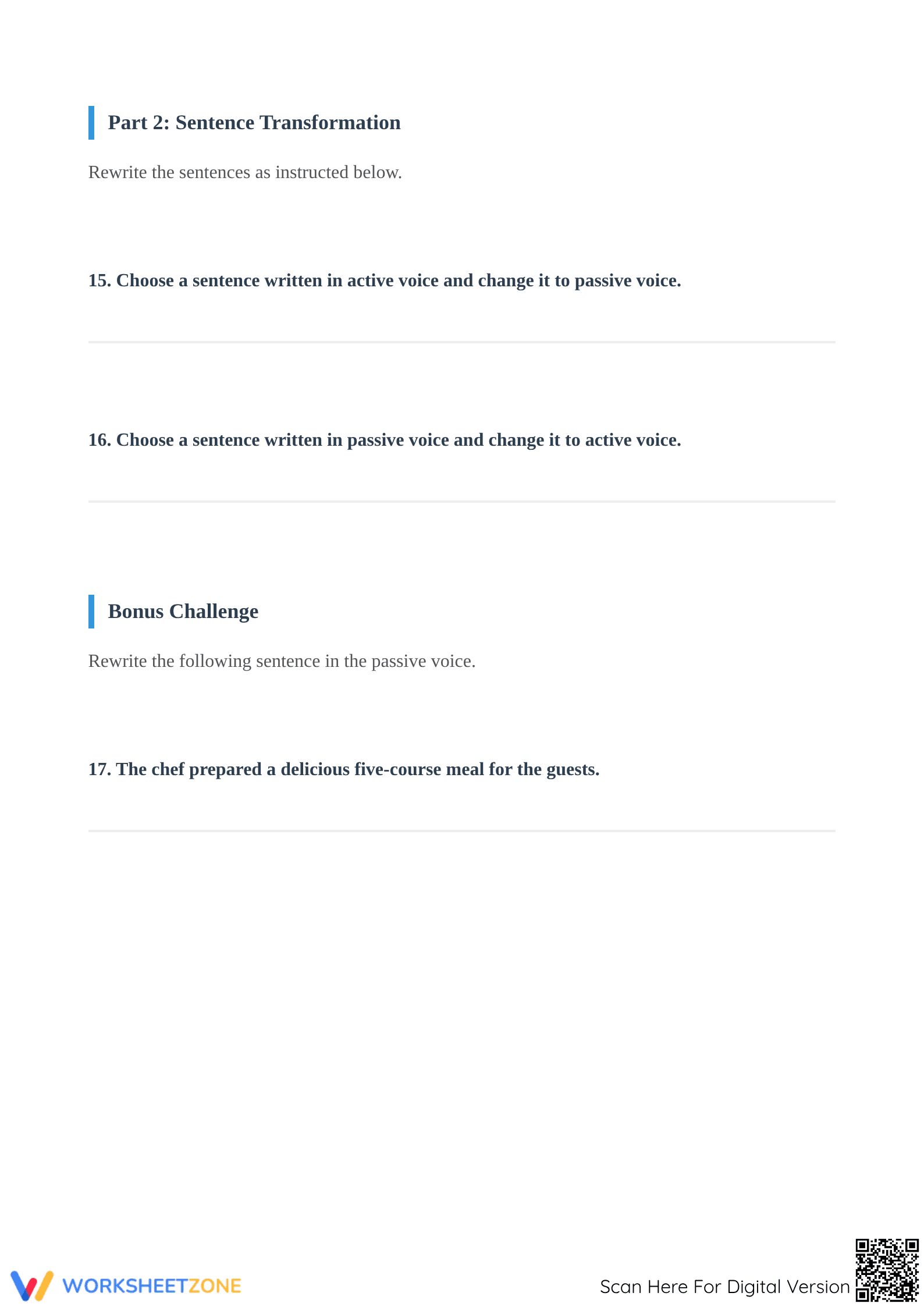
This three-page printable includes a reference guide defining active and passive voice with clear examples. The main activity features 14 identification questions where students analyze sentences and select the correct voice. Next, students tackle two sentence transformation tasks and one bonus challenge requiring them to rewrite sentences. A complete answer key is provided.
Skill Progression
- Guided practice: The worksheet opens with a clear definition and side-by-side examples of active and passive constructions, giving students a reliable reference point.
- Supported practice: The first 14 problems focus purely on identification, allowing students to build confidence by simply recognizing the subject-verb relationship without generating new text.
- Independent practice: The final section pushes students to apply their knowledge by actively rewriting sentences, culminating in a bonus challenge.
This gradual-release approach ensures students internalize the concept before attempting complex sentence transformations.
Standards Alignment
This resource is directly aligned to CCSS.ELA-LITERACY.L.8.1.B: Form and use verbs in the active and passive voice. It also supports broader writing standards by encouraging students to choose the most effective voice for their intended meaning. Both standard codes can be copied directly into lesson plans, IEP goals, or district curriculum mapping tools.
How to Use It
Deploy this worksheet during your grammar block after a brief direct instruction lesson on verb voice. It works perfectly as an independent classwork assignment or a targeted homework task. As a formative assessment tip, review students' answers on the transformation section (questions 15-17) to quickly gauge if they understand how to manipulate the subject and object without changing the sentence's core meaning. Most students will complete the full activity in 20 to 30 minutes.
Who It's For
This worksheet is designed primarily for 8th-grade ELA students, though it serves as an excellent review tool for high schoolers needing a grammar refresher. For students requiring accommodations, the clear examples at the top of page one provide a built-in scaffold. Pair this activity with a creative writing assignment, challenging students to revise their own passive sentences into strong, active statements.
Mastering sentence structure is a critical component of effective written communication. According to Fisher & Frey (2014), providing students with targeted, structured grammar practice significantly improves their ability to construct clear, purposeful sentences in their own writing. This worksheet directly supports CCSS.ELA-LITERACY.L.8.1.B by requiring students to form and use verbs in the active and passive voice. By moving from basic identification to active sentence transformation, learners develop the syntactic awareness necessary for advanced composition. Understanding when to use active voice for clarity and passive voice for emphasis allows students to manipulate language for specific rhetorical effects. This resource provides the exact focused repetition needed to solidify these essential grammar mechanics, ensuring students can confidently apply these skills across all academic disciplines, standardized assessments, and daily writing tasks.


