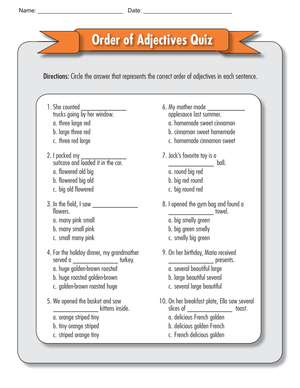
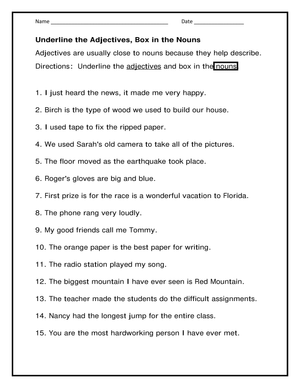
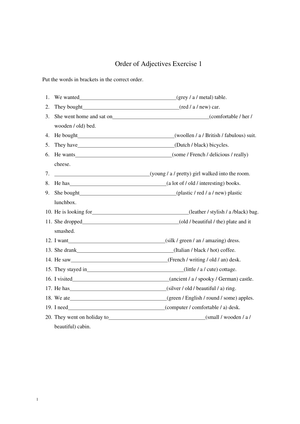
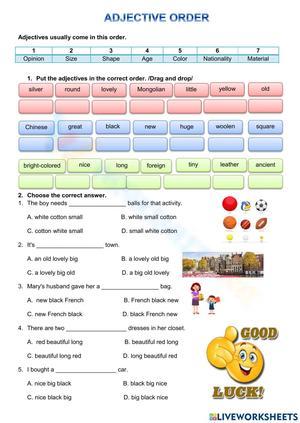
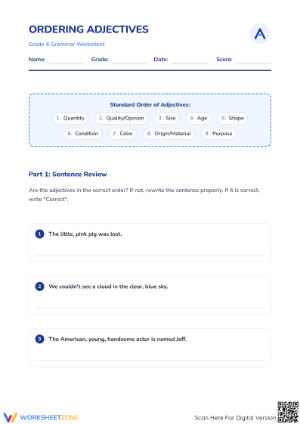
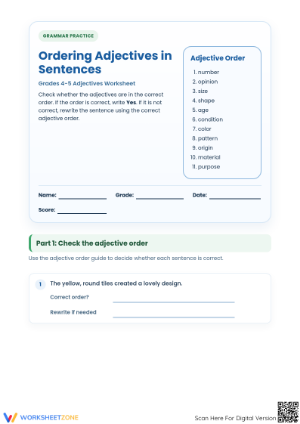
These 4th grade order of adjectives pdf worksheets give teachers a printable set of exercises for one of the more counterintuitive conventions in English grammar — the specific sequence in which adjectives must appear before a noun. Native speakers feel the wrongness of "a wooden old small box" immediately but rarely understand why, which means direct instruction is the only reliable path to mastery. The set targets that gap with varied activity formats built for independent practice, small-group work, and whole-class guided lessons.
The Adjective Sequence Students Learn to Apply
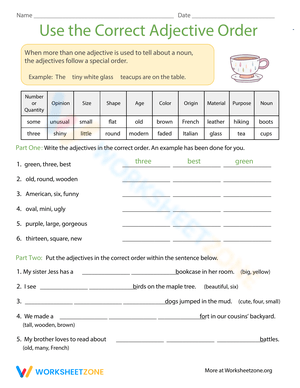
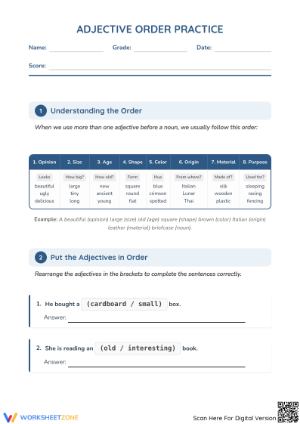
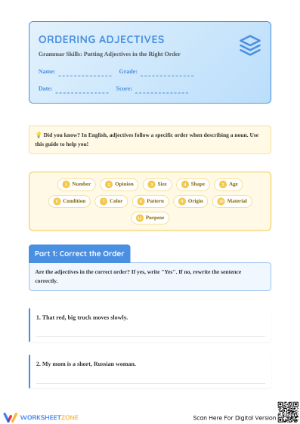
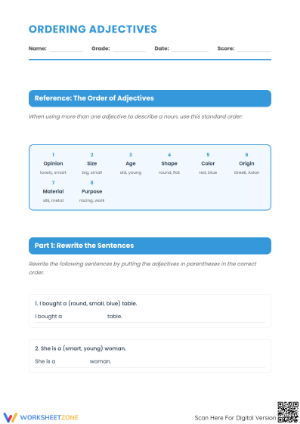
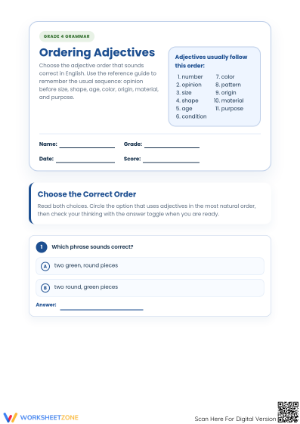
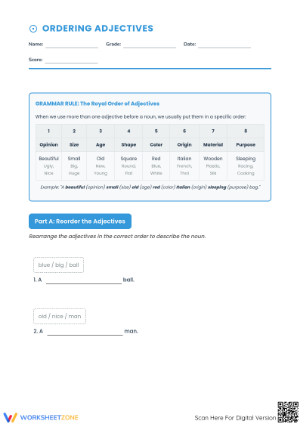
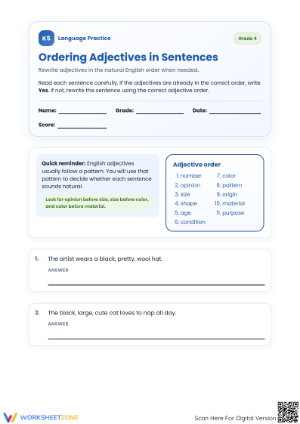
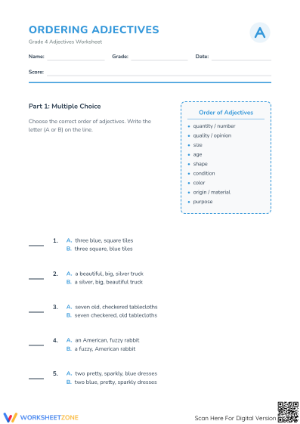
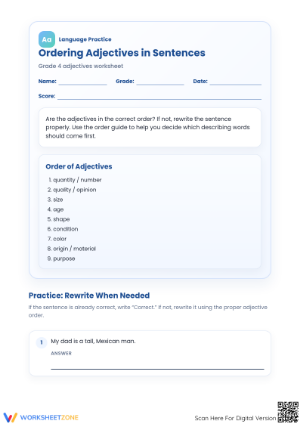
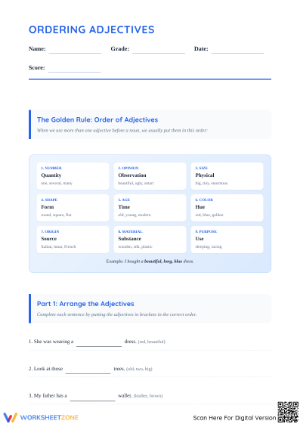
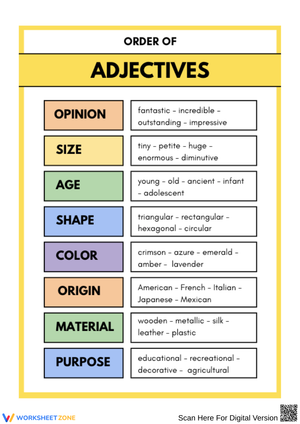
The conventional English adjective order is sometimes called the Royal Order of Adjectives, represented by the mnemonic OSASCOMP: Opinion, Size, Age, Shape, Color, Origin, Material, Purpose. Each worksheet in the set builds students' ability to move through that sequence fluently — first by recognizing the categories individually, then by placing multiple adjectives in the right order within a noun phrase. Posted as a classroom anchor chart alongside the worksheets, OSASCOMP becomes a reference tool students reach for without being asked.
Students practice four distinct task types across the worksheets:
- Reordering scrambled adjective phrases — A noun phrase arrives with adjectives listed out of sequence; students rearrange them correctly using the OSASCOMP categories as a reference.
- Fill-in-the-blank sentences — Two or three adjectives are given in parentheses and students place them in the correct order before completing the sentence. This embeds the convention inside full thoughts rather than isolated phrases.
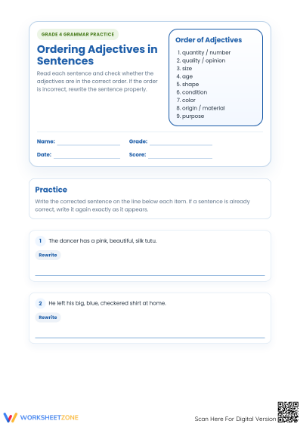
- Error identification and correction — Students read sentences with adjectives in the wrong order, mark the problem, and rewrite the sentence. This directly mirrors the editing work they do in writing workshop.
- Original sentence construction — Using a provided set of adjectives, students write their own sentences following the conventional order. This shifts practice from recognition into production and allows for real creative investment.
One instructional move that consistently strengthens this work: pull mentor sentences from whatever read-aloud students are currently finishing. When a student finds "a small battered leather suitcase" in a novel they already know, the OSASCOMP sequence stops feeling arbitrary. That connection to authentic reading is worth building deliberately, and students who notice the pattern in their independent reading transfer it to their own writing much faster.
Mistakes Students Make That These Worksheets Help You Catch
The most consistent error at this grade is swapping opinion and size adjectives. Students write "a small lovely pendant" because size words feel more objective and therefore more natural to anchor first. The category chart corrects this once students internalize that opinion always precedes size — but before that rule clicks, expect to see it repeatedly in the error-correction tasks. Treating those early errors as data rather than failures keeps the feedback loop productive.
The trickier confusion involves material and color. Students often write "a red wooden barn" and feel uncertain whether either order is acceptable. What helps: remind them that material describes what the object fundamentally is, while color adds only a surface detail, which is why color comes first. The sentence "a wooden red barn" sounds off to proficient listeners even though neither word seems more subjective than the other — that's the convention doing its work below the level of conscious awareness.
ELL students face a distinct challenge. Many languages use post-nominal adjectives or a completely different stacking sequence. A Spanish-speaking student may produce "a box old wooden small" because Spanish adjectives frequently follow the noun and carry their own ordering logic. The error-identification worksheets are particularly valuable for this group because they ask students to notice explicitly where English convention departs from what their home-language grammar suggests — which is a more honest and productive framing than simply marking answers wrong.
Fitting These Worksheets Into Your Teaching Week
The most practical entry point is a brief whole-class lesson — ten minutes at most — that introduces OSASCOMP with three or four carefully chosen examples on the board. Post the chart, then move directly into the reordering worksheet the same day. Keeping the initial lesson short reduces cognitive load; students consolidate the rule through practice, not through extended lecture. A longer introduction tends to backfire because students forget the categories before they have a chance to use them.
After that introduction, the remaining worksheets slot into several different structures throughout the week. Posting one scrambled phrase as a morning warm-up takes fewer than five minutes and builds cumulative fluency without sacrificing instructional time elsewhere. By the end of two weeks of daily exposure, most students apply the sequence without checking the chart. The 4th grade order of adjectives pdf worksheets also drop naturally into writing workshop as a focused editing task: students return to a draft in progress, highlight every multi-adjective phrase, and check each one against the OSASCOMP sequence before their teacher conference. That gives the grammar work immediate, purposeful application rather than keeping it confined to exercise sentences.
Standard Alignment
CCSS ELA-Literacy L.4.1d requires fourth graders to order adjectives within sentences according to conventional patterns and to recognize that certain orderings sound unnatural to proficient speakers. This standard sits inside the broader Language strand alongside comma use and relative clauses, which means adjective order instruction pairs naturally with the punctuation work students tackle in the same unit. Teachers who sequence this standard after students have already been writing multi-adjective descriptions in writing workshop find the transfer faster — students have real phrases to revise, so the grammar task has immediate context rather than existing in isolation.
Adapting the Set for Mixed-Ability Classrooms
For students who struggle with the full eight-category sequence, start with just two: size and color. Those are the most visually concrete categories — students can picture them without abstract reasoning. Once students reliably order those two, add opinion, then age. The 4th grade order of adjectives pdf worksheets lend themselves to this partial-sequence approach because the reordering tasks can be restricted to phrases involving only two or three categories without changing the format of the worksheet itself. Keep the chart visible throughout; removing it too early turns a grammar lesson into a memory test, which is a different and less useful skill.
Students who are ready to move beyond the standard benefit most from the sentence-construction tasks. Instead of providing adjectives to arrange, ask these students to generate their own multi-adjective noun phrases and then label each adjective's category in the margin. That metacognitive step — naming the category while writing — is the same editing habit strong writers use during revision. It also prepares them for the coordinate-adjective comma work they will encounter in fifth grade, where they need to distinguish between adjectives that take commas and those that do not.
Frequently Asked Questions
Do students need to memorize OSASCOMP?
No. The goal is habitual use of the sequence, not recall of the acronym. Most fourth graders internalize the most common categories — opinion, size, color, material — within two weeks of consistent practice. The full eight-category chart is a reference tool students use during writing and editing. Requiring memorization before they have practiced with the chart adds an unnecessary barrier to early success.
What standard covers adjective order in fourth grade?
CCSS ELA-Literacy L.4.1d addresses this skill directly. It is one of several Language standards at the fourth-grade level alongside pronoun case, relative pronouns, and progressive verb tenses. Adjective order instruction works best after students have already been writing descriptive sentences, so the standard connects immediately to writing they have already produced rather than existing as a decontextualized grammar exercise.
Do multi-adjective phrases require commas between the adjectives?
Not when the adjectives come from different OSASCOMP categories. Those are cumulative adjectives — "a small red leather bag" needs no comma because each adjective belongs to a different category. Commas apply to coordinate adjectives that belong to the same category and could be joined by "and." Teaching this distinction alongside the 4th grade order of adjectives pdf worksheets prevents an over-punctuation habit that students otherwise carry well into middle school.
How do I support English Language Learners specifically?
A bilingual version of the OSASCOMP anchor chart helps considerably for students whose home language uses post-nominal adjectives or a different ordering convention. Pairing ELL students with bilingual partners during error-correction tasks — so they can discuss why a given English ordering sounds natural — builds oral language skills alongside the grammar work. The expectation stays high; ELL students learn the conventional English sequence just as readily as native speakers do with the right reference tools in place.












 Interactive Worksheet Maker
 Quiz Maker
 Word Search Maker
 Crossword Puzzle Maker
 Word Scramble Generator
 Sentence Scramble Generator
 Handwriting Worksheet Generator
 Name Tracing Generator
 Fill In The Blank Generator




 BACK TOSCHOOL