


























Views
Downloads



Grade 4 Ordering Adjectives — Printable No-Prep Worksheet
Paste this activity's link or code into your existing LMS (Google Classroom, Canvas, Teams, Schoology, Moodle, etc.).
Students can open and work on the activity right away, with no student login required.
You'll still be able to track student progress and results from your teacher account.
This Grade 4 grammar worksheet provides a structured approach to mastering the conventional order of adjectives. Students learn to arrange multiple descriptors—such as size, age, and color—to create sentences that sound natural to native speakers. By completing these exercises, learners move from awkward phrasing to fluent, sophisticated sentence construction.
At a Glance
- Grade: 4 · Subject: ELA
- Standard:
CCSS.ELA-LITERACY.L.4.1.D— Order adjectives within sentences according to conventional patterns- Skill Focus: Adjective sequence (Opinion to Purpose)
- Format: 4 pages · 22 problems · Answer key included · PDF
- Best For: Independent practice and grammar centers
- Time: 20–30 minutes
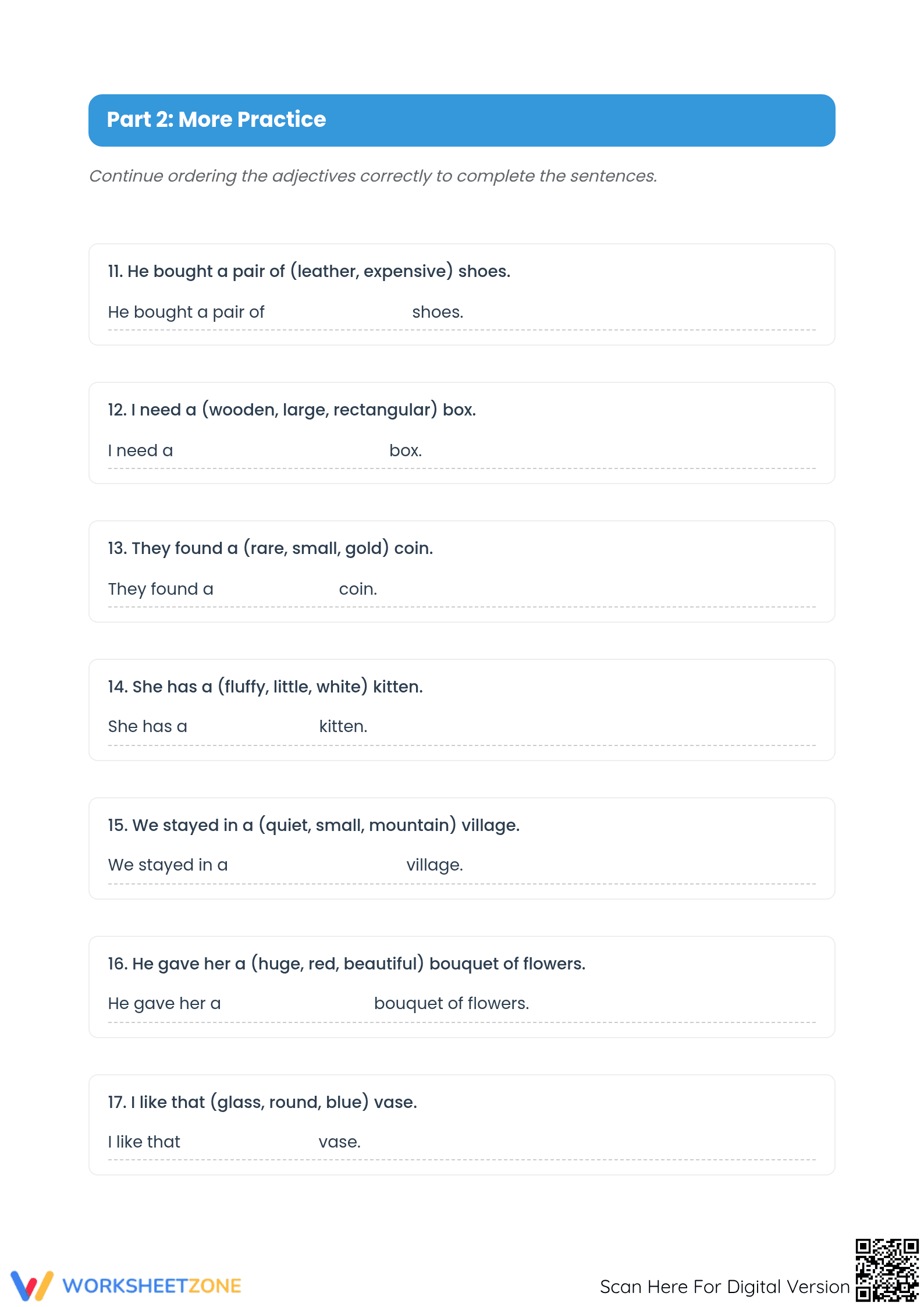
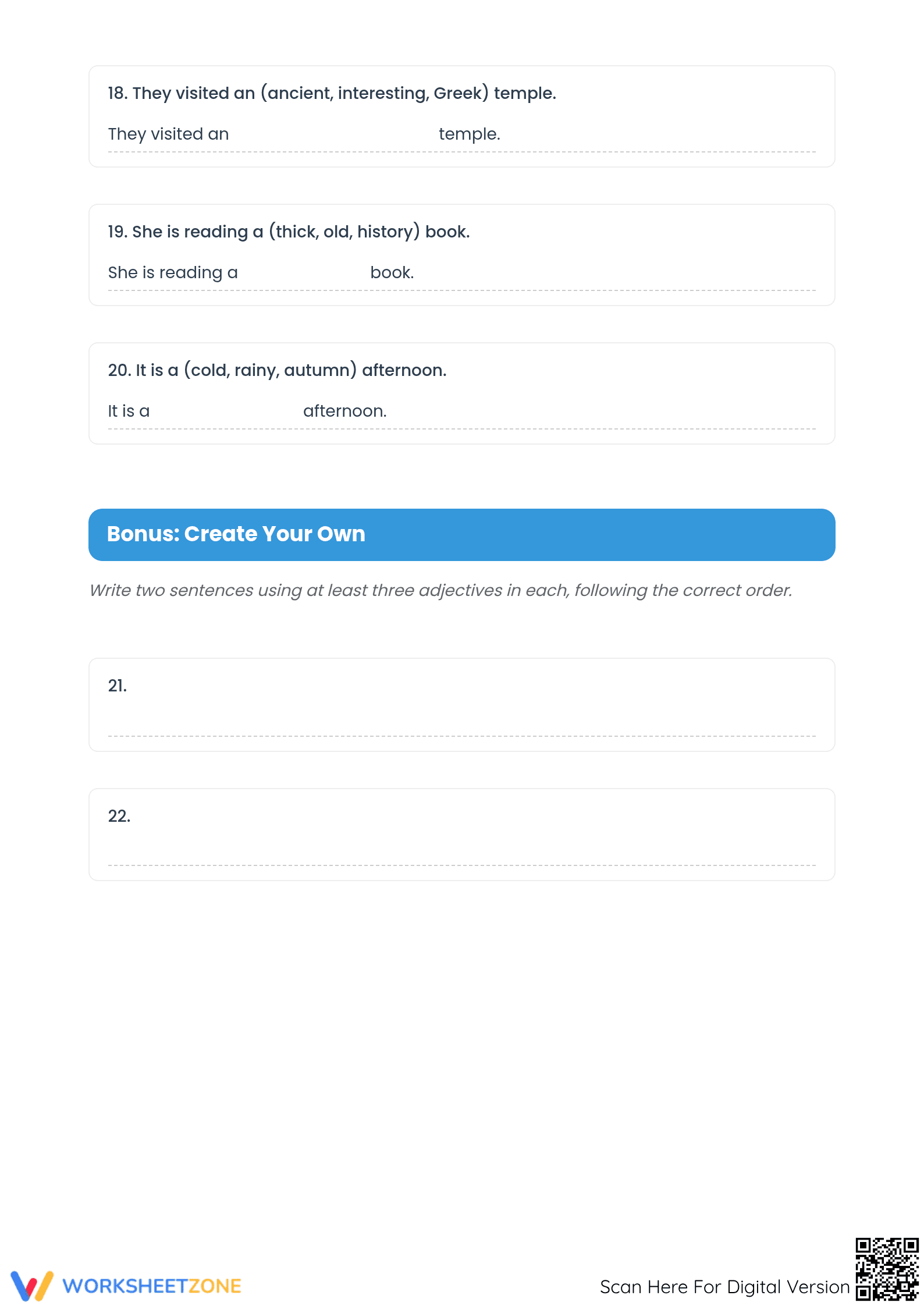
What's Inside: This comprehensive 4-page PDF includes a detailed reference chart outlining the eight standard categories of adjective order: opinion, size, age, shape, color, origin, material, and purpose. The worksheet features 20 sentence-rewrite tasks where students must reorder scrambled adjectives in parentheses, followed by a bonus section with 2 original sentence-creation prompts. A full answer key is provided for immediate feedback.
Zero-Prep Workflow
- Print (30 seconds): Generate the 4-page document. The integrated reference guide means you do not need to find additional anchor charts or textbooks.
- Distribute (1 minute): Hand out the packets for a quiet independent work session or as a reliable sub plan activity.
- Review (5 minutes): Use the clear, one-to-one answer key to grade student work or facilitate a quick whole-class correction session.
Standards Alignment: This resource is specifically designed for `CCSS.ELA-LITERACY.L.4.1.D`, which requires students to order adjectives within sentences according to conventional patterns (e.g., a small red bag rather than a red small bag). Both standard codes can be copied directly into lesson plans, IEP goals, or district curriculum mapping tools.
How to Use It: Assign this worksheet during the "You Do" phase of a gradual release lesson on word classes. It serves as an excellent formative assessment after a direct instruction session on the adjective hierarchy. Expect students to spend approximately 25 minutes completing the rewrite tasks and the creative bonus section.
Who It's For: While designed for Grade 4 students, this resource is highly effective for ESL/ELL learners who are struggling with the nuances of English syntax. It pairs naturally with descriptive writing units or mentor texts that utilize rich, multi-adjective imagery.
According to Fisher & Frey (2014), providing students with explicit scaffolds—such as the 8-point reference chart included here—is essential for moving grammar concepts from short-term recognition to long-term application. This worksheet applies those principles by requiring students to actively manipulate language rather than simply identifying parts of speech. By practicing the specific sequence of `CCSS.ELA-LITERACY.L.4.1.D` across 22 distinct tasks, students internalize the rhythmic patterns of English descriptors. Research from the NAEP suggests that mastery of these foundational syntactic structures is a strong predictor of overall writing fluency in the upper elementary grades. This resource ensures that students have the repetitive, focused practice necessary to eliminate common errors in adjective placement, making it a vital tool for any Grade 4 ELA curriculum focused on linguistic precision and sentence variety.


