


























Views
Downloads


Ordering Adjectives Worksheet | Essential Grade 4-5 ELA
Paste this activity's link or code into your existing LMS (Google Classroom, Canvas, Teams, Schoology, Moodle, etc.).
Students can open and work on the activity right away, with no student login required.
You'll still be able to track student progress and results from your teacher account.
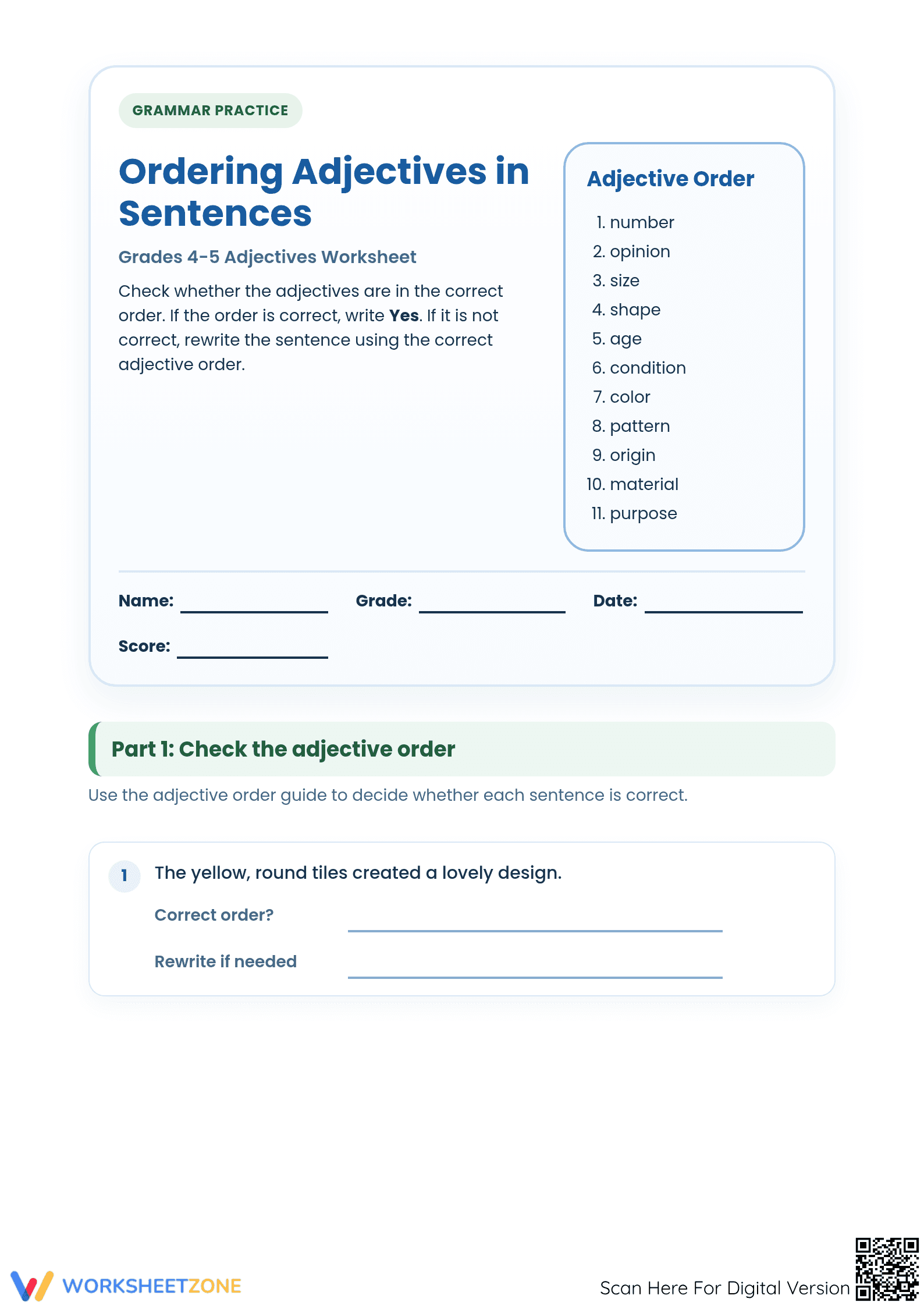
This Grade 4-5 ELA worksheet helps students master the complex rules of adjective sequencing. By applying a conventional 11-category hierarchy, learners move from identifying errors to independently constructing grammatically correct sentences. This resource ensures students can communicate with clarity and precision in their descriptive writing through targeted practice.
At a Glance
- Grade: 4-5 · Subject: ELA
- Standard:
CCSS.ELA-LITERACY.L.4.1.D— Order adjectives within sentences according to conventional patterns like size and color.- Skill Focus: Adjective sequencing and syntax
- Format: 4 pages · 12 problems · Answer key included · PDF
- Best For: Grammar centers and independent practice
- Time: 20–30 minutes
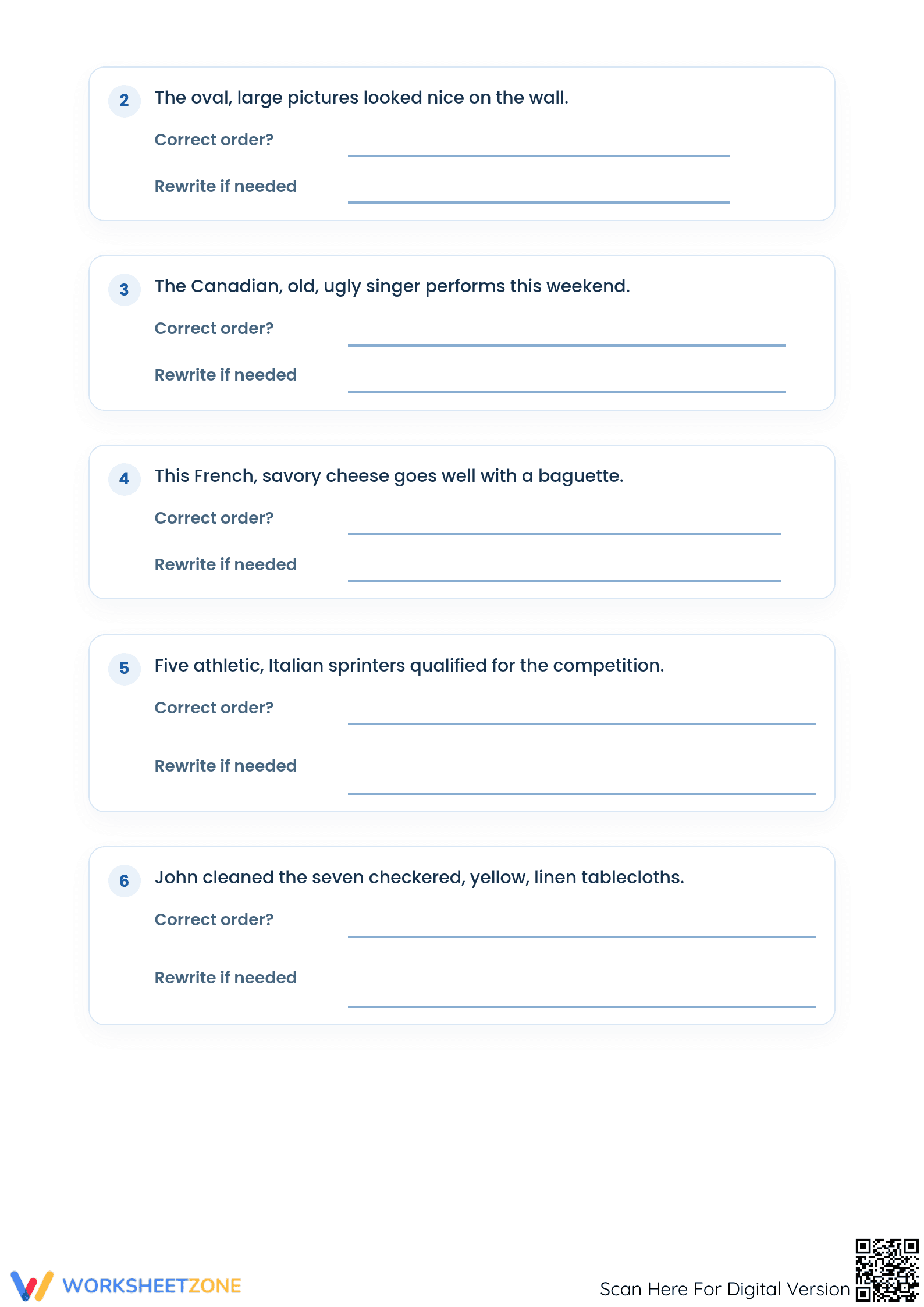
The packet contains a comprehensive 4-page layout. It features a prominent Adjective Order reference box listing 11 specific categories, from number and opinion to material and purpose. Students engage with 12 multi-part tasks that require them to evaluate existing sentences and perform corrective rewrites. A full answer key is provided for immediate feedback and grading.
Skill Development Pathway
- Guided Evaluation: The first 10 tasks provide a structured framework where students determine if a sentence is correct before attempting a rewrite, using the 11-point guide as a scaffold.
- Supported Application: Mid-worksheet items introduce complex adjective strings, challenging students to apply the hierarchy to less common descriptive patterns like origin and material.
- Independent Synthesis: The final Extra Practice section removes the binary prompts, requiring students to reorganize jumbled adjective strings entirely on their own to demonstrate mastery.
This gradual-release model follows the I Do, We Do, You Do instructional framework, ensuring students build confidence before tackling unassisted writing tasks.
This resource is specifically aligned with CCSS.ELA-LITERACY.L.4.1.D, which requires students to order adjectives within sentences according to conventional patterns. It also supports general writing fluency and syntactic variety. Both standard codes can be copied directly into lesson plans, IEP goals, or district curriculum mapping tools.
Use this worksheet during the independent practice phase of a grammar lesson. After introducing the adjective order chart, assign the first page as a formative check. If students struggle with the opinion vs. fact distinction, use the guide for a quick re-teach. Completion typically takes 25 minutes, making it an ideal choice for desk-work rotations.
This practice is designed for 4th and 5th-grade students, but it is also effective for English Language Learners (ELL) who often find English adjective order counter-intuitive. Pair this with a descriptive writing prompt to see the skills transfer to original composition.
According to Fisher & Frey (2014), the use of scaffolds like the 11-category adjective guide provided here is essential for developing syntactic control in young writers. Research indicates that explicit instruction in word order, particularly for lexical classes like adjectives, prevents the fossilization of grammatical errors in student prose. This worksheet addresses CCSS.ELA-LITERACY.L.4.1.D by providing 12 targeted opportunities for students to internalize the number-opinion-size hierarchy. By moving from recognition to production, the resource ensures that the cognitive load remains manageable while still pushing for higher-order application. Educators can use the included answer key to identify specific categories—such as origin or material—where students may need additional direct instruction. This systematic approach to grammar instruction is a proven method for improving overall writing quality and sentence-level accuracy in the upper elementary grades.


