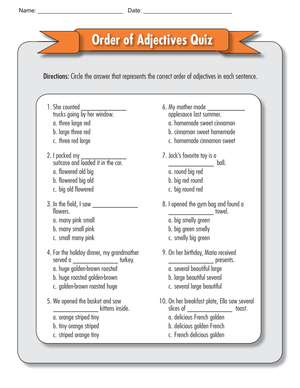
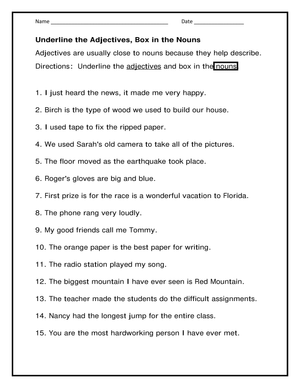
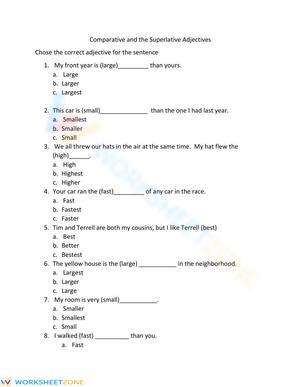
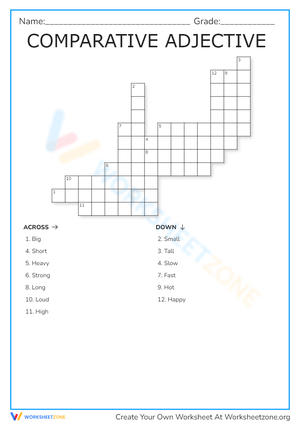
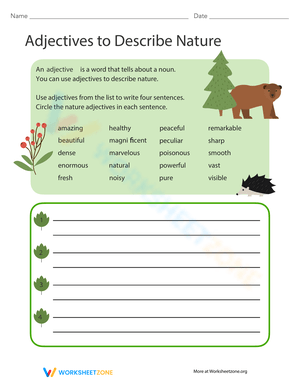
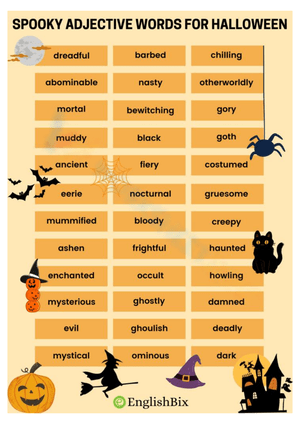
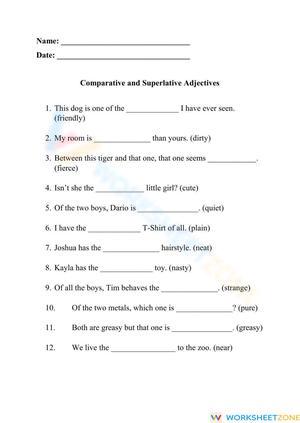
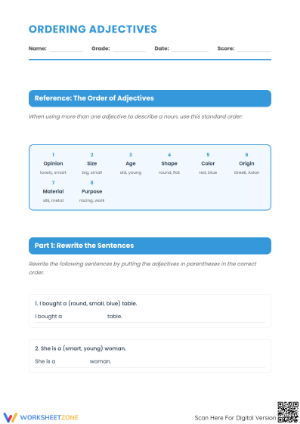
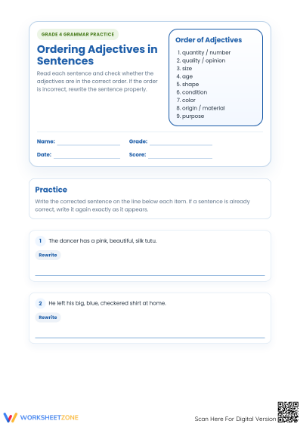
These adjectives pdf worksheets for 4th grade give teachers a targeted set of exercises built around the grammar demands of the upper-elementary years — ordering multiple adjectives within a sentence, forming comparative and superlative forms including the irregular ones, and telling adjectives apart from adverbs. Each worksheet addresses a specific skill rather than combining unrelated tasks, which matters when you're trying to determine exactly where a student is breaking down. Teachers who work the set into grammar rotations or writing workshop revision days find the focused format easier to debrief than mixed-skill review activities.
The Specific Skills Targeted Across the Set
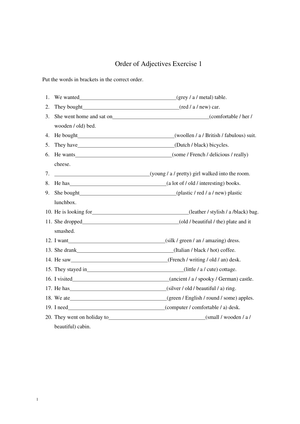
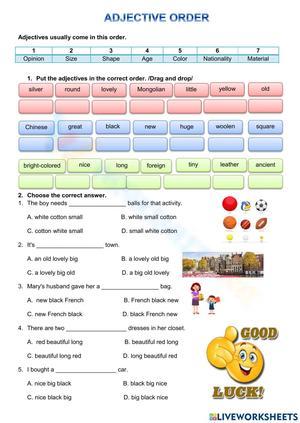
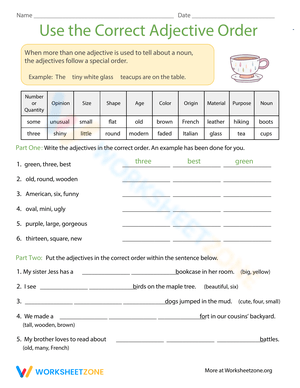
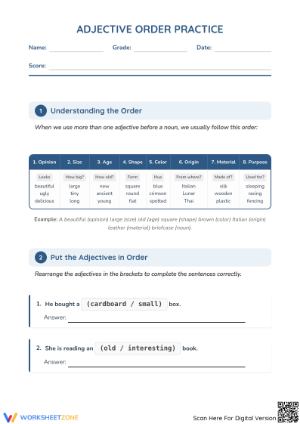
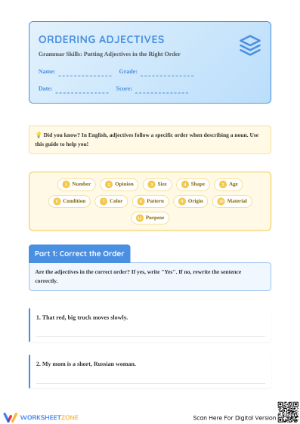
Fourth grade is the year the CCSS calls for explicit instruction in adjective ordering — something students often get right by intuition but struggle to apply consistently when drafting or revising. The worksheets address this directly, asking students to sequence multi-adjective strings according to the conventional English pattern: opinion, size, age, shape, color, origin, material, purpose. Students underline, reorder, and rewrite sentences rather than just circling answers, so the practice demands production, not just recognition.
Beyond ordering, the set covers:
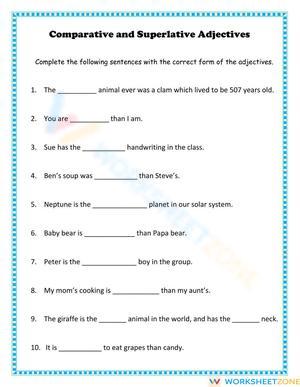
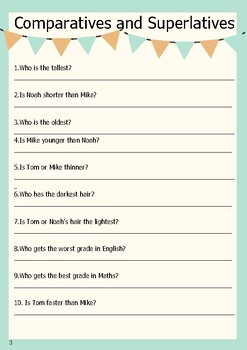
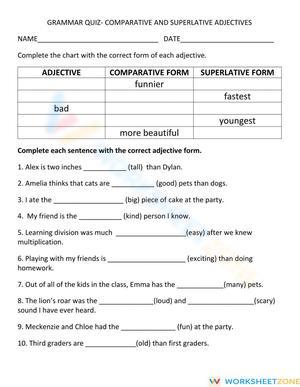
- Comparative and superlative forms — both regular endings (-er, -est) and the irregular forms students routinely mishandle
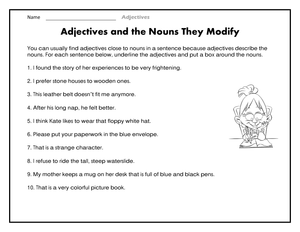
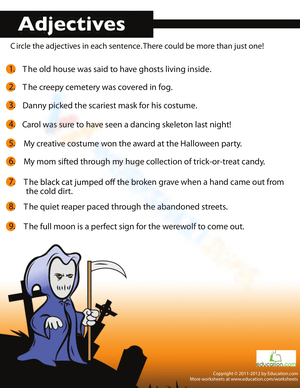
- Descriptive adjective identification — marking adjectives in context and labeling what question each one answers (which one? what kind? how many?)
- Proper adjectives — capitalizing adjectives derived from proper nouns, a skill that runs directly alongside capitalization conventions
- Demonstrative adjectives — distinguishing this, that, these, and those when they appear before a noun versus as standalone pronouns
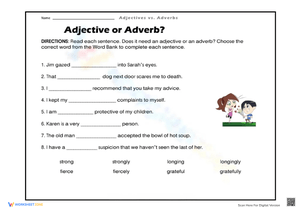
- Adjective vs. adverb contrast — rewriting sentences that use the wrong modifier, such as swapping quick for quickly
Mistakes Students Make That These Worksheets Help You Catch
The double comparative is the most persistent problem in this skill area. Students who know that good becomes better will still write more better when they want to add emphasis — the word more feels intensifying to them, not redundant. The same logic produces double superlatives: most tallest, most fastest. These aren't careless errors; they reflect a partially internalized rule applied too broadly. The worksheets that ask students to identify and correct these constructions inside full sentences are more useful here than isolated drill tables, because students need to encounter the error in running text before they can reliably catch it in their own writing.
Adjective ordering errors are subtler. Students usually write "a little old wooden house" correctly because they've heard the phrase. Put them in front of an unfamiliar combination — "a French antique round clock" — and they freeze or guess. The underlying sequence (opinion before size before age before shape before color before origin before material) is real, but asking a fourth grader to memorize eight ranked categories rarely transfers to new sentences. What does transfer: reading combinations aloud, noticing that one order sounds right and another sounds off, and working through enough sentence-level practice that the pattern becomes implicit. The reordering exercises in this set build that kind of knowledge more reliably than chart memorization.
One more error worth watching in actual student writing: proper adjectives lose their capital letters mid-paragraph. After whole-class instruction on Mexican food or Italian dressing, students capitalize correctly in isolation but drop the capital when the adjective appears inside a longer sentence they're composing. Worth keeping an eye on when you use adjectives pdf worksheets for 4th grade alongside a writing assignment and students move between the two tasks.
How to Build These Worksheets Into Your Lesson Plans
These work best when they follow direct instruction by a day or two rather than immediately at the end of the same lesson. The slight delay forces retrieval rather than simple repetition — students have to pull the rule back up instead of reciting it while it's still fresh. A Monday mini-lesson on comparative forms followed by an independent worksheet on Tuesday morning produces more durable learning than handing out the worksheet during the final ten minutes of the same block.
For writing workshop, the strongest application is revision. After students draft a descriptive paragraph, distribute the adjective-ordering worksheet as a reference, then send them back to their own drafts to audit every multi-adjective string they wrote. Students rarely catch ordering errors in their own work without a concrete anchor point — the worksheet gives them one. This shifts the exercise from isolated grammar drill to a genuine revision tool students can explain the purpose of.
Small group work benefits from requiring verbal justification. When two students disagree about whether "a big old red barn" or "an old big red barn" is correct, the discussion — not the answer key — is where the grammar learning actually happens. Adjectives pdf worksheets for 4th grade pair well with partner settings precisely because adjective order is intuitive enough that students can often identify which version sounds right before they can articulate a rule, and that gap between intuition and explanation is productive territory.
Standard Alignment
CCSS ELA-Literacy L.4.1d requires students to order adjectives within sentences according to conventional patterns. This is the central standard the set addresses. Most ordering and multi-adjective exercises map directly to this expectation, which surfaces in 4th-grade grammar checkpoints and in the editing tasks embedded in standardized writing prompts. It is one of the few grammar standards at this grade that calls for sequence knowledge rather than simple identification, which is why it warrants more class time and more varied practice than many teachers initially plan for.
CCSS ELA-Literacy L.4.1 more broadly covers conventions of standard English grammar and usage, including forming and using comparative and superlative adjectives — and specifically flagging irregular forms. The comparative and superlative worksheets address this expectation directly. Teachers tracking progress toward end-of-year L.4.1 benchmarks will find the set maps cleanly to the full standard cluster without requiring additional alignment work.
Adjusting the Set for a Range of Learners
Students still building basic adjective recognition need a different starting point than students who can identify adjectives but stumble on ordering. For the former group, choose worksheets that ask students to mark adjectives in sentences and note what question each one answers. That question-based framework — what kind? how many? which one? — gives students a functional test they can apply independently. Jumping to ordering exercises before this is solid produces frustration, not skill.
For students ready to push further, the comparative and superlative worksheets offer genuine challenge when the task requires sentence-level production rather than fill-in-the-blank. Ask those students to write original sentences using irregular forms in context — not just "write the superlative of bad," but "write a sentence comparing three options using worst correctly." The move from recognizing a form to generating it in an original sentence is where advanced 4th graders hit productive difficulty. You can also use adjectives pdf worksheets for 4th grade as editing checklists during peer review, giving stronger writers the meta-task of explaining their corrections to a partner rather than simply marking answers.
Frequently Asked Questions
What adjective skills does the CCSS expect 4th graders to control by year's end?
L.4.1d specifically targets adjective ordering — students should place multiple adjectives before a noun in the correct conventional sequence. The broader L.4.1 standard also covers comparative and superlative formation, including irregular forms like good/better/best and bad/worse/worst. By the end of fourth grade, errors like more better or most tallest should be recognizable and self-correctable during revision. The standard marks a shift from identification toward consistent application in student writing.
How do I teach adjective order without making students memorize an eight-category sequence?
The category sequence is a useful teacher reference, but rote memorization of it rarely transfers to new sentences. A more durable approach: have students read adjective strings aloud and identify which order sounds natural. Native English speakers internalize the conventional pattern through exposure long before they can name the categories. The reordering exercises in this set lean on that existing implicit knowledge — students work through enough examples that the pattern becomes reliable even when they can't explain the rule behind it.
Should I use these worksheets for grades or only for practice?
These function best as formative practice rather than summative grades — they show you where a student is in the learning process, not whether a standard has been fully met. Use them mid-unit to identify who needs reteaching before a formal grammar assessment. If a student consistently produces double comparatives on practice exercises, that's your signal to address the error directly before moving on. Reserve summative judgment for applied writing tasks, where adjective use appears in authentic context rather than prompted drill.
Can these worksheets be assigned as homework, or do students need in-class support first?
Most identification and comparative/superlative exercises work fine as independent homework once direct instruction has been delivered. The ordering exercises are trickier to send home before students have worked through at least one example in class, because the "which order sounds right" test is harder to apply without anyone to read the sentence to. A five-minute introduction — even just two or three worked examples on the board — makes the homework more productive and cuts down on the blank worksheets that come back the next morning.












 Interactive Worksheet Maker
 Quiz Maker
 Word Search Maker
 Crossword Puzzle Maker
 Word Scramble Generator
 Sentence Scramble Generator
 Handwriting Worksheet Generator
 Name Tracing Generator
 Fill In The Blank Generator