


























Views
Downloads


Ordering Adjectives Worksheet | Grade 4 Essential Practice
Paste this activity's link or code into your existing LMS (Google Classroom, Canvas, Teams, Schoology, Moodle, etc.).
Students can open and work on the activity right away, with no student login required.
You'll still be able to track student progress and results from your teacher account.
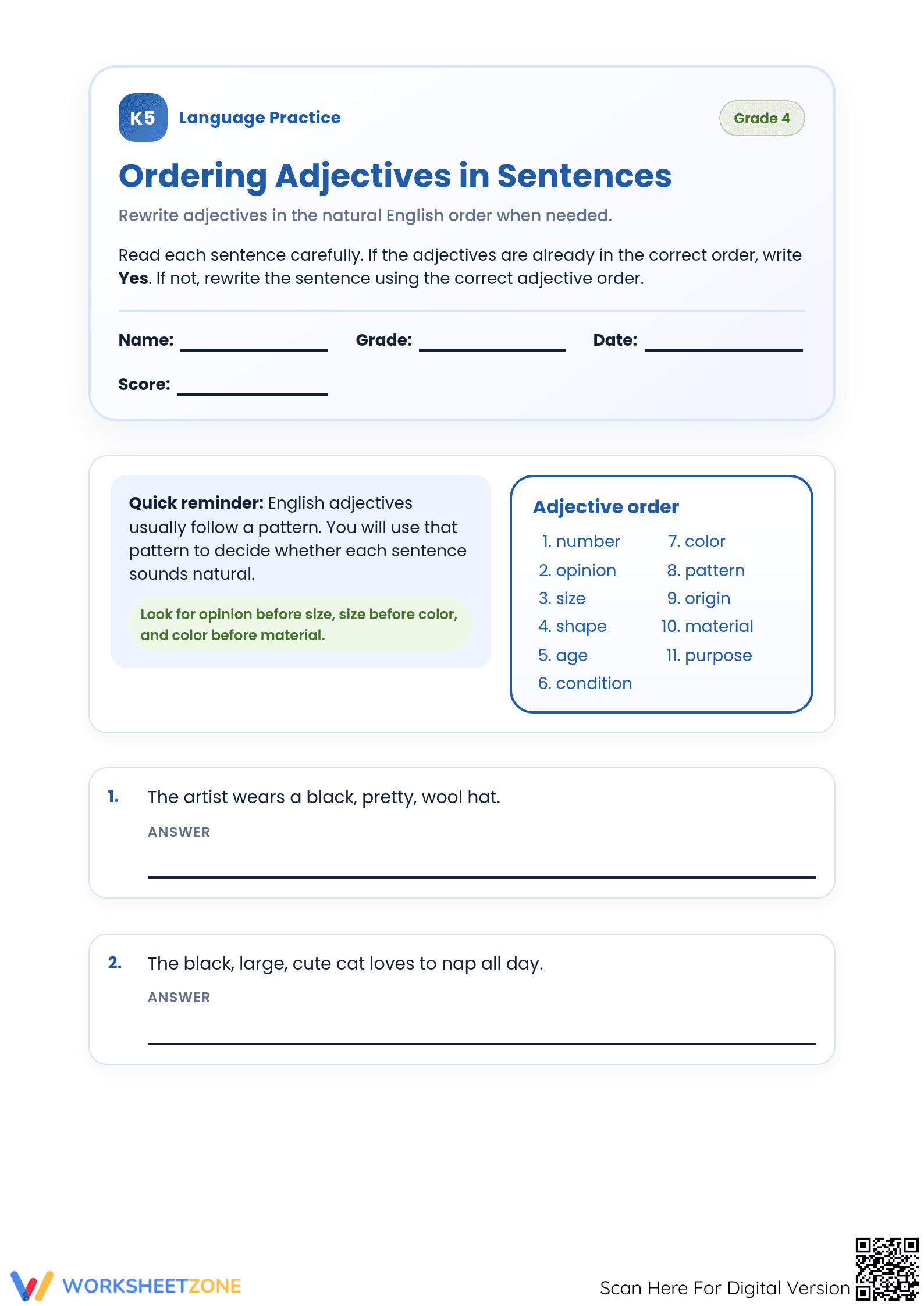
This Grade 4 ordering adjectives worksheet helps students master the conventional patterns of English syntax. By rearranging descriptive words into the natural order, learners improve sentence flow and grammatical precision. This resource provides immediate practice for identifying and correcting misplaced modifiers in complex sentences to ensure clear communication.
At a Glance
- Grade: 4 · Subject: ELA
- Standard:
CCSS.ELA-LITERACY.L.4.1.D— Order adjectives within sentences according to conventional patterns like size and color- Skill Focus: Adjective Sequencing
- Format: 3 pages · 10 problems · Answer key included · PDF
- Best For: Independent practice or homework reinforcement
- Time: 15–20 minutes
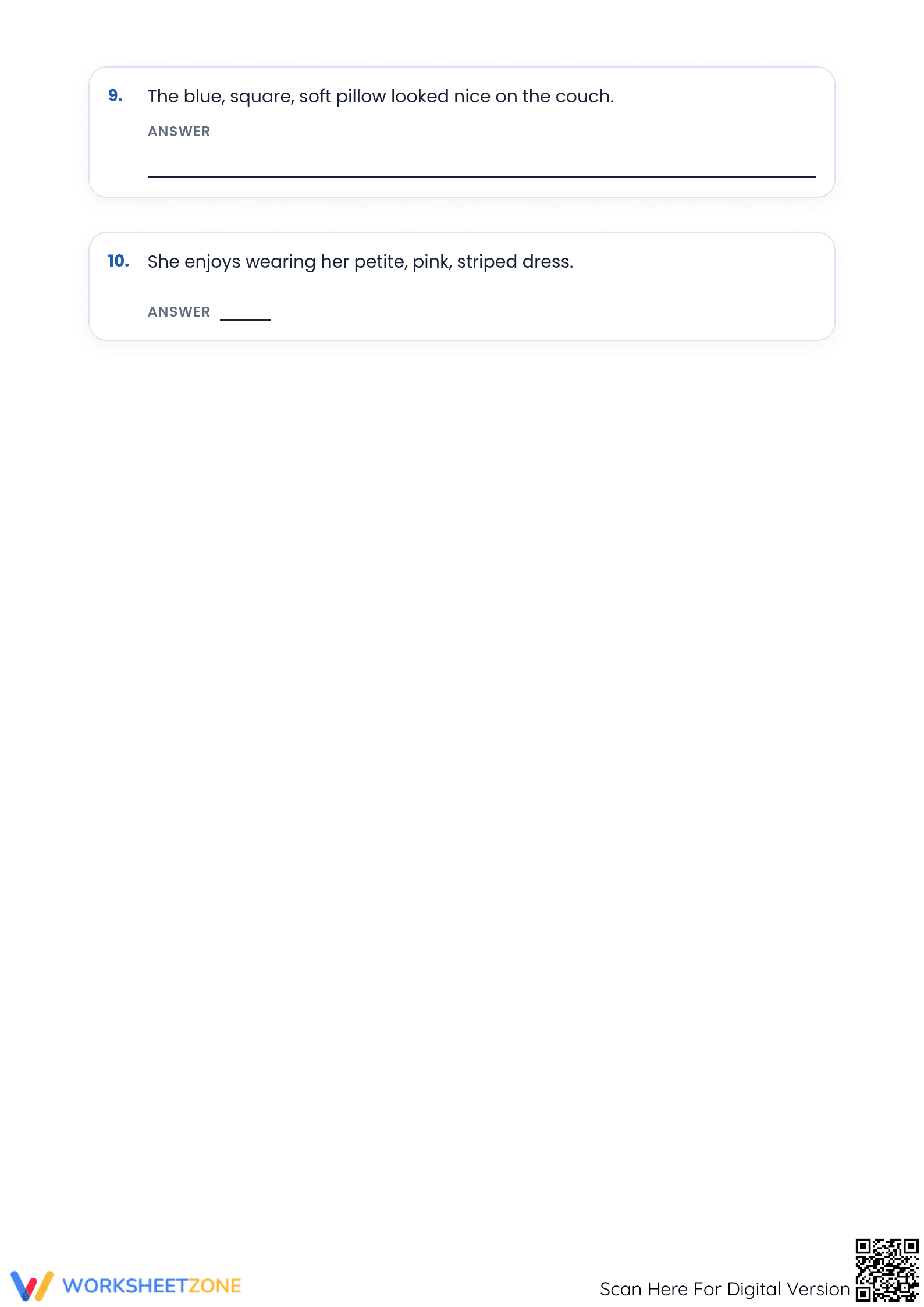
This 3-page PDF includes a comprehensive 11-point reference guide detailing the standard order of adjectives, ranging from number and opinion to material and purpose. It features 10 targeted sentence-rewrite exercises where students must evaluate the naturalness of a sentence and correct it if necessary. A full answer key is provided for quick grading and immediate feedback.
The zero-prep workflow is designed for busy educators. Simply print the three pages in under 1 minute, distribute them to students as a bell-ringer or independent center activity in 30 seconds, and use the included answer key for rapid review or peer-grading in under 1 minute. It is an ideal grab-and-go resource for substitute folders or last-minute lesson supplements.
The primary focus is CCSS.ELA-LITERACY.L.4.1.D, which requires students to order adjectives within sentences according to conventional patterns. This skill supports broader language standards regarding command of the conventions of standard English grammar and usage. Both standard codes can be copied directly into lesson plans, IEP goals, or district curriculum mapping tools.
Use this worksheet during the independent practice phase of a gradual release lesson on descriptive writing. It serves as an excellent formative assessment to check if students can apply the 11-point hierarchy without teacher prompts. Expect completion within 15 to 20 minutes, depending on whether students utilize the provided anchor chart for support during the task.
This resource is tailored for fourth-grade students but works well for fifth-grade review or ESL learners struggling with English syntax. It pairs naturally with a descriptive writing prompt or a mentor text analysis where students highlight adjectives in published works. The clear layout ensures accessibility for students requiring visual structure in their language tasks.
According to the RAND AIRS 2024 report, structured practice in syntactic conventions significantly improves the writing stamina and clarity of upper elementary students. This worksheet targets CCSS.ELA-LITERACY.L.4.1.D by providing a scaffolded reference chart alongside 10 high-utility practice items. By explicitly teaching the 11-category hierarchy of adjective sequencing—moving from subjective opinions to objective materials—students develop a more sophisticated ear for natural English phrasing. Research from Fisher & Frey (2014) emphasizes that providing students with clear organizational tools, such as the included adjective order list, reduces cognitive load during the drafting process. This allows learners to focus on word choice and sentence variety rather than struggling with basic word order. This resource ensures that Grade 4 students meet national benchmarks for language proficiency while building a foundation for complex middle-school composition.


