


























Views
Downloads
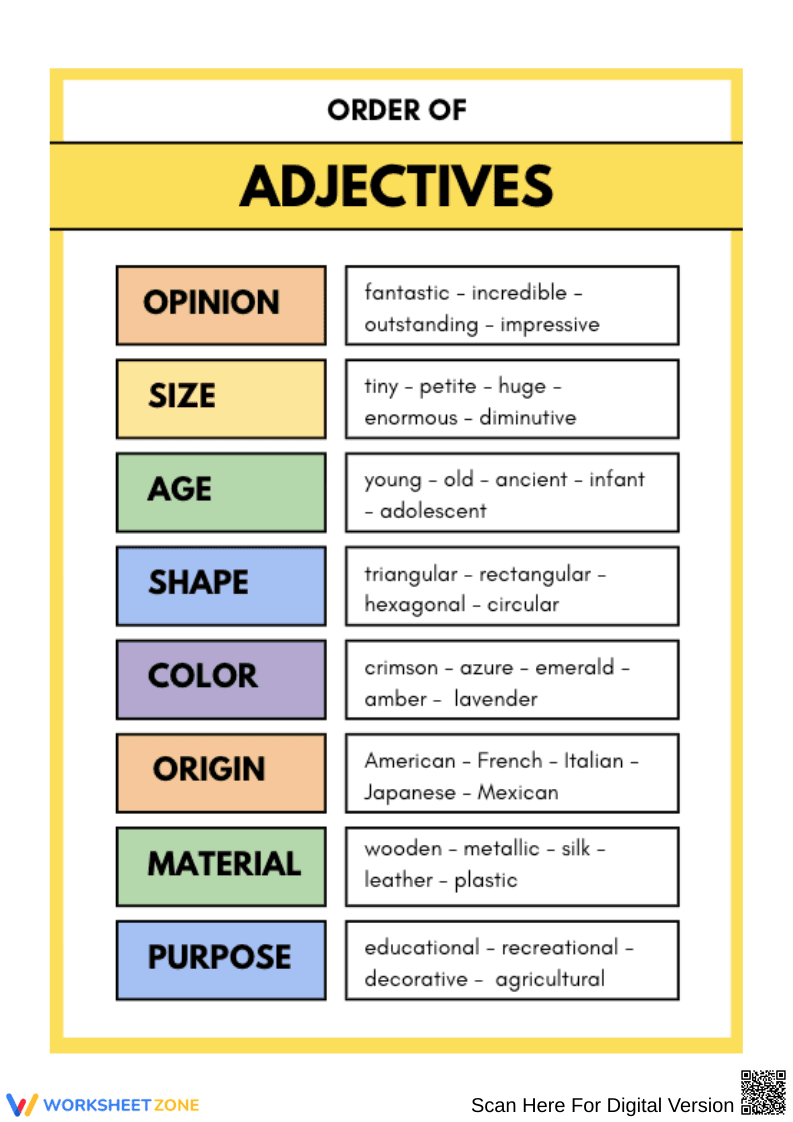

Grade 4 Order of Adjectives — Printable No-Prep Chart
Paste this activity's link or code into your existing LMS (Google Classroom, Canvas, Teams, Schoology, Moodle, etc.).
Students can open and work on the activity right away, with no student login required.
You'll still be able to track student progress and results from your teacher account.
This printable grammar reference chart helps third and fourth-grade students master the conventional order of adjectives in English sentences. By providing a clear, color-coded visual guide, the resource enables young writers to structure descriptive phrases with accuracy and precision, improving overall writing quality.
At a Glance
- Grade: 3-4 · Subject: ELA Grammar
- Standard:
CCSS.ELA-LITERACY.L.4.1.D— Order adjectives within sentences according to conventional patterns to write clearly- Skill Focus: Adjective sequencing order
- Format: 1 page · 8 categories · Reference chart · PDF
- Best For: Writing workshop anchor chart and student writing folders
- Time: 5–10 minutes of daily reference
This single-page reference sheet features a clean, color-coded layout detailing the eight distinct categories of adjective order: opinion, size, age, shape, color, origin, material, and purpose. Each category is paired with multiple clear examples, such as "crimson" and "lavender" for color, or "wooden" and "metallic" for material. The visual hierarchy helps students quickly determine which word comes first when using multiple modifiers in a single sentence.
Zero-Prep Workflow
This resource requires zero teacher preparation and integrates into your daily routine. First, print the single-page PDF document (1 minute). Second, distribute the sheet to students or display it on your classroom board (1 minute). Third, review the eight categories briefly during your mini-lesson (5 minutes). The total teacher preparation time is under 2 minutes, making this chart an ideal addition to emergency sub plans or independent writing folders.
Standards Alignment
This reference tool aligns directly with the Common Core State Standard `CCSS.ELA-LITERACY.L.4.1.D`, which requires students to order adjectives within sentences according to conventional patterns. Additionally, it supports the broader writing standard `CCSS.ELA-LITERACY.W.4.1.D` by helping students use precise language and domain-specific vocabulary to inform or explain. Both standard codes can be copied directly into lesson plans, IEP goals, or district curriculum mapping tools.
How to Use It
Use this chart during guided practice to support students as they draft descriptive paragraphs. Alternatively, laminate the page and place it in a writing center for independent reference. For formative assessment, observe students during writing time and note if they correctly sequence multiple adjectives, providing quick corrective feedback using the chart. Students typically reference this tool for 5 to 10 minutes.
Who It's For
This resource is designed for third and fourth-grade students learning to expand their descriptive writing capabilities. It serves as an excellent scaffold for English language learners and struggling writers who benefit from visual aids and concrete examples. Pair this reference chart with a descriptive writing passage or an anchor chart lesson on parts of speech to maximize student comprehension and application.
This grammar reference guide targets the conventional sequencing of modifiers, directly addressing the linguistic demands of `CCSS.ELA-LITERACY.L.4.1.D`. Research by Fisher & Frey (2014) on scaffolded instruction emphasizes that visual anchors and structured reference tools support cognitive offloading, allowing students to focus on complex composition tasks rather than rote memorization of grammatical rules. By categorizing adjectives into eight distinct, color-coded groups, this chart provides the necessary scaffolding for intermediate elementary students to internalize syntax patterns. Teachers can utilize this tool to bridge the gap between isolated grammar instruction and authentic writing applications, ensuring students develop the syntactic fluency required for upper-elementary writing tasks. The structured layout serves as a reliable scaffold during independent writing, promoting self-regulation and editing skills in diverse classrooms.


