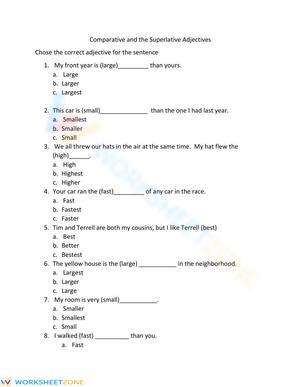
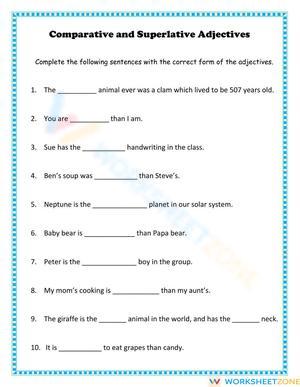
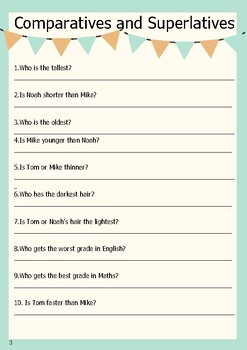
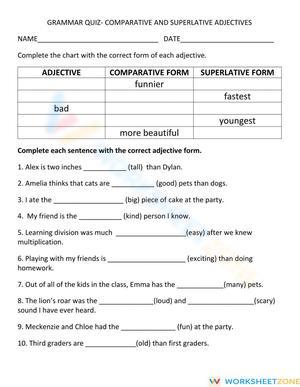
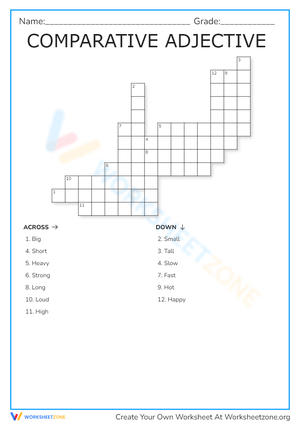
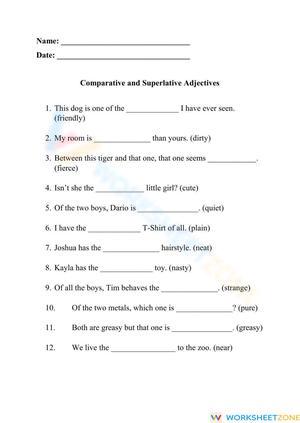
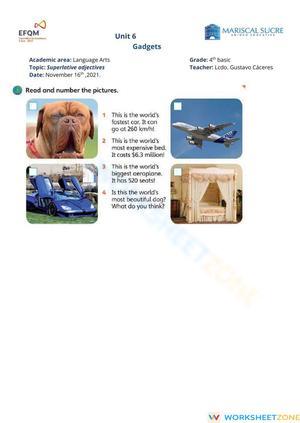
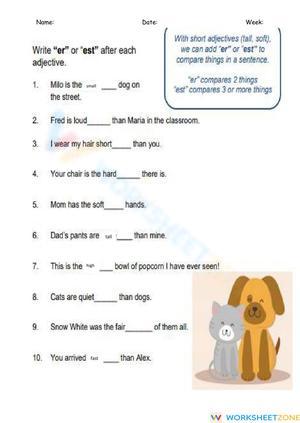
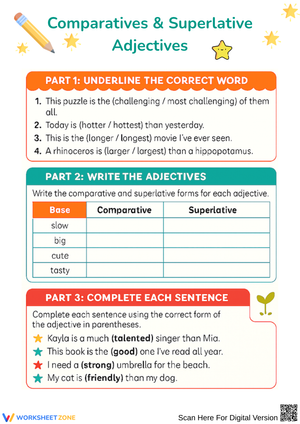
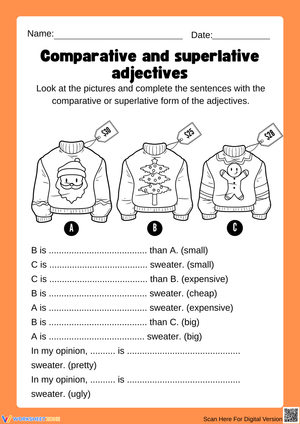
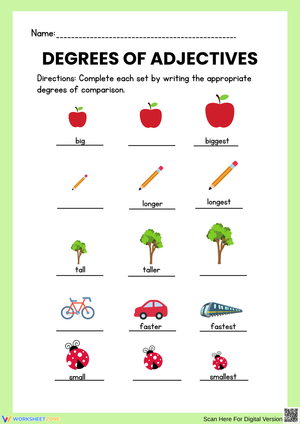
4th grade comparative and superlative adjectives printable worksheets give teachers a focused way to address one of the most rule-dense grammar topics at this level. Students at this stage usually have a solid sense of what an adjective does, but asking them to navigate between -er/-est suffixes, more/most constructions, and a handful of irregular forms that follow no predictable pattern — all at the same time — produces specific, correctable errors. This set targets those errors directly, exercise by exercise.
The Specific Skills Each Worksheet Builds
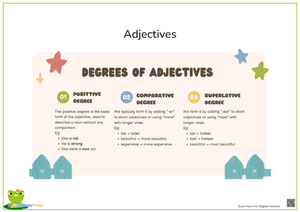
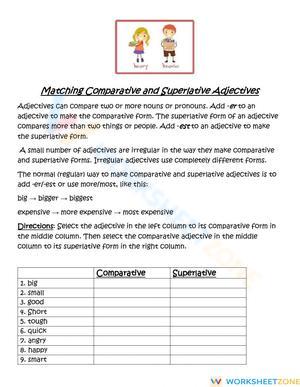
The major rule clusters are kept separate rather than combined in the early exercises. The rules for one-syllable adjectives — adding -er or -est, doubling the final consonant when the word ends in a consonant-vowel-consonant pattern — get isolated practice before students encounter the separate logic for two-syllable and longer words. That separation matters because students who meet both rule sets simultaneously tend to overapply whichever they picked up first, and it is almost always the suffix rule.
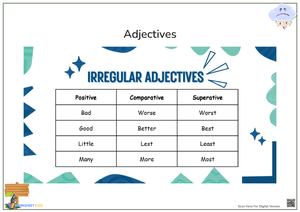
Across the worksheets, students underline adjectives in context sentences, rewrite sentences to switch between comparative and superlative forms, sort word cards into transformation categories, and proofread short passages for errors. Irregular forms — good / better / best, bad / worse / worst, far / farther / farthest — appear in their own dedicated exercises rather than mixed in alongside spelling-rule practice. That sequence keeps the cognitive load manageable while students are still building automaticity with the suffix and modifier rules.
Student Error Patterns Worth Catching Before They Stick
The double comparative is the most reliable error to watch for: students write "more taller" or "most happiest" because they have partially absorbed both rule sets without internalizing the constraint that an adjective takes exactly one comparison marker. These constructions rarely surface in isolated fill-in-the-blank practice — they appear later in writing workshop, when students are attending to content and grammar is running in the background. The proofreading exercises build the habit of noticing these redundant forms in context, not just recognizing them when directly tested.
A second pattern: students apply -er/-est to long adjectives by analogy and produce forms like "importantest" or "beautifuler." This happens more often in 4th grade than teachers expect, because students at this age are generalizing grammar rules aggressively. The sorting activities address this before students write anything — they have to place each adjective in the correct transformation category first, which forces the decision that silent rule memorization tends to skip.
The CVC doubling rule produces its own subset of errors in the opposite direction. Students who know to double the consonant in big → bigger sometimes overgeneralize and write "sweetter" or "cleanner," applying the rule to words where the vowel is already long. A quick warm-up question — asking students to identify whether the vowel sound is short or long before they transform the word — catches most of these before the written work begins.
Fitting These Worksheets Into Your Lesson Planning
The word-sorting worksheet works well as the anchor for the introductory lesson. Projecting it and working through the first column together — naming the rule out loud before writing the answer — builds the decision-making habit that carries into independent practice. Two or three days later, once students have tried writing comparative and superlative forms in their own sentences and have made some of the predictable mistakes, the proofreading worksheet becomes far more instructionally useful than it would have been on day one.
Several teachers build 4th grade comparative and superlative adjectives printable worksheets into their Monday morning routine after a weekend gap, using a short bell-ringer format — three or four sentences to correct — to reactivate last week's grammar rules before writing workshop begins. That eight-minute window, followed by a brief share-out where students read their corrected sentences aloud, functions as a low-stakes formative check without eating into the main instructional block. The proofreading exercises are particularly well-suited to this use because students can complete them independently while attendance is taken.
Standard Alignment
These 4th grade comparative and superlative adjectives printable worksheets address CCSS L.4.1.d, which requires students to form and use comparative and superlative adjectives and adverbs correctly, including irregular forms, when writing or speaking. This standard appears in Grade 4 — rather than Grade 3 — because the full scope of the skill depends on spelling fluency students are still developing at the earlier level. The CVC doubling rule and the y-to-i transformation both require students to analyze word structure before making changes, and that kind of phonological awareness is more reliably in place by mid-fourth grade. Basal grammar programs often give this standard a single lesson and move on, leaving the irregular forms and the more/most logic without the repetition needed for transfer to writing. These worksheets fill that gap.
Adjusting the Set for Different Levels of Students
Students who are still uncertain about basic adjective identification benefit from starting with the sentence-underlining exercises, where finding the adjective is the whole task before any transformation is required. A printed reference card listing the three main transformation types — suffix, more/most, irregular — kept beside the worksheet as a reference reduces working-memory pressure while the rules are still new.
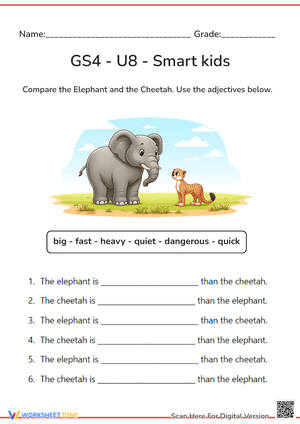
Students who move through the core exercises quickly can work with the cross-curricular comparison prompts involving animals, landforms, or planetary data, which require generating adjectives rather than transforming ones already provided. That shift — from applying a rule to a given word to choosing the right word and then applying the rule — is a meaningfully harder task. Asking these students to write two original sentences using an adjective that appears nowhere in the worksheet extends the work without creating a separate assignment. The 4th grade comparative and superlative adjectives printable worksheets in this set include enough format variety that differentiation often means choosing which worksheet a student works on rather than heavily modifying any single one.
Frequently Asked Questions
When do I use "more" instead of adding -er to an adjective?
The syllable count of the adjective determines the form. For adjectives with three or more syllables — "interesting," "beautiful," "difficult" — students always use more for the comparative and most for the superlative. Many two-syllable adjectives that do not end in -y follow the same pattern. The -er and -est suffixes are reserved for one-syllable adjectives and two-syllable adjectives ending in -y. Adding -er to a longer word is never correct in standard usage, and students need to hear that stated plainly rather than hedged.
How do I teach the CVC doubling rule without students over-applying it?
The most direct approach is to make vowel sound identification an explicit step before any transformation happens. Before a student changes "hot" to "hotter," ask: is the vowel sound short or long? Short vowel in a CVC word — double the consonant. Long vowel — do not double. Students who skip that step and pattern-match from big → bigger will write "sweetter" for "sweet." Building the identification question into a consistent routine prevents most of those errors before they become habits.
How can I explain the difference between comparative and superlative to students who keep confusing them?
A concrete physical demonstration works reliably here. Place two pencils on a desk and say: we are comparing these two — comparative form. Add a third, then a fourth. Now we have a group, and we are picking out the one at the extreme end — superlative. The key is connecting the grammatical label to a visible, countable situation before students apply the rule to sentences. Students who mix up the forms in writing usually understand the concept once they try it with objects in hand; the issue is that they have not connected the written form to the underlying logic.
Which irregular adjectives should 4th graders actually memorize?
Start with the two that appear most often in student writing: good (better / best) and bad (worse / worst). Students who internalize those four words eliminate the majority of irregular-adjective errors teachers see at this level. Introduce far (farther / farthest) once the first two pairs are solid. Trying to memorize all irregular forms at once tends to push students into guessing rather than recalling, so the sequence matters — introduce fewer forms and give them time to stick before adding more.












 Interactive Worksheet Maker
 Quiz Maker
 Word Search Maker
 Crossword Puzzle Maker
 Word Scramble Generator
 Sentence Scramble Generator
 Handwriting Worksheet Generator
 Name Tracing Generator
 Fill In The Blank Generator




 BACK TOSCHOOL