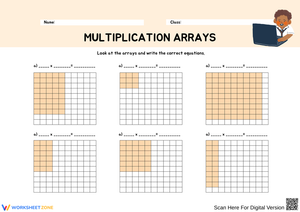
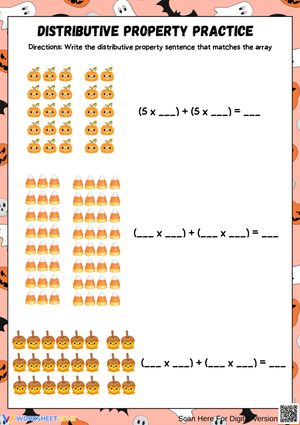
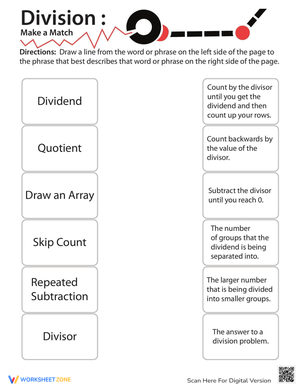
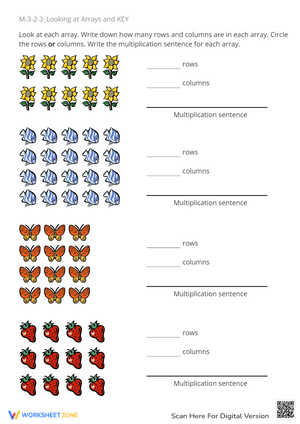
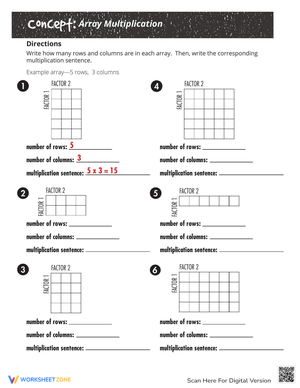
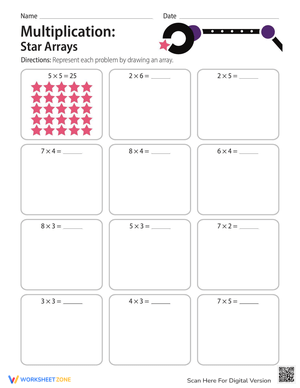
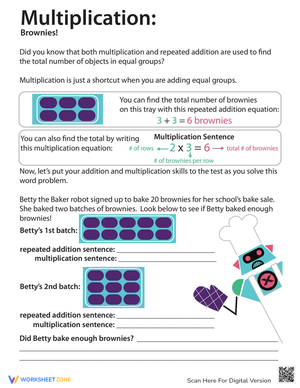
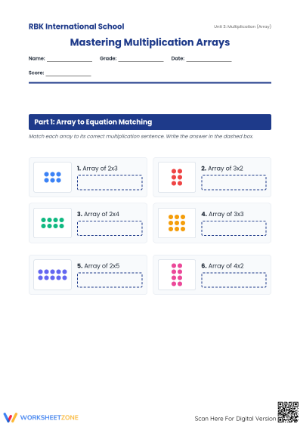
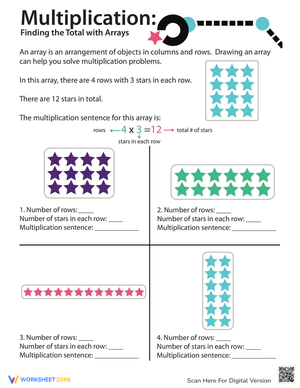
These multiplication arrays printable worksheets for 3rd grade give teachers a concrete visual model at the moment students need it most — when repeated addition has become familiar but multiplication notation is still new. Each worksheet asks students to draw, label, count, and write, so the connection between an array's structure and its equation gets reinforced multiple times within a single task.
Skills These Worksheets Build
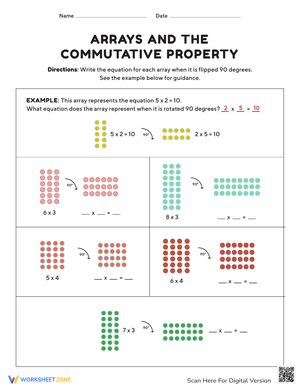
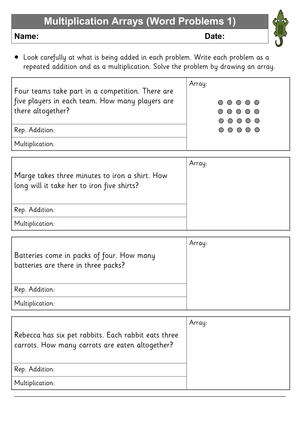
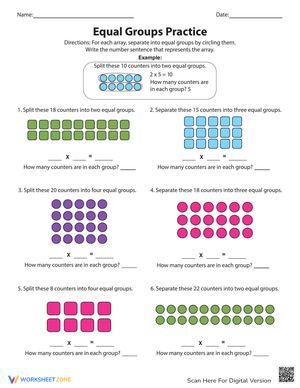
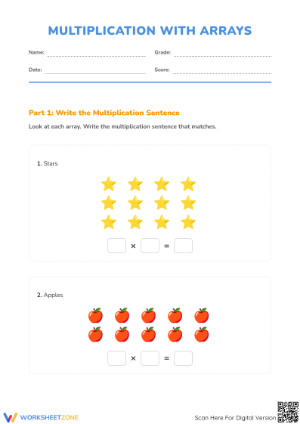
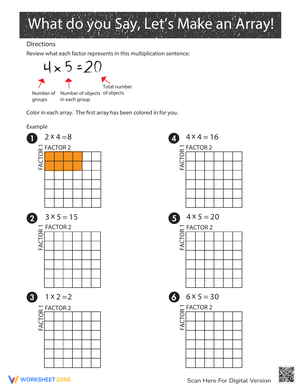
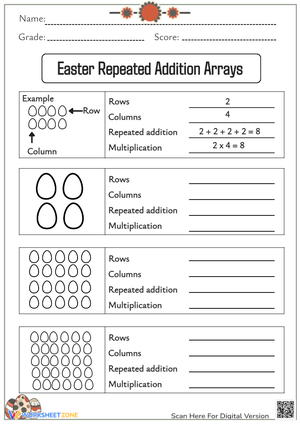
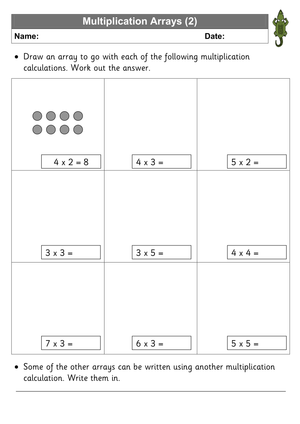
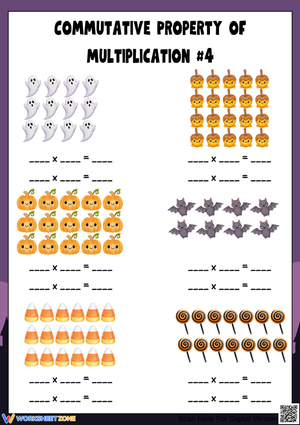
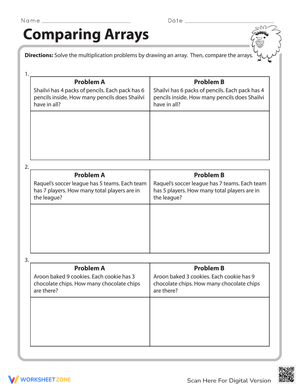
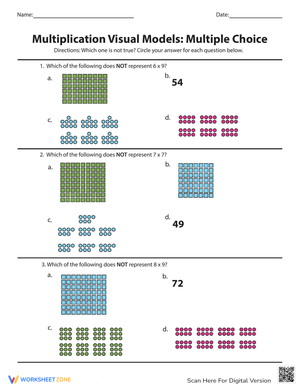
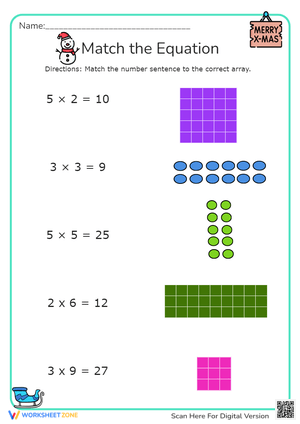
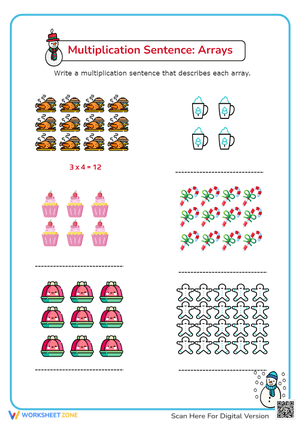
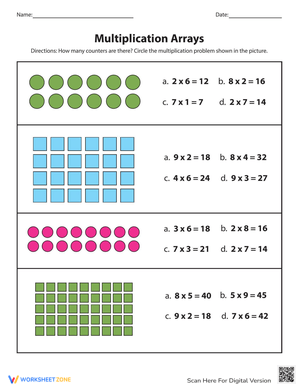
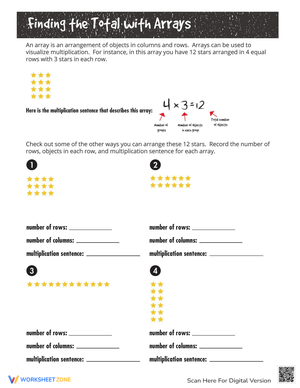
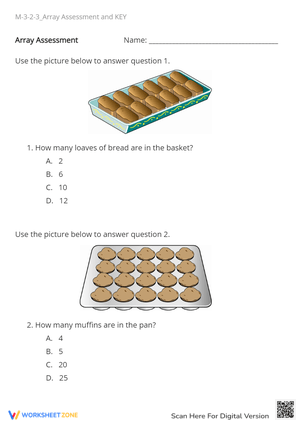
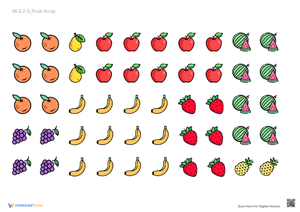
The set moves through array concepts in a deliberate order. Early worksheets show pre-drawn arrays — rows of dots or shaded squares — and students write both the multiplication equation and the corresponding repeated addition sentence. Later worksheets reverse the direction: students receive a fact like 4 × 6 and draw the array themselves. A dedicated section addresses the commutative property directly, presenting two arrays side by side (a 3-row, 5-column arrangement next to a 5-row, 3-column one) so students can see that the product doesn't change when the factors switch positions. The final tasks tie arrays to short word problems — arranging chairs in rows, planting seeds in a garden grid — so students practice translating a real situation into a multiplication model.
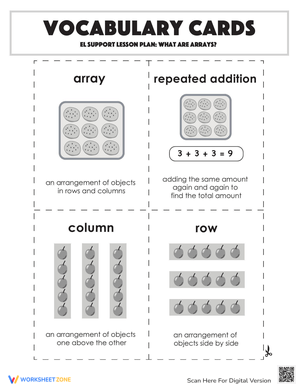
- Identifying and labeling rows and columns in pre-drawn arrays
- Writing multiplication equations and repeated addition sentences from a given array
- Drawing arrays to match a given multiplication fact
- Comparing commutative pairs using side-by-side arrays
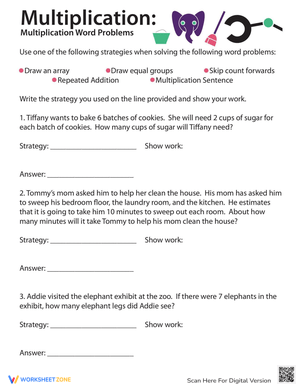
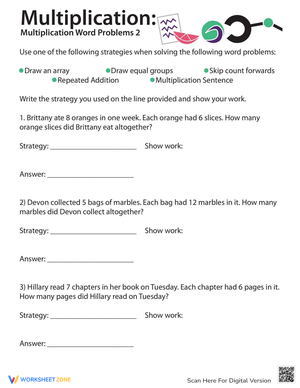
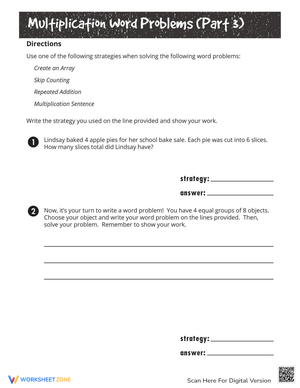
- Applying the array model to word problem contexts
- Finding all possible array arrangements for a single product
Error Patterns That Surface in Every Array Unit
The rows-versus-columns mix-up appears in nearly every class at the start of this unit. A student may look at a 3-row, 5-column array and label it as 5 rows and 3 columns. The product works out either way — that's the commutative property doing its work — but the error signals a fragile mental model of what each factor actually represents. This becomes a real problem later, when students work with area or division and factor placement carries meaning. The labeling tasks on these worksheets make this confusion visible early, which is exactly when it's easiest to fix.
The more telling error shows up in repeated addition. Given a 4 × 3 array, many students write 4 + 4 + 4 instead of 3 + 3 + 3 + 3. They read the first factor as the addend rather than as the number of groups. In student work this looks like a minor slip, but it reveals that the student doesn't yet understand what the first factor in a multiplication sentence tells you. A classroom fix that works: ask the student to trace one row with their finger and count the dots in it — that count becomes the addend, and the number of rows they traced tells them how many times to write it. It takes thirty seconds and resets the mental model.
Fitting These Worksheets Into Your Lesson Planning
Start the unit with physical materials before the worksheets come out. Have students build arrays using square tiles or unit cubes at their desks, label them on a sticky note, and talk about what the rows and columns represent. A ten-to-twelve minute session like this creates a reference point students can return to mentally when the paper tasks feel abstract. Once the tile work is done, the pre-drawn array worksheets feel like a natural next step — students are mapping what their hands already did onto a printed grid.
Print multiplication arrays printable worksheets for 3rd grade on cardstock and laminate a class set for your centers rotation. Students write equations with dry-erase markers, erase, and reuse the same worksheet across several days. Pairing students works well here: one partner draws an array in the blank grid space, the other writes the equation — then they switch. That back-and-forth turns what could be solitary seatwork into a brief math conversation, and students catch each other's rows-versus-columns errors before the teacher sees them.
The open-ended "find every array for this product" worksheets are strongest as a Friday challenge or an early-finisher task. Give students the number 24 and ask how many distinct arrays they can find. Students who finish quickly discover six — and that search quietly introduces factor thinking before the vocabulary arrives in 4th grade.
Adapting the Set for a Range of Learners
Students who struggle with spatial organization do better when the drawing task is removed entirely. Use worksheets where the array is pre-drawn and the only job is to count rows and columns and write the equation. Printing those worksheets on graph paper adds another layer of support — the squares are already defined, so students color groups rather than count scattered dots. The instructional goal for these students is a stable understanding of the rows-and-columns structure; the drawing tasks can come once that foundation is in place.
For students who have the basic equation-writing down, the multiplication arrays printable worksheets for 3rd grade that ask them to find every possible array for a given product require genuine factor thinking. Working through all the rectangular arrangements of 12 — one row of 12, two rows of six, three rows of four, and their commutative pairs — is genuinely challenging at this level. Students who complete these tasks enter 4th-grade factor-pair lessons with a visual memory that anchors the abstract vocabulary when it finally arrives.
Standard Alignment
3.OA.A.1 — Interpret products of whole numbers, such as interpreting 5 × 7 as the total number of objects in 5 groups of 7 objects each. Arrays are the primary visual model for this standard, and the worksheets address its interpretive requirement directly: students aren't only computing a product, they're explaining what each factor means within the equation. Grade 3 is the first year this interpretive work is formally expected — before this, students use repeated addition, but the standard shifts the expectation toward understanding multiplication as its own operation. The labeling and equation-writing tasks in this set carry more instructional weight than they appear to on the surface precisely because of that developmental shift.
Frequently Asked Questions
What is a multiplication array, and why does Grade 3 use it as a model?
An array is an arrangement of objects or squares in equal rows and columns. Grade 3 uses it because students are forming their first understanding of multiplication — and an array makes the structure of a multiplication equation visible. Students can count the same set of squares by rows, by columns, or as a total, which gives them three entry points into the same fact. That flexibility matters most in the year when multiplication is brand new and students need more than one way into a problem.
How do the worksheets address the commutative property?
Several worksheets present two arrays side by side — 3 rows of 5 next to 5 rows of 3 — and ask students to write both equations and compare the products. Seeing that the total doesn't change when the factors switch is more convincing than being told it doesn't. Students who complete these tasks tend to remember the commutative property because they observed it; it's no longer a rule someone handed them.
Can these worksheets serve as a formative assessment?
Yes. The labeling and equation-writing tasks tell you exactly where each student is. A student who gets the product right but reverses the row and column labels has a different gap than one who writes the wrong repeated addition sentence entirely. Collecting a few completed multiplication arrays printable worksheets for 3rd grade after a lesson gives you a clear picture of who is ready for drawing tasks, who needs another session with pre-drawn arrays, and who is ready for the commutative comparisons — without needing a separate quiz.













 Interactive Worksheet Maker
 Quiz Maker
 Word Search Maker
 Crossword Puzzle Maker
 Word Scramble Generator
 Sentence Scramble Generator
 Handwriting Worksheet Generator
 Name Tracing Generator
 Fill In The Blank Generator