




























Views
Downloads




Printable Multiplication with Arrays Worksheet | Grade 3

Paste this activity's link or code into your existing LMS (Google Classroom, Canvas, Teams, Schoology, Moodle, etc.).
Students can open and work on the activity right away, with no student login required.
You'll still be able to track student progress and results from your teacher account.
This essential multiplication with arrays worksheet helps students visualize the concept of repeated addition through structured visual representations. By translating groups of objects into formal math sentences, learners build a concrete foundation for multiplication mastery. This printable resource ensures students move beyond rote memorization to truly understand the spatial relationship between factors and products.
At a Glance
- Grade: 3 · Subject: Math
- Standard:
CCSS.MATH.CONTENT.3.OA.A.1— Interpret products of whole numbers as the total objects in equal groups or arrays- Skill Focus: Visual Multiplication with Arrays
- Format: 5 pages · 12 problems · Answer key included · PDF
- Best For: Initial multiplication instruction and spatial math practice
- Time: 25–35 minutes
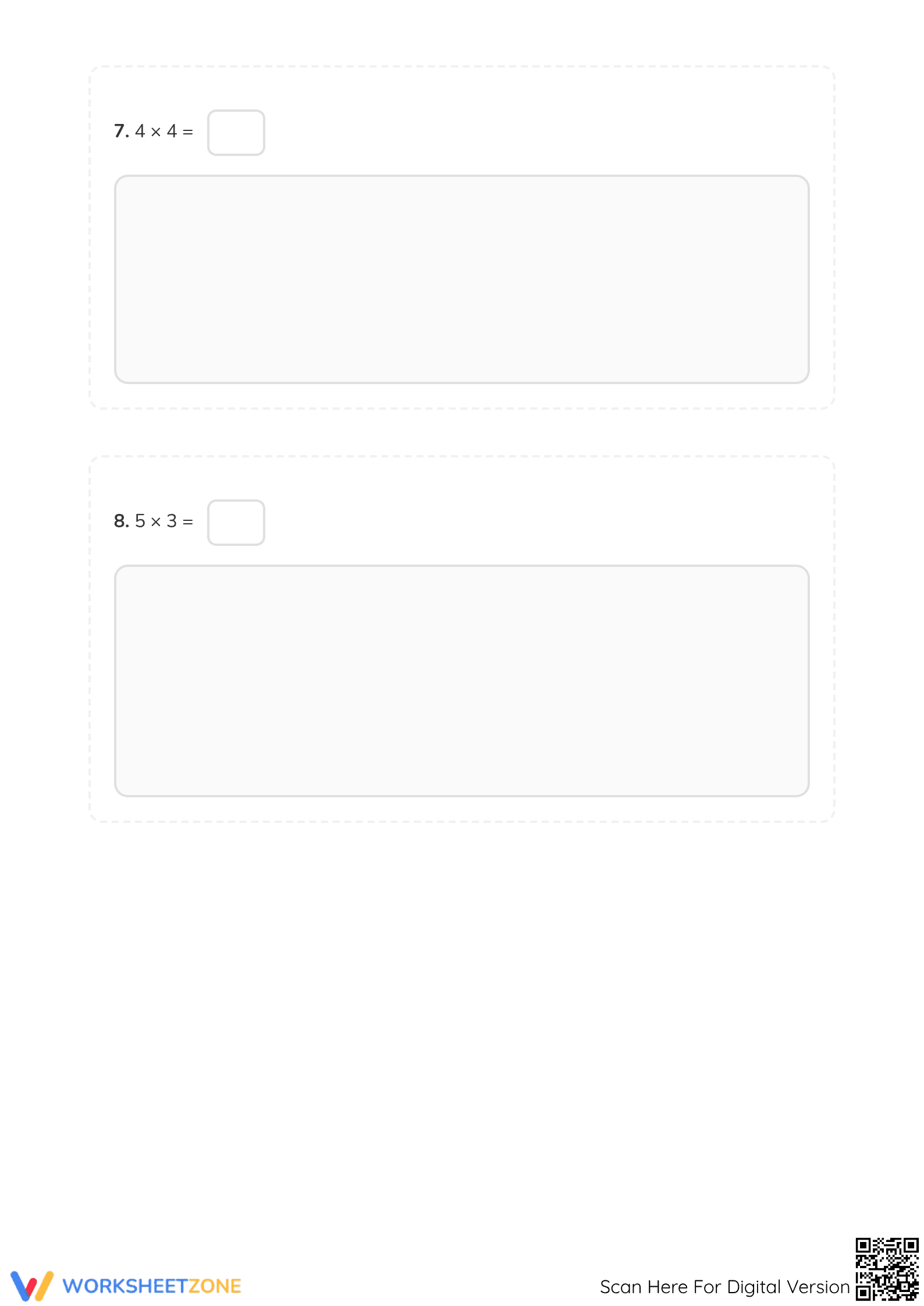
This comprehensive 5-page packet features twelve targeted problems organized into three distinct parts. Students begin with identification tasks using familiar icons like stars and apples, progress to drawing their own arrays within designated workspace boxes, and conclude with real-world word problems. The set includes a full answer key, providing immediate feedback for independent learners or quick grading for busy educators.
Skill Progression
- Guided Identification: Students analyze 4 pre-drawn arrays (stars, apples, sunflowers, and soccer balls), filling in the factor boxes to construct the matching multiplication equation.
- Supported Construction: The second phase requires students to draw their own arrays based on given equations like 2x4 and 3x5, bridging the gap between abstract numbers and visual models.
- Independent Application: The final four word problems challenge students to read a scenario, determine the array structure, and solve for the total product without visual cues.
This sequence follows the gradual-release model, moving from observation to creation and finally to abstract problem-solving.
Standards Alignment
The primary focus is CCSS.MATH.CONTENT.3.OA.A.1, which requires students to interpret products of whole numbers. Additionally, the word problem section supports CCSS.MATH.CONTENT.3.OA.A.3 by asking students to use multiplication within 100 to solve situations involving equal groups or arrays. Both standard codes can be copied directly into lesson plans, IEP goals, or district curriculum mapping tools.
How to Use It
Use this during the "We Do" phase of direct instruction to model how rows and columns correspond to factors. Alternatively, assign it as a post-instruction formative assessment to observe how students handle the transition from drawing to word problems. Teachers should watch for students who confuse rows and columns, providing immediate correction during the drawing phase. Expect completion in about 30 minutes.
Who It's For
This resource is ideal for Grade 3 students beginning their multiplication journey or Grade 4 learners requiring a visual refresher. It serves as an excellent companion to a "Multiplication as Groups" anchor chart or a hands-on lesson using physical manipulatives like counters or tiles.
Grounded in research from EdReports 2024, visual modeling through arrays is a high-leverage strategy for building the conceptual understanding required by CCSS.MATH.CONTENT.3.OA.A.1. The ability to spatially organize objects into rows and columns allows students to transition from simple counting to multiplicative thinking. By requiring students to draw their own models, this worksheet aligns with the "Concrete-Representational-Abstract" sequence advocated by Fisher & Frey (2014), which has been shown to reduce cognitive load during initial skill acquisition. Systematic practice with twelve diverse tasks ensures that learners internalize the relationship between factors and products. This standards-aligned approach provides the necessary scaffolding for third-grade students to master basic multiplication facts before moving toward multi-digit operations. Educational data suggests that students who master array-based visualization are significantly more likely to succeed in later geometry and area-based units.


