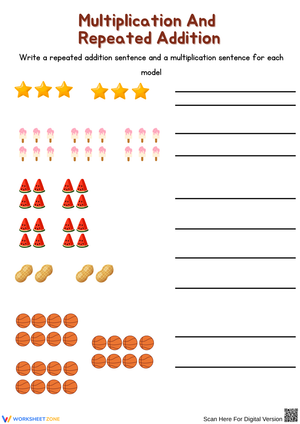
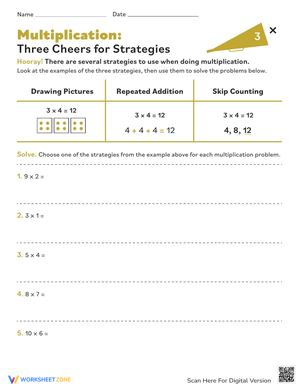
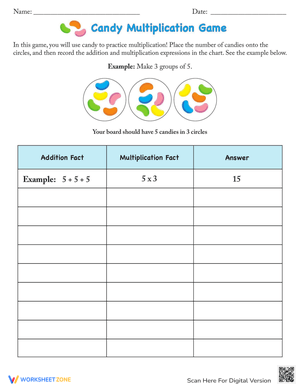
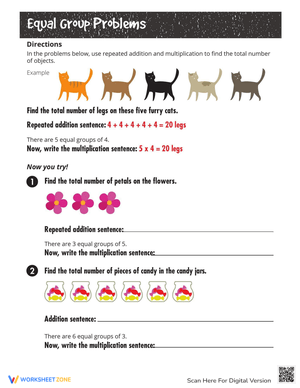
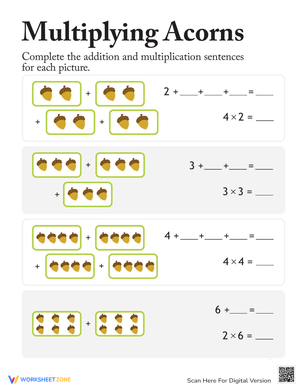
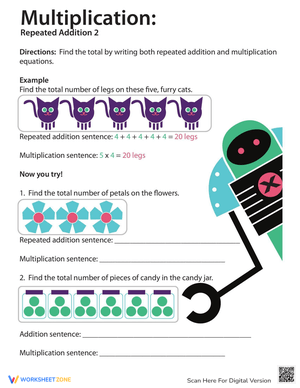
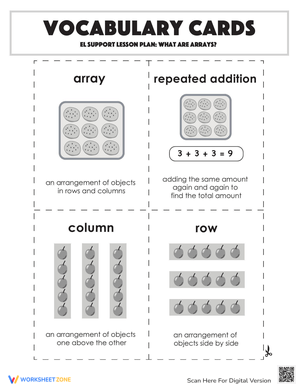
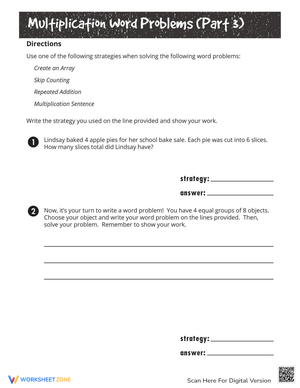
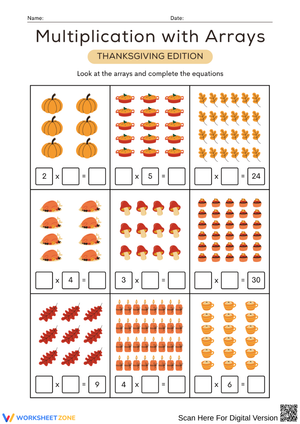
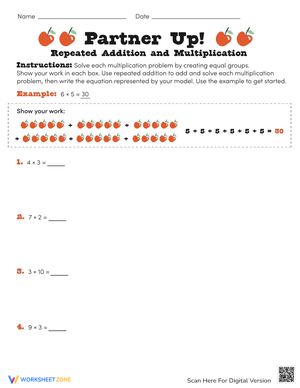
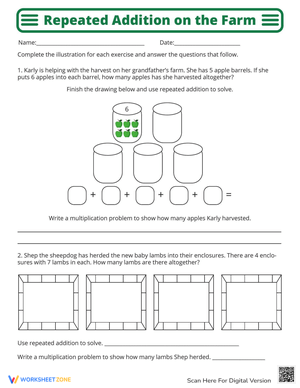
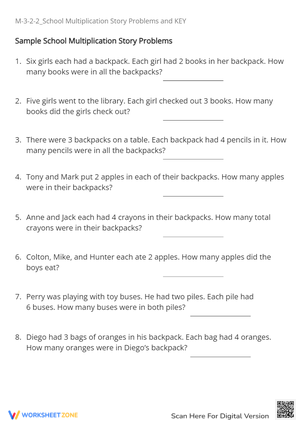
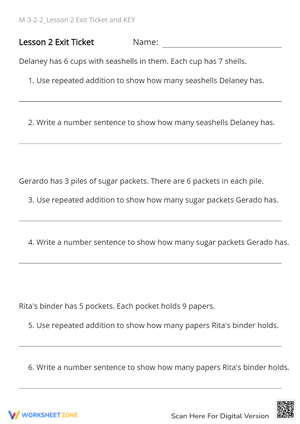
These multiplication repeated addition printable worksheets for 3rd grade give teachers a direct, concrete entry point into one of the most consequential conceptual shifts in elementary math — moving from counting individual objects to reasoning in equal groups. The set translates that shift into structured practice: students write repeated addition sentences, draw equal groups, compose multiplication equations, and develop fluency moving between all three representations.
The Specific Skills Targeted
Each worksheet focuses on a distinct facet of the additive-to-multiplicative transition rather than piling every skill into a single undifferentiated task. Across the set, students work on:
- Reading a visual of equal groups and writing the corresponding addition sentence, then the multiplication equation
- Starting from a repeated addition sentence and translating it into multiplication notation
- Marking equal jumps on a number line to show that each jump represents one group
- Working in both directions — from the equation to the drawing, and from the drawing back to the equation
- Distinguishing the number of groups from the size of each group, a distinction that collapses under pressure for many third graders
That last item carries more instructional weight than it first appears. Third graders enter this unit having spent two years adding and subtracting individual units. Asking them to suddenly see "three groups of four" rather than "twelve things" requires a genuine reorganization of how they look at a quantity. The labeling routine built into these worksheets — identify the group count, identify the group size, then write the equation — slows that process down deliberately, which is exactly what this concept needs at this stage.
Common Errors Worth Watching For and Addressing
The factor-order error is the one that catches teachers off guard. A student working from the repeated addition sentence 4 + 4 + 4 will almost always write 4 × 3 rather than 3 × 4. They read the addend first — the number already printed on the worksheet — and place it first in the equation. The number of groups (three) goes second because it has to be counted, not read. This isn't carelessness; it's a predictable consequence of how a printed sentence is processed left to right. Catching this early matters because the mental model of "first factor equals number of groups" becomes structurally important once students reach division and need to interpret the dividend, divisor, and quotient in relation to a real-world context.
A second pattern shows up when students draw equal groups from a given multiplication equation. Presented with 2 × 6, a surprising number of students draw six circles with two items each rather than two circles with six items each — they see the 6 and draw six circles. Both versions produce the correct product, but only one reflects the equation as written. The distinction becomes meaningful when groups represent something real: in a word problem about trays of muffins, whether "2" means trays or muffins per tray changes the interpretation of every number in the problem.
How to Fit These Worksheets Into Your Lesson Sequence
The most effective placement within the introductory unit is right after a concrete manipulative lesson, not before it. Students who build three groups of four with counters and then immediately sit down to translate that physical experience onto a worksheet retain the concrete-to-representational connection. Wait a day and that link weakens noticeably. One practical routine: build the groups together as a class, record the addition sentence on the board, then send students to their seats to replicate and extend that process independently.
For small-group rotations, these worksheets hold up well at the independent station because the task structure is clear enough that students don't stall waiting for direction. While pulling a guided group to work on number line jumps, the rest of the class works through equal-groups drawings without needing ongoing prompting. The worksheets also earn their place as Monday morning review in the weeks after the multiplication unit has formally closed — five minutes of repeated addition keeps the conceptual model active before students shift into fact fluency practice later in the day.
One classroom addition worth building into any lesson using these worksheets: ask students to color-code before writing any equation. Circle the number of groups in one color, underline the group size in another, then write the equation. Students who skip straight to the equation are far more likely to produce the factor-order error described above. The color-coding step adds less than two minutes to the task and removes a consistent source of mistakes.
Standard Alignment
CCSS.MATH.CONTENT.3.OA.A.1 asks students to interpret products of whole numbers — specifically, to understand m × n as the total number of objects in m groups of n objects each. Every worksheet in this set addresses that standard directly. In classroom terms, the standard positions multiplication not as a new operation to memorize but as a more efficient description of a grouping action students can already perform. Teachers who hit this standard well spend the first week entirely on equal groups and repeated addition before introducing the multiplication symbol — and that sequence is exactly what this set supports.
Adapting These Worksheets Across Student Readiness Levels
Students who need more support work best with worksheets where the equal groups are already drawn; their task is writing the addition sentence and equation without producing the visual from scratch. For students who freeze when given an unfamiliar arrangement, offering a partially completed addition sentence — __ + __ + __ = __ — reduces the number of active decisions without removing the mathematical thinking.
Students moving quickly through the material — or who have already picked up some multiplication facts — should be required to work in the harder direction: given a multiplication equation, draw the groups and write the addition sentence. Requiring those students to show the additive form even when they already know the product builds the conceptual grounding that supports the distributive property and derived-fact strategies later in the year. For this group, choosing multiplication repeated addition printable worksheets for 3rd grade that include both the drawing-to-equation and equation-to-drawing directions within the same set lets teachers assign different starting points without needing entirely separate materials.
Frequently Asked Questions
When should students stop writing the addition sentence and just use multiplication notation?
Watch for two indicators: the student writes the addition sentence automatically without drawing each item, and they consistently place the correct factor first — groups, then group size. Once both are reliable, the addition sentence shifts from a required step to optional support. Most students reach that point two to three weeks into a focused multiplication unit, though some benefit from keeping the addition form available through the end of the unit and into early division work.
Do these worksheets address the commutative property?
Not directly — and that's intentional. The commutative property (3 × 4 = 4 × 3) is a meaningful discovery students should reach after they understand what each factor represents. Introducing commutativity while students are still sorting out groups versus group size adds another layer before the foundation is stable. Once students write equations fluently from equal-group drawings, you can use multiplication repeated addition printable worksheets for 3rd grade that present the same quantity in two arrangements — 3 groups of 4, then 4 groups of 3 — and ask students whether the totals match. That comparison becomes a natural, grounded entry point for the commutative property rather than a rule handed down from above.
Can these worksheets be used with students who have already memorized some facts?
Yes — but require them to show the full work. Students who know that 5 × 3 = 15 by recall will skip the addition step if given the option. The goal of this set isn't fact retrieval; it's conceptual grounding. A student who recites the correct product but draws the wrong number of groups has a gap worth finding. These worksheets surface those gaps in a low-stakes setting, which is exactly when they should be found — not on a unit assessment.
Are the worksheets accessible for students still building single-digit addition fluency?
The multiplication repeated addition printable worksheets for 3rd grade that use groups of 2, 5, and 10 are accessible to students who are still developing addition fluency — those number patterns overlap with skip counting, which most third graders already know. Worksheets featuring groups of 7, 8, or 9 require stronger addition fluency and often frustrate students for whom the arithmetic itself is still effortful. Start with the lower-factor worksheets and watch carefully whether the addition is becoming the bottleneck rather than the multiplication concept — if it is, that's a signal to address the fluency gap directly before pushing further into the multiplication work.













 Interactive Worksheet Maker
 Quiz Maker
 Word Search Maker
 Crossword Puzzle Maker
 Word Scramble Generator
 Sentence Scramble Generator
 Handwriting Worksheet Generator
 Name Tracing Generator
 Fill In The Blank Generator