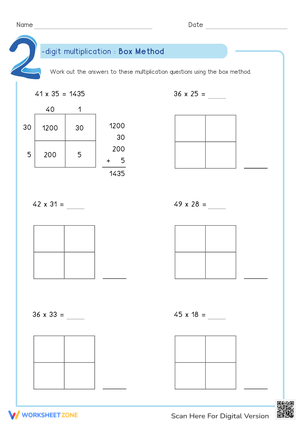
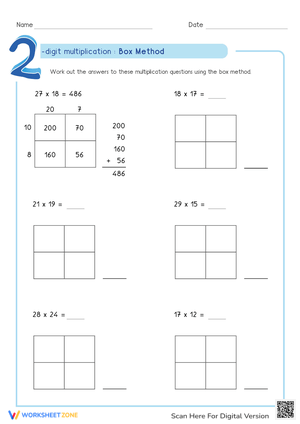
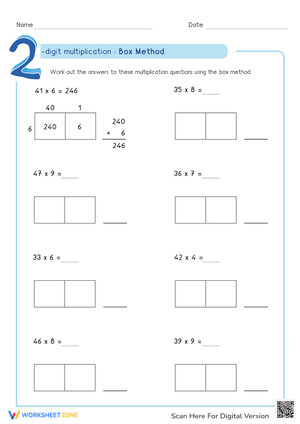
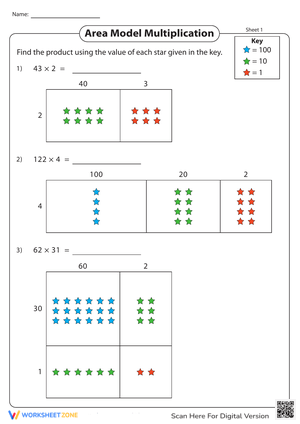
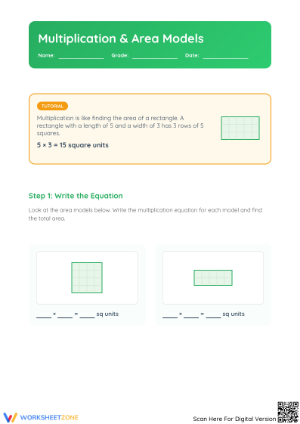
These 3rd grade area models worksheets give students the rectangle-based framework they need to understand why multiplication works — not just which facts to recall — and they give teachers a visible record of exactly where each student's thinking breaks down. The set covers the full arc of area model instruction, from matched arrays to student-drawn rectangles to multi-step problems where decomposing a factor is entirely the student's decision.
The Specific Skills Each Worksheet Targets
Each worksheet in the set focuses on a distinct stage of area model thinking, so teachers can assign exactly what matches their current instruction rather than working through unrelated review. The progression moves from recognition to construction to application.
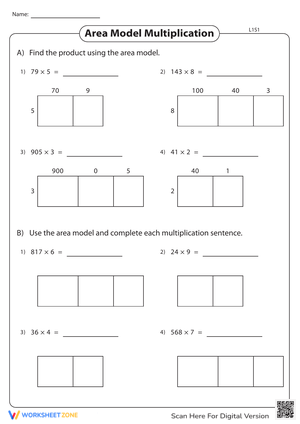
- Array-to-rectangle matching: Students connect rows-and-columns thinking to the rectangular area model, anchoring the new representation to something they already know.
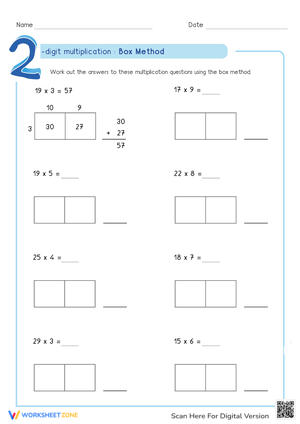
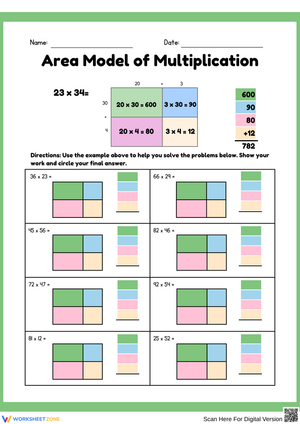
- Labeled side lengths: Students read pre-drawn rectangles, identify the factor on each side, and record the partial products inside each section.
- Partially completed models: One dimension or one interior value is missing, requiring students to reason about the structure rather than copy a format.
- Student-drawn rectangles: Given a multiplication expression, students decide how to partition a factor and draw the model themselves.
- Equation connections: Students write the matching number sentence alongside the rectangle, reinforcing that the model and the symbol represent the same operation.
- Word problems: Classroom-context situations ask students to select factors, build the model, and explain what the total area represents.
That range matters more than it might appear. A student who correctly fills in a pre-drawn model may stall completely when asked to draw and label one from scratch. Each worksheet type exposes a different layer of understanding, which is what makes the set useful for diagnosis as well as practice.
Where These Worksheets Fit in the Teaching Week
The most effective placement for area model work is directly after the teacher demonstration — not the next day, when the visual fades, but within the same lesson block. Model the partitioning strategy on the board or document camera, then hand students a worksheet with partially completed models while the example is still visible. That immediate practice differs meaningfully from sending the same worksheet home as homework, where there is no model to reference and errors can quietly compound overnight.
For small-group reteaching, choose worksheets where the rectangle is pre-drawn and the dimensions are already labeled. Students who freeze when facing a blank space can focus on multiplication reasoning without managing spatial layout at the same time. A few days later — not the next period — use a draw-your-own worksheet as an exit task with that same group. The delay applies spaced retrieval in a low-stakes format: students who have internalized the model structure will retrieve it; those who have not will show you exactly what still needs work. Having a set of 3rd grade area models worksheets organized by task type makes that targeted pull straightforward rather than a prep-time scramble.
Math centers are another strong fit. Pair one worksheet with colored pencils so students can shade each partial-product section in a different color. That coloring slows them down enough to think about each rectangle section individually rather than rushing toward a total answer.
The Mistakes That Show Up in Student Models
Area model worksheets are better diagnostic tools than standard fact drills precisely because student reasoning is spatial — you can usually pinpoint the exact moment thinking went wrong just by reading the rectangle.
The most revealing error involves incorrect partitioning. A student solving 6 × 14 might split 14 into 10 and 6 instead of 10 and 4 — a mistake that looks plausible because both parts are single-digit or round numbers, but produces a model that does not represent 14 at all. That error is nearly invisible on a computation worksheet, but on an area model it is right there in the labeled dimensions. These students are not struggling with multiplication facts; they are struggling with decomposition, and reteaching can aim directly at that gap.
A second pattern: students who find both partial products correctly but then add them incorrectly at the final step. The multiplication reasoning is working — the problem is addition or fact fluency — and the worksheet makes that distinction clear before the error gets misread as a conceptual problem with the model itself.
A third issue appears specifically on draw-your-own worksheets. Some students draw two separate rectangles instead of partitioning one shared area. They often arrive at correct partial products but miss the point that the two sections belong to a single combined rectangle. That conceptual gap rarely surfaces until students are asked to construct the model themselves, which is one reason the draw-your-own worksheet belongs in the set even though it frustrates students who struggle with proportional spatial layout.
Matching Worksheets to Different Learner Levels
Students who need more support benefit most from worksheets with large, clearly divided rectangles, pre-labeled side lengths, and fewer items per worksheet. The goal is to isolate the partial-products step so students are not managing too many unfamiliar demands at once. Reducing visual density is not the same as reducing rigor — these students are still doing multiplication reasoning; they just do not also need to figure out where to draw the lines.
A well-structured set of 3rd grade area models worksheets gives teachers options across the visual support spectrum without requiring extra prep time. For students who have the basic model down, use worksheets where partition lines are absent and they must decide how to decompose each factor. Or present a completed rectangle with one side length hidden — students work backward from known partial products to find the missing dimension, which requires multiplicative reasoning in both directions.
One practical move that works well: print two versions of the same worksheet — one on plain paper and one with a light graph paper background behind the rectangles. Students who struggle with proportional spacing place partitions more accurately on the graph version, which means you are assessing their multiplication thinking rather than their drawing precision. Neither version needs to be labeled as easier or harder; students simply use the one that lets them show what they know about the math.
Standard Alignment
CCSS 3.OA.B.5 calls for students to apply properties of operations as strategies for multiplication, with the distributive property named explicitly. Each time a student splits a factor and finds two partial products, they are applying that property in a concrete, visual form — which is exactly what this standard describes. CCSS 3.MD.C.7 connects multiplication to area directly, asking students to find the area of rectangles by multiplying side lengths. These two standards reinforce each other throughout area model instruction, and a well-sequenced set of worksheets lets teachers address both within the same unit without treating them as separate lessons. State standards adapted from the Common Core carry forward the same distributive-property and area-multiplication expectations at Grade 3, making the alignment broadly applicable across most classrooms.
Frequently Asked Questions
When in Grade 3 should teachers introduce area model worksheets?
After students are comfortable with arrays and can read a multiplication equation — usually mid-fall in the multiplication unit. Start with worksheets that match arrays to rectangles before moving to partitioned models. The area model should come before students encounter the standard algorithm, so it builds meaning rather than running alongside a procedure they already know.
Do these worksheets address two-digit by one-digit multiplication?
The set focuses on Grade 3 ranges, primarily single-digit by single-digit and single-digit by two-digit problems. That scope matches 3.OA and 3.MD expectations. Students ready for two-digit by two-digit work are operating beyond Grade 3 standards and would be better served by a Grade 4 area model set.
Can teachers use these alongside fact fluency practice?
Yes, and the two types work well together in the same unit for different purposes. Area model worksheets prioritize understanding factor decomposition and partial products — not speed. Timed fluency drills address a separate skill. Using both keeps conceptual and procedural development moving forward at the same time without conflating them.
How do the worksheets work in a digital or hybrid classroom?
These 3rd grade area models worksheets upload cleanly to most learning management systems and annotate well with standard tablet tools. For printed use, the rectangle format gives students enough space to label dimensions, shade sections, and write equations — all in one clean workspace without running out of room. Either format works; the math structure does not depend on the delivery method.
What is a good extension task for students who finish early?
Ask them to show the same multiplication problem using a different partition. A student who modeled 6 × 14 as (6 × 10) + (6 × 4) can try representing it as (6 × 7) + (6 × 7). Both are correct, both total 84, and comparing them builds the flexible decomposition thinking that carries directly into Grade 4 multiplication work.













 Interactive Worksheet Maker
 Quiz Maker
 Word Search Maker
 Crossword Puzzle Maker
 Word Scramble Generator
 Sentence Scramble Generator
 Handwriting Worksheet Generator
 Name Tracing Generator
 Fill In The Blank Generator