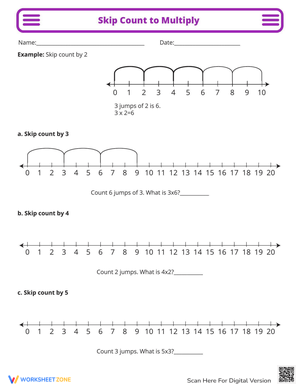
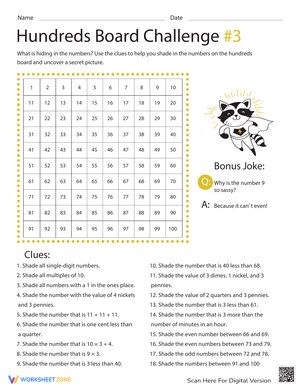
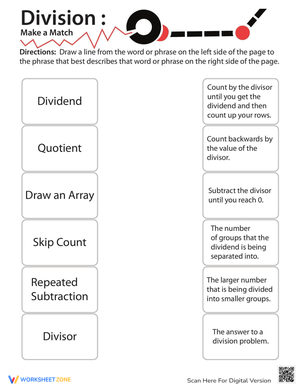
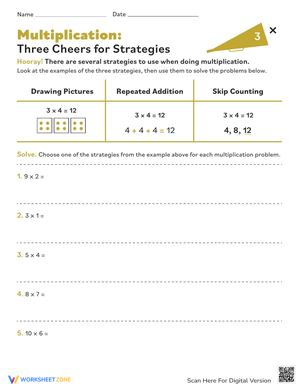
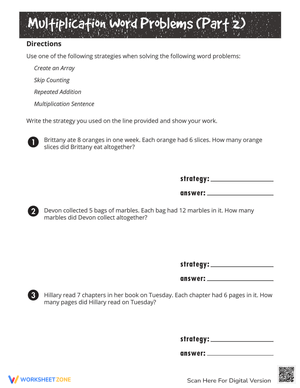
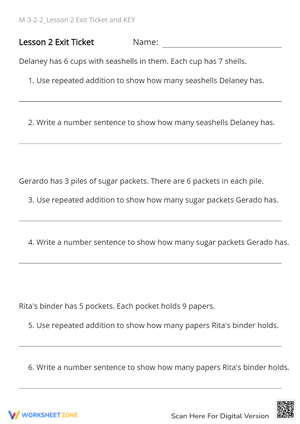
These 3rd grade multiplication skip counting printable worksheets give students a concrete path from repeated addition to fluent multiplication facts — a transition that sounds simple but reliably stalls somewhere around the 6s and 7s for a meaningful chunk of any class. The set builds on what students already know from Grade 2 and moves systematically into the sequences that cause the most friction: 3s, 4s, 6s, 7s, 8s, and 9s.
The Specific Patterns and Skills Each Worksheet Targets
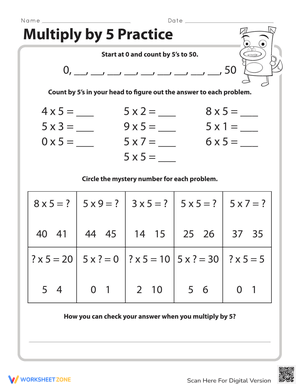
Each worksheet focuses on one skip-counting sequence at a time, keeping working memory demand manageable for students who are still building automaticity with smaller multiples. The exercise types rotate across the set:
- Fill in missing numbers along marked number lines
- Complete partial sequences with gaps at the beginning, middle, or end
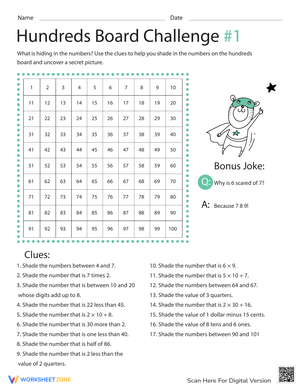
- Circle multiples on a hundred chart and describe the repeating pattern in writing
- Match a repeated-addition expression (6 + 6 + 6 + 6) to the corresponding skip-counting sequence and multiplication fact
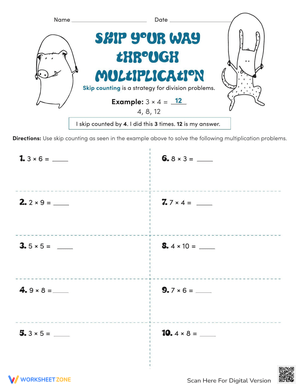
That last task — writing the multiplication fact that a completed sequence represents — is the pivot point of the set. The jump from "I can count by 4s" to "I know 5 × 4" is not automatic for most third graders; they need a prompt that makes the connection explicit. These worksheets build that link deliberately and return to it across multiple sequences so the habit sticks.
Mistakes Students Make That These Worksheets Help You Catch
The most consistent error we see in student work is interval drift — students start a sequence correctly and then lose the interval size midway. A student counting by 6s might write 6, 12, 18, 24, 32, 38 because somewhere around 24 they silently switched to adding 8. This almost never surfaces during whole-class oral skip counting, where the room's rhythm carries struggling students along. It surfaces immediately on paper. The fill-in-the-blank format catches drift errors that would otherwise go unnoticed until a multiplication quiz makes the gap visible.
A second reliable pattern: students who can recite the 9s starting from 9 often cannot complete a sequence that begins at 36 and asks them to continue. They want to restart from 9 every time. Worksheets in the set that begin mid-sequence — "27, ___, ___, 54, ___, 72" — are there specifically to break that dependency.
There is also a conceptual gap worth flagging with the 2s. Many students write 2, 4, 6, 8, 10 accurately and then explain it as "those are even numbers" rather than "groups of 2." That framing matters: a student who sees counting by 2s as a list of even numbers, not a multiplication structure, will struggle to interpret 2 × 7 as a product. Asking students to write the matching multiplication fact at the end of each completed sequence is what surfaces that gap early.
Building These Worksheets Into Your Math Block
The most reliable placement is the first five minutes of math class — before the lesson, not after. When students open a worksheet and quietly fill in a sequence while the room settles, they arrive at the lesson already thinking in multiples. That warm-up effect is real and worth the five minutes it costs, especially on Monday mornings when the previous week's work has faded.
These 3rd grade multiplication skip counting printable worksheets also work well as Friday formative checkpoints. Pull one sequence introduced earlier in the week, have students complete it independently in about three minutes, and collect it. You get a fast read on who has internalized the pattern and who needs another pass with concrete materials — a number line, a set of counters — before you move the class forward.
For math centers, these work well as independent practice alongside a fact fluency activity. Students can self-check their number lines by counting on their fingers, which keeps the center genuinely independent and frees the teacher for small-group work. A timed variation — 90 seconds to complete one full sequence, students record their own time — adds enough low-stakes pressure to make practice feel different from regular seatwork without triggering math anxiety in students who already have a hard relationship with timed tests.
Standard Alignment
The primary standard these worksheets address is CCSS.MATH.CONTENT.3.OA.A.1, which requires students to interpret products of whole numbers — specifically, to understand 5 × 7 as the total number of objects in 5 groups of 7. Skip counting is the entry point into that interpretation: when a student writes 7, 14, 21, 28, 35 and counts five hops, they are demonstrating 3.OA.A.1 in action rather than just retrieving a stored fact.
The set also supports CCSS.MATH.CONTENT.3.OA.C.7, which asks students to fluently multiply and divide within 100. Fluency built on pattern understanding holds up better under assessment pressure than fluency built on raw memorization. Students who can reconstruct a sequence when a fact slips their mind are more resilient on tests than students who have gaps in a memorized list and no fallback strategy.
Adjusting the Set for a Range of Learners
For students who freeze when asked to count a sequence cold, pair any worksheet with a partially-completed reference chart — not as a permanent support, but as a way to lower the barrier enough that they practice the skill rather than spending the entire time reconstructing a sequence from scratch. Pull the chart after two or three successful independent completions.
Students who move through the basic sequences quickly can work with 3rd grade multiplication skip counting printable worksheets that include larger starting numbers, backward sequences, or multi-step prompts like "The 7s sequence reaches 63 in ___ steps. Write the matching multiplication equation and its related division fact." That format builds the flexible thinking that appears on state assessments. For students who need the most support, a hundred chart with target multiples already circled reduces the working memory load enough to let them focus on connecting the sequence to a multiplication fact, which is the actual instructional goal.
Frequently Asked Questions
Which sequences should I introduce first, and in what order?
Start with 2s, 5s, and 10s — most students arrive in third grade with some familiarity from Grade 2, and early success builds the confidence needed for harder sequences. From there, 3s and 4s are the next manageable step. The 6s, 7s, 8s, and 9s come last. The 9s are worth spending extra time on because the digit-sum pattern — the digits of each product add to 9 — gives students a reliable self-check, and many students find that observation genuinely interesting rather than tedious.
How does skip counting practice carry over into division later in the year?
Students who can count forward in a sequence can also count backward, and backward skip counting is the informal foundation of division. A student who knows the 6s sequence can figure out 42 ÷ 6 by working backward from 42 in six-step intervals. That strategy does not replace division instruction, but it gives students a meaningful fallback when the division algorithm is new and unfamiliar. The connection is worth naming explicitly when you introduce division.
Are these useful for students who already know their multiplication facts?
The 3rd grade multiplication skip counting printable worksheets that include mid-sequence gaps or backward sequences offer a different challenge for fluent multipliers — they require pattern understanding rather than fact recall, which is a meaningful distinction. A student who writes 48 instantly for 6 × 8 but cannot fill in ___, ___, 48, 54, 60 without restarting from 6 has a memorization gap, not fluency. These worksheets surface that difference clearly.













 Interactive Worksheet Maker
 Quiz Maker
 Word Search Maker
 Crossword Puzzle Maker
 Word Scramble Generator
 Sentence Scramble Generator
 Handwriting Worksheet Generator
 Name Tracing Generator
 Fill In The Blank Generator