


























Views
Downloads




Mastering Multiplication Arrays | Grade 3 Essential Math
Paste this activity's link or code into your existing LMS (Google Classroom, Canvas, Teams, Schoology, Moodle, etc.).
Students can open and work on the activity right away, with no student login required.
You'll still be able to track student progress and results from your teacher account.
This Grade 3 multiplication arrays worksheet provides comprehensive practice to help students visualize and solve basic multiplication facts. By connecting visual arrays to equations and word problems, learners develop a deep conceptual understanding of multiplication as repeated addition. This resource ensures students can accurately represent multiplication situations using rows and columns.
At a Glance
- Grade: 3 · Subject: Math
- Standard:
CCSS.MATH.CONTENT.3.OA.A.1— Interpret products of whole numbers by observing and creating rectangular arrays- Skill Focus: Multiplication Arrays
- Format: 4 pages · 30 problems · Answer key included · PDF
- Best For: Conceptual introduction to multiplication or review
- Time: 25–35 minutes
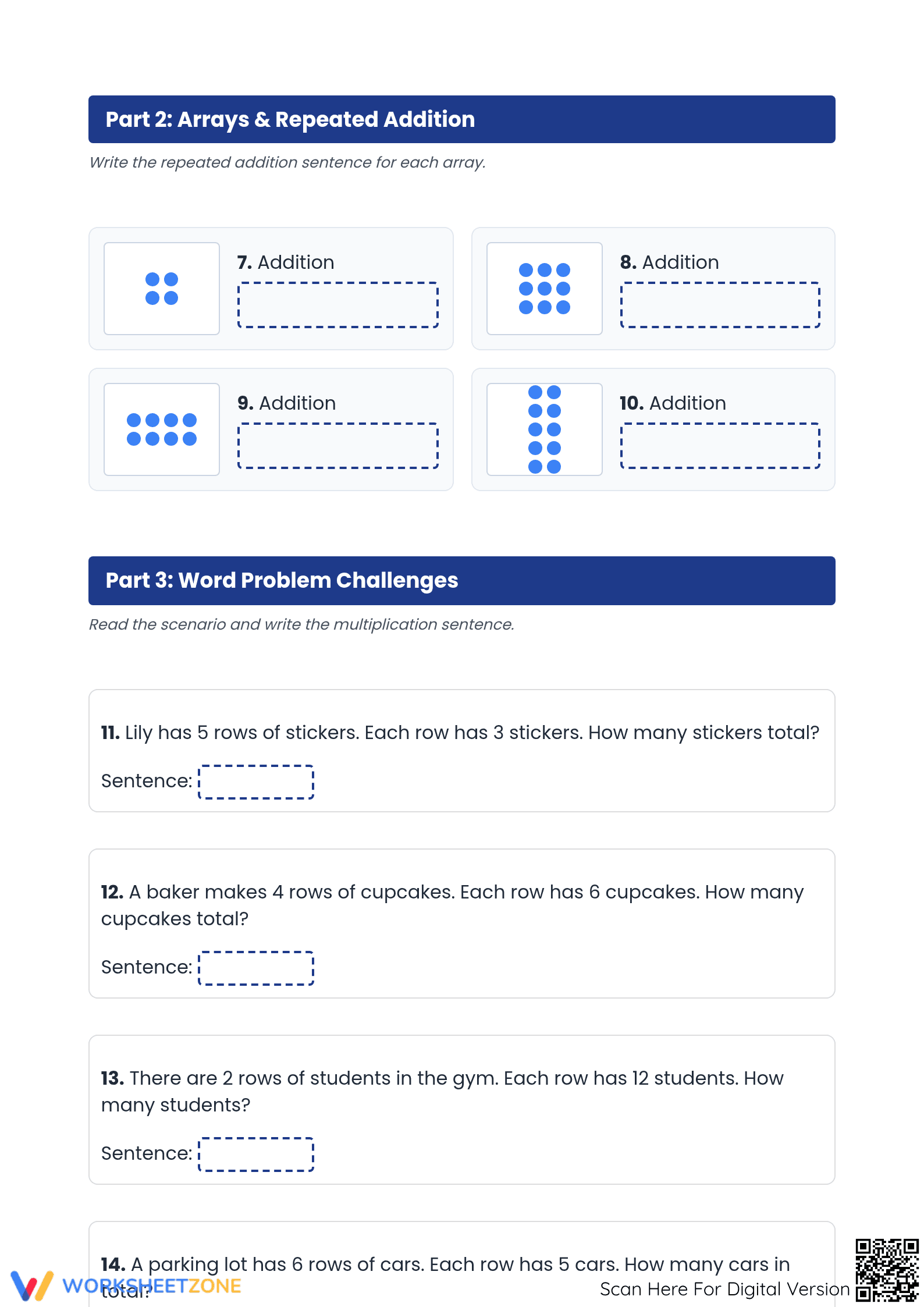
This 4-page PDF contains five distinct sections designed to build mastery through varied task types. It includes 6 array-to-equation matching tasks, 4 repeated addition exercises, 5 word problem challenges, 3 true-or-false conceptual checks, and 12 challenge equations for fluency practice. A full answer key is provided to ensure quick grading and immediate feedback for learners.
Skill Progression
- Guided Practice: Students begin by matching visual arrays to their corresponding multiplication sentences, ensuring they recognize the relationship between rows and columns (6 tasks).
- Supported Practice: The middle sections introduce repeated addition and word problems, scaffolding the transition from concrete visuals to abstract mathematical models (9 tasks).
- Independent Practice: The final section presents "Challenge Equations" where students apply their knowledge to larger array descriptions without immediate visual support (15 tasks).
This structure follows a gradual-release model to ensure students move confidently from teacher-led instruction to independent mastery of multiplication concepts.
Standards Alignment
This worksheet is strictly aligned to CCSS.MATH.CONTENT.3.OA.A.1, focusing on interpreting products of whole numbers through rectangular arrays. It also supports 3.OA.A.3 by using multiplication within 100 to solve word problems in situations involving equal groups and arrays. Both standard codes can be copied directly into lesson plans, IEP goals, or district curriculum mapping tools.
How to Use It
Use this resource during the explore phase of a multiplication unit to help students discover the relationship between rows and products. It serves as an excellent formative assessment tool; observe if students struggle with the row-column order in the first section to identify those needing targeted intervention. Expected completion time for the full 30-problem set is approximately 30 minutes.
Who It's For
Designed for third-grade students beginning their multiplication journey, this worksheet is also suitable for second-grade enrichment or fourth-grade RTI groups. It pairs naturally with a set of physical counters or an anchor chart showing the "Rows x Columns" mnemonic to reinforce the spatial structure of multiplication.
Alignment to CCSS.MATH.CONTENT.3.OA.A.1 ensures that students develop the foundational ability to interpret multiplication through visual arrays, a critical step in mathematical literacy. Research by Fisher & Frey (2014) highlights that visual models like arrays provide the necessary scaffolding for students to transition from additive to multiplicative reasoning. By engaging with 30 diverse tasks including word problems and challenge equations, learners internalize the spatial structure of multiplication. This worksheet's structure supports the NAEP framework for numerical operations by emphasizing the connection between representations and computations. The inclusion of a citation capsule and standard-aligned tasks makes this a reliable resource for classroom instruction, intervention, or home practice. Teachers can utilize this evidence-based tool to bridge the gap between concrete manipulatives and abstract symbol manipulation, fostering long-term retention of multiplication facts. This summary is intended for use in curriculum documentation or digital resource management systems.


