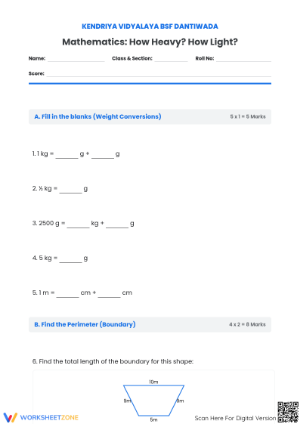
These measuring weight worksheets for 3rd grade cover the full range of skills in CCSS.MATH.CONTENT.3.MD.A.2 — from reading analog and digital scales to solving mass-based word problems — giving teachers a set of resources they can pull into a lesson without building from scratch. The set focuses on grams and kilograms as primary units, with targeted practice on matching objects to reasonable customary measurements when that comparison supports the lesson.
What Each Worksheet Targets
The resources break the measurement standard into four distinct skill areas, each addressed in its own worksheet:
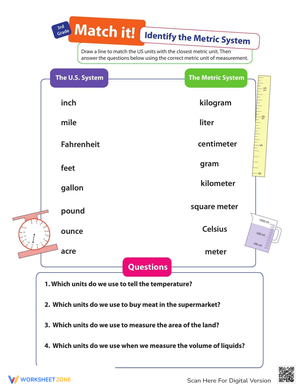
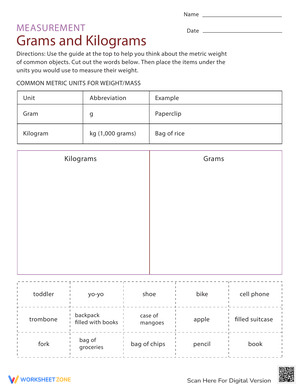
- Unit selection: Students look at illustrated objects — a grape, a bicycle, a bag of flour — and identify whether grams, kilograms, ounces, or pounds best fits a reasonable measurement. Students who know grams are "small" still write "the dog weighs 8 grams" with alarming regularity, and this worksheet surfaces that confusion early.
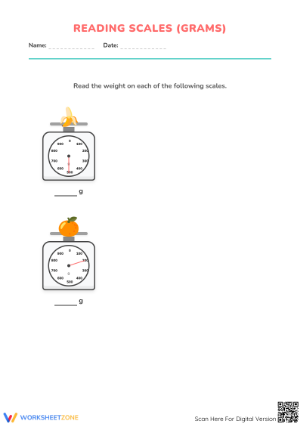
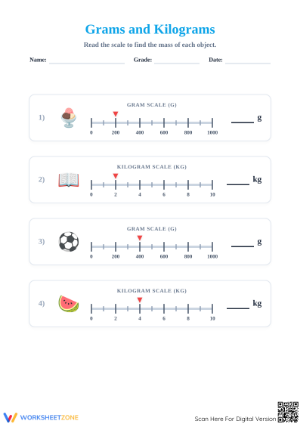
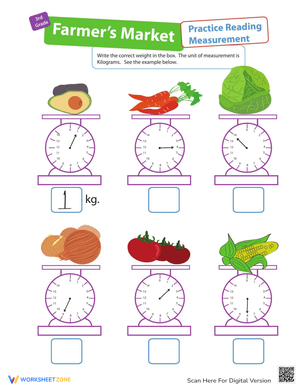
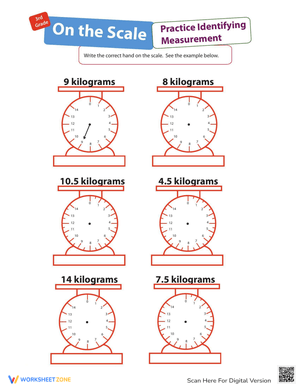
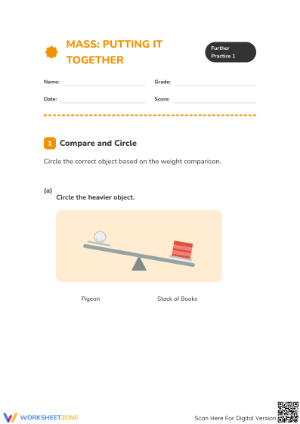
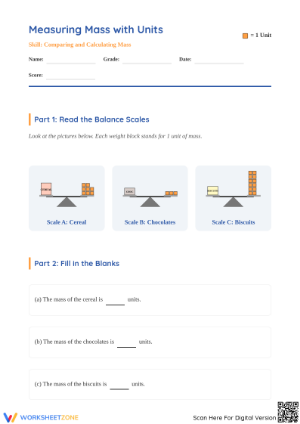
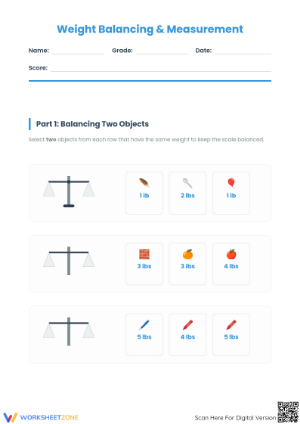
- Scale reading: Each worksheet presents scale diagrams — balance scales, spring scales, and digital readouts — at increasing complexity. Early worksheets label every increment; later ones leave several intervals unmarked and require students to calculate the interval value before reading the pointer position.
- Estimation with benchmarks: Students compare pictured objects to familiar reference weights (a paperclip at roughly 1 gram, a textbook at roughly 1 kilogram) and select the most reasonable mass from a set of answer choices.
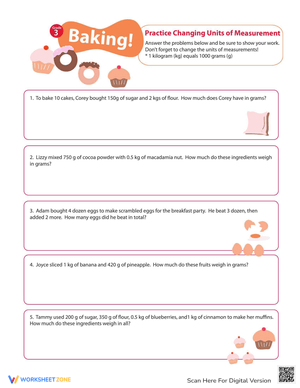
- Word problems involving mass: One-step problems using all four operations, set inside a single unit system as the standard requires. Students must write the unit as part of every answer — that habit gets built in from the first problem.
Reading Analog Scales — The Skill That Trips Students Up Most
Most 3rd graders manage a fully labeled scale without much difficulty. The problem appears the moment a scale labels only some increments. A student who has not worked through unlabeled intervals will simply name the nearest labeled number — on a scale that runs 0–500g with marks at every 25g but labels only at 0, 100, 200, 300, 400, and 500, a pointer sitting at 375g gets recorded as "300." The student isn't guessing wildly; they just haven't calculated what the unlabeled marks represent.
The scale-reading worksheets address this with a deliberate pre-step: before reading the pointer, students count the spaces between two labeled numbers, divide the difference by that count, and write the interval value in a small box printed on the worksheet. That written calculation step makes the interval explicit rather than assumed. It slows students down in exactly the right way — and it mirrors what they'll need to do mentally when they encounter a real measurement tool.
Building These Worksheets Into Your Instructional Week
The unit-selection and estimation worksheets work best early in the unit — even as a Monday warm-up before any formal scale instruction. Running the unit-selection worksheet before you've taught scales at all tells you which students already confuse gram-magnitude with kilogram-magnitude, so you can address it during that day's lesson rather than finding out on the unit test. Five minutes is enough; the misconception either shows up or it doesn't.
The scale-reading worksheets pair well with a short hands-on session. If you have access to even one kitchen scale, let students weigh a few classroom objects — a stapler, an eraser, a notebook — before they open the printed diagrams. Students who have physically watched a needle move to 340g read scale diagrams with noticeably more accuracy than students who go straight to paper. For classrooms without equipment, a brief video clip of a scale in use before the worksheet achieves a similar effect. Save the word-problem worksheets for Thursday or Friday of the introduction week, once scale reading is reasonably solid. Asking students to solve two-step reasoning problems while they're still uncertain how to read the measurement tool creates unnecessary confusion.
Student Errors Worth Catching Before the Unit Test
The most persistent error is magnitude confusion. A student who can tell you that grams are smaller than kilograms will still circle "12 grams" as the weight of a full water bottle without registering the problem. The estimation worksheets catch this immediately — when a student selects a single-digit gram count for a large object, the benchmark instruction hasn't landed yet, and a quick anchor moment (actually holding a paperclip in one hand and a textbook in the other) tends to fix it faster than re-teaching the lesson.
A second pattern appears in word problems: students calculate correctly but write the number alone, without the unit. "450" instead of "450 grams." This isn't arithmetic confusion — it's a notation habit that hasn't formed yet. Building in a requirement to circle the unit label before moving to the next problem, enforced consistently across several worksheets, closes the gap by mid-unit.
The third error is specific to unlabeled-interval scale reading, and it's subtle: students count the tick marks between labeled numbers rather than the spaces between marks. On a scale with three unmarked lines between every labeled pair, they count 3 and calculate the interval as one-third of the labeled distance. The correct calculation requires dividing by 4, because three lines create four spaces. A quick physical demonstration — three fingers held up, asking "how many spaces between my knuckles including the ends?" — lands this concept faster than any verbal explanation.
Standard Alignment
These measuring weight worksheets for 3rd grade align to CCSS.MATH.CONTENT.3.MD.A.2, which requires students to measure and estimate the masses of objects using grams and kilograms, and to solve one-step word problems involving those measurements. Within the 3rd grade measurement domain, this standard covers both mass and liquid volume — teachers who run a combined measurement unit can use the mass worksheets as one strand alongside liquid volume resources. The word-problem worksheets also reinforce CCSS.MATH.CONTENT.3.OA expectations, since students apply multiplication and division inside a measurement context, which is exactly the kind of cross-domain practice that shows up on state assessments.
Using This Set With Students at Different Readiness Levels
For students who are not yet secure with two-digit number reading, the early scale-reading worksheets — fully labeled, simple increments — provide a reachable entry point without lowering the conceptual target. Pairing those students with the estimation worksheet first (multiple-choice, referencing objects they recognize) builds enough confidence to move into diagram work without the frustration of blank-interval scales arriving too soon.
Students working ahead of grade level can extend any word problem by writing a second question from the same scenario. If the original problem gives a baker 500 grams of flour, an extension might ask how many batches of 125 grams she could make — same context, multi-step reasoning, still inside the 3.MD standard. The measuring weight worksheets for 3rd grade set also includes comparison problems where students express the mass difference between two objects, which pushes naturally toward the multiplicative comparison thinking 4th grade will require.
Frequently Asked Questions
Do students need to convert between grams and kilograms at this grade level?
No. CCSS.MATH.CONTENT.3.MD.A.2 asks students to measure and work within a unit, not to convert between them. Expressing 1,500 grams as 1.5 kilograms is a 4th and 5th grade expectation. Every word problem and scale-reading task in this set stays within a single unit — students are never asked to rewrite an answer in a different unit.
Can these worksheets be used without physical scales in the classroom?
Yes. The scale diagrams are drawn with enough detail for students to practice interval reading and pointer identification from the paper alone. That said, if you have access to a single kitchen scale or a makeshift balance (a hanger, two paper cups, and some string), one brief demonstration before the diagram work measurably improves accuracy — students understand what the needle or display represents once they've seen it respond to an actual object. The measuring weight worksheets for 3rd grade hold up independently, but the physical connection makes the abstract diagram more legible to students who need it.
How do I handle the mass-versus-weight distinction when students ask?
A practical answer works best at this level: mass is how much matter is in an object and doesn't change, while weight is the pull of gravity on that matter and technically varies by location. In everyday classroom language — and in most elementary math materials — the terms get used interchangeably, and that's acceptable here. If a student raises it because their science teacher drew a distinction, acknowledge it briefly and redirect: for this standard, the job is measuring and estimating accurately using the right units, not defining physics terms.













 Interactive Worksheet Maker
 Quiz Maker
 Word Search Maker
 Crossword Puzzle Maker
 Word Scramble Generator
 Sentence Scramble Generator
 Handwriting Worksheet Generator
 Name Tracing Generator
 Fill In The Blank Generator