


























Views
Downloads

Printable Grade 4 Math: Weight Conversion & Perimeter
Paste this activity's link or code into your existing LMS (Google Classroom, Canvas, Teams, Schoology, Moodle, etc.).
Students can open and work on the activity right away, with no student login required.
You'll still be able to track student progress and results from your teacher account.
Strengthen your students' mathematical fluency with this comprehensive measurement and geometry worksheet. Students will master the relationship between kilograms and grams while applying perimeter formulas to various shapes. This dual-focus resource ensures learners can confidently navigate real-world mass estimation and spatial calculations, providing essential practice for upper elementary curriculum goals and standardized test preparation.
At a Glance
- Grade: 4 · Subject: Math
- Standard:
CCSS.MATH.CONTENT.4.MD.A.2— Use four operations to solve word problems involving mass and perimeter- Skill Focus: Metric weight conversion (kg to g) and multi-shape perimeter calculation
- Format: 4 pages · 24 problems · Answer key included · PDF
- Best For: Independent classroom practice, homework assignments, and formative assessment
- Time: 35–50 minutes of focused classroom work
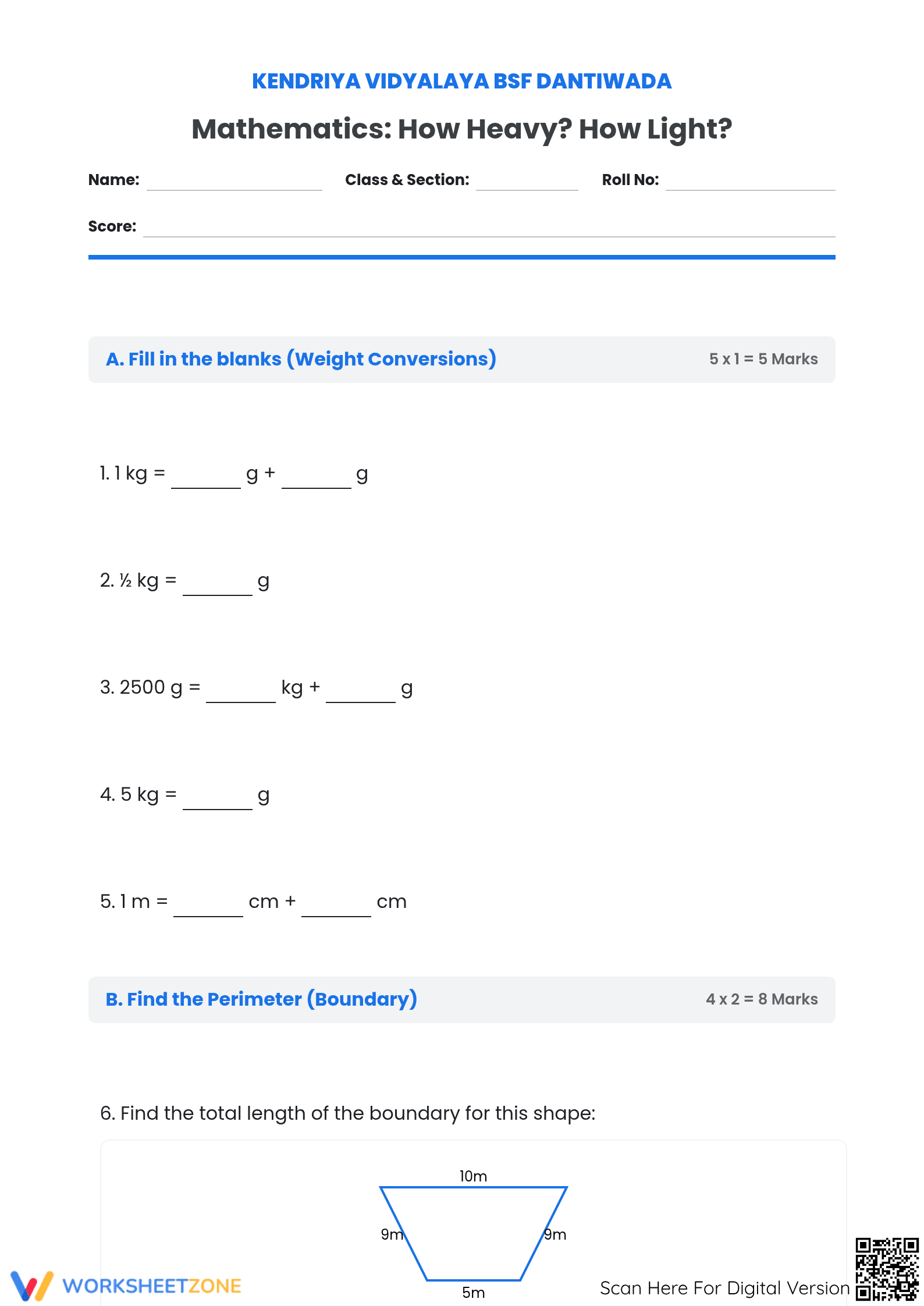
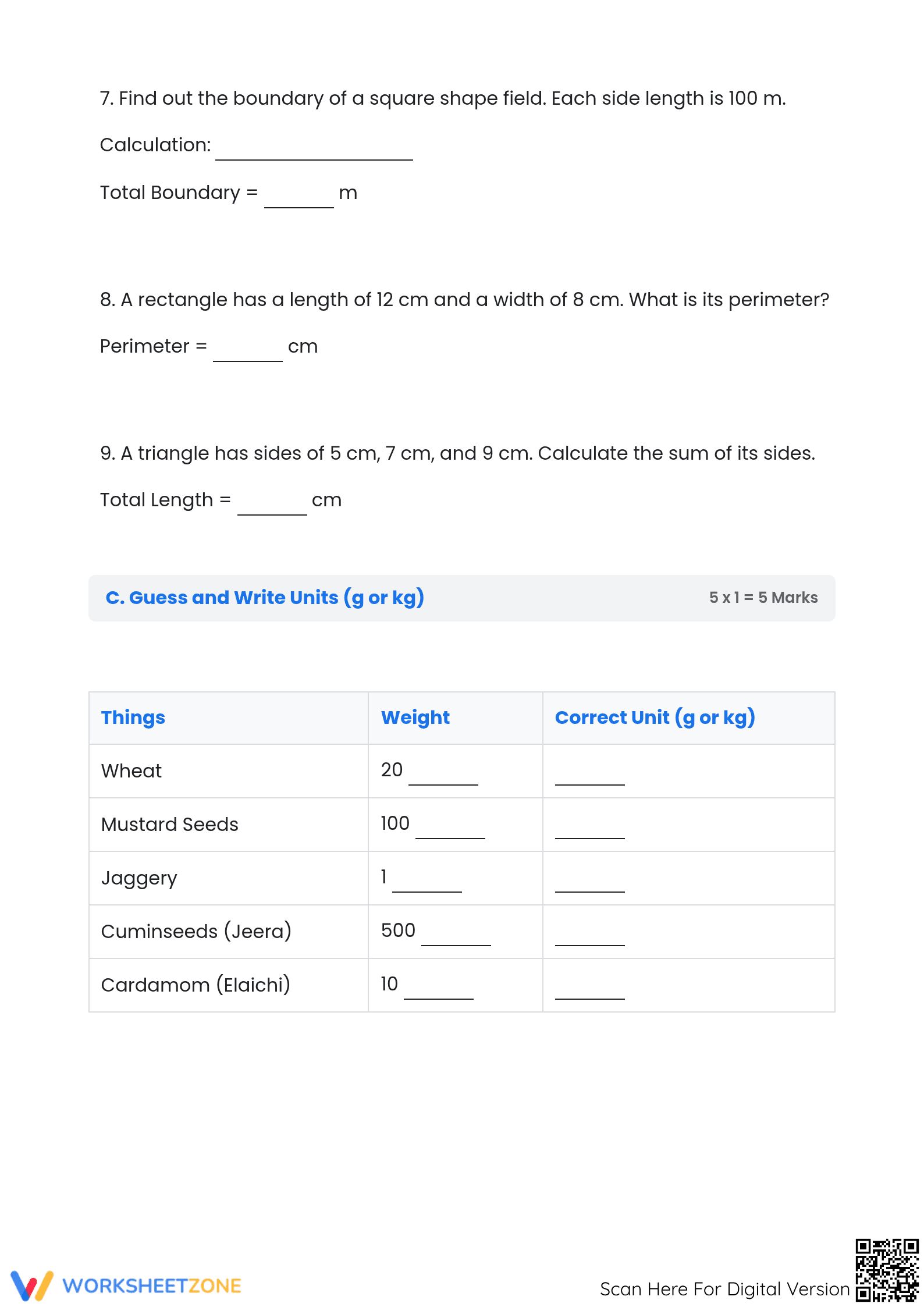
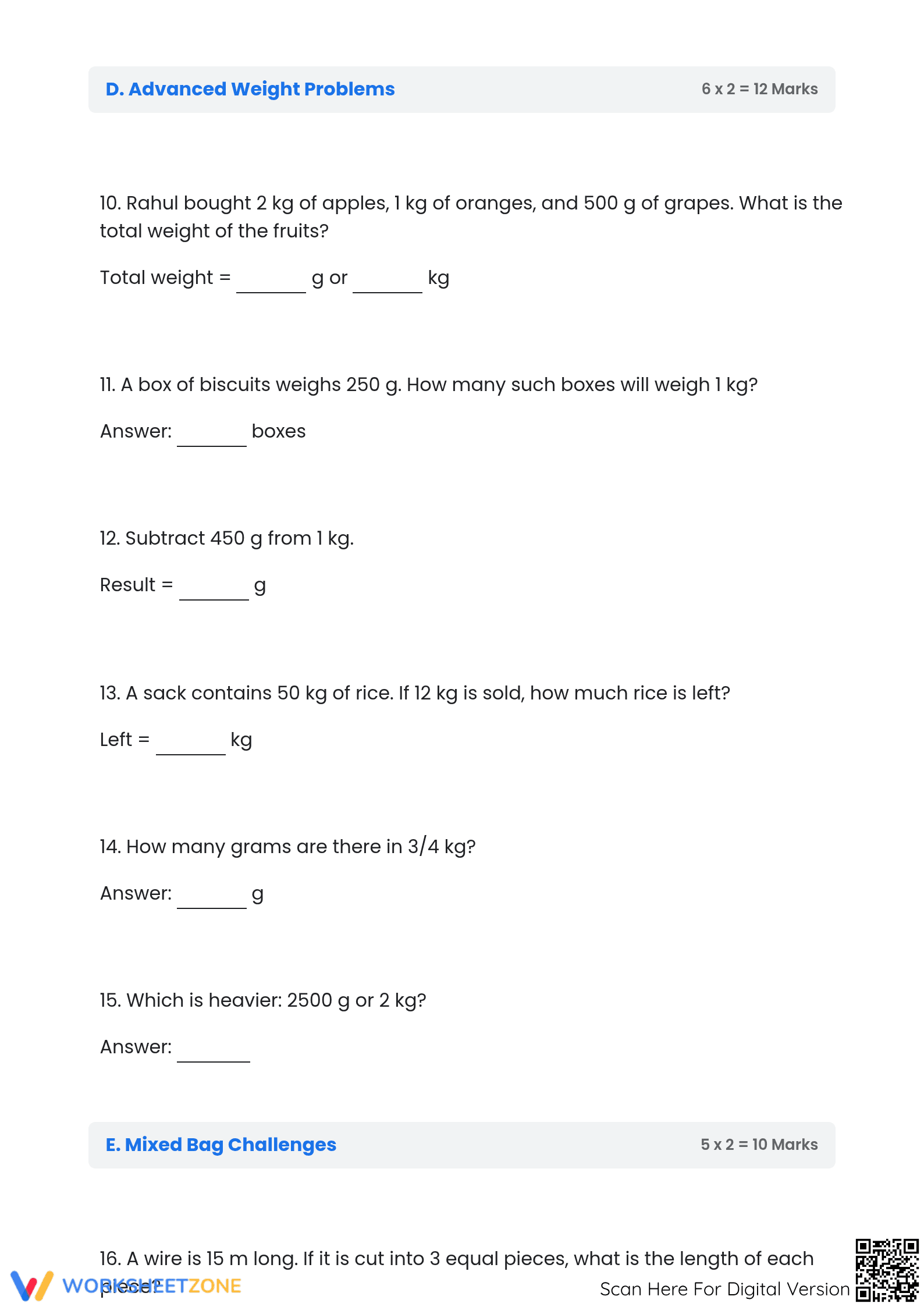
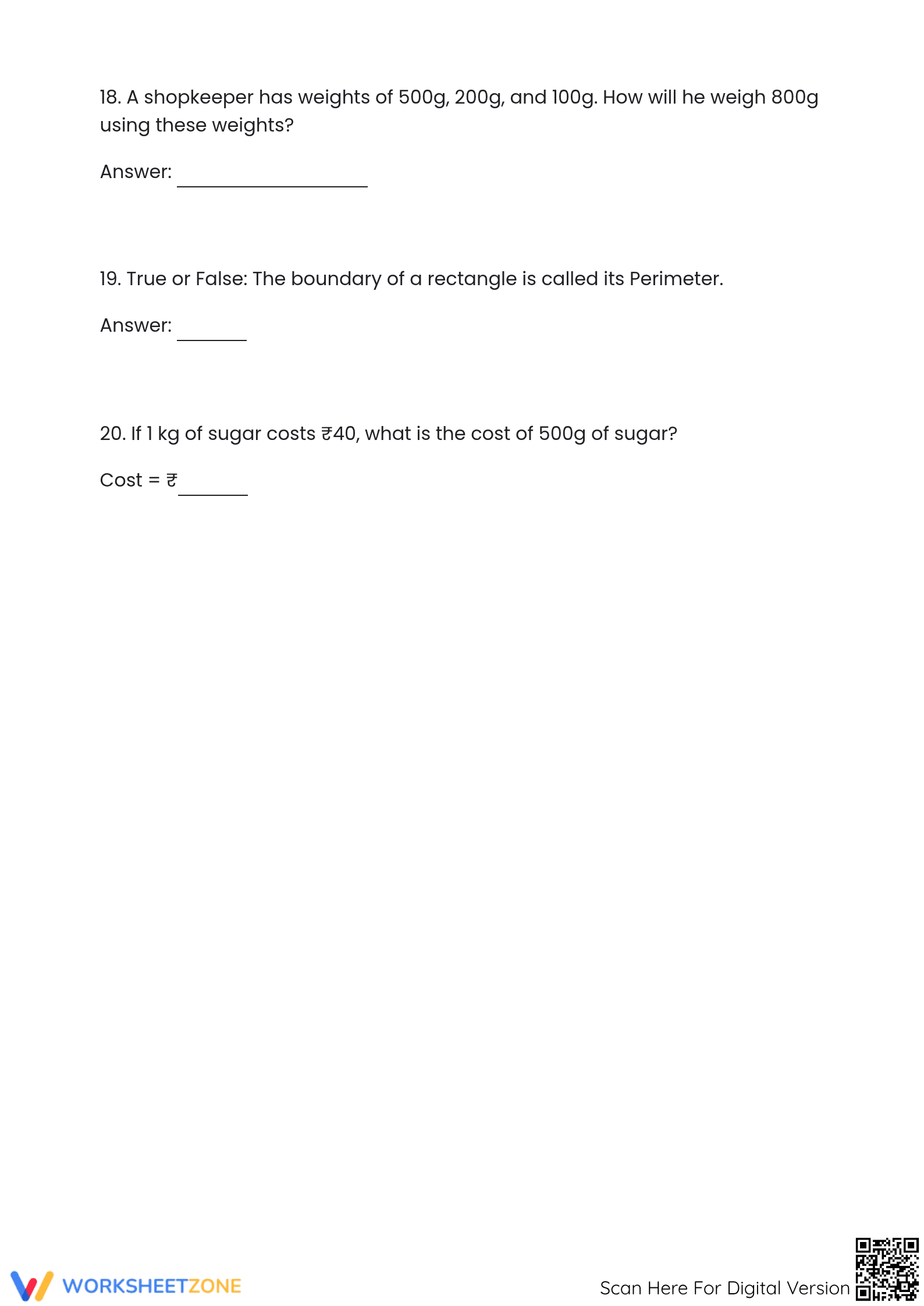
This four-page printable PDF features 24 structured problems divided into five distinct sections. It begins with fundamental metric conversions and transitions into perimeter calculations for squares, rectangles, and triangles. The set includes unit estimation tables, complex multi-step word problems involving weight subtraction and money, and mixed challenges. A full answer key is provided for immediate feedback.
Skill Progression
- Guided Practice: The worksheet opens with 5 scaffolded conversion tasks, providing a high-support entry point into the metric system and base-ten relationships.
- Supported Practice: Sections B and C move to geometry and estimation, using visual diagrams and tabular formats to help students apply formulas in controlled contexts.
- Independent Practice: The final sections present 10 multi-step problems and mixed challenges requiring students to synthesize operations and measurement concepts autonomously.
This sequence follows a gradual-release model, moving from rote computation to complex real-world application.
Standards Alignment
This resource is primary aligned to CCSS.MATH.CONTENT.4.MD.A.2, which requires students to use the four operations to solve word problems involving masses of objects. Additionally, it supports CCSS.MATH.CONTENT.4.MD.A.3 through the application of perimeter formulas for various polygons. Both standard codes can be copied directly into lesson plans, IEP goals, or district curriculum mapping tools.
How to Use It
Use this as a mid-unit review after introducing metric units and geometry formulas. It works well as a formative assessment to identify students struggling with fractional weight concepts. Monitor the advanced section to gauge translation of text into math operations. Completion typically takes 40 minutes.
Who It's For
Designed for Grade 4 but serves as enrichment for Grade 3 or review for Grade 5. Pairs perfectly with an anchor chart on metric prefixes or a hands-on lab using scales to weigh objects before attempting the estimation section.
According to the EdReports 2024 analysis of mathematical standards, mastering measurement and data (MD) strands in the fourth grade is a critical prerequisite for success in middle school algebra and physics. This worksheet targets the synthesis of mass conversion and perimeter calculation, skills that NAEP data indicates are frequently under-practiced in traditional textbooks. By requiring students to solve word problems that blend metric units with geometry, the resource aligns with the Fisher & Frey (2014) recommendation for purposeful literacy in the mathematics classroom. The inclusion of multi-step problems involving money and fractions of units ensures that students are not merely memorizing formulas but are applying CCSS.MATH.CONTENT.4.MD.A.2 in authentic scenarios. This rigorous approach supports the development of procedural fluency and conceptual understanding, providing a robust foundation for more complex spatial reasoning and algebraic manipulation in future grade levels.


