


























Views
Downloads
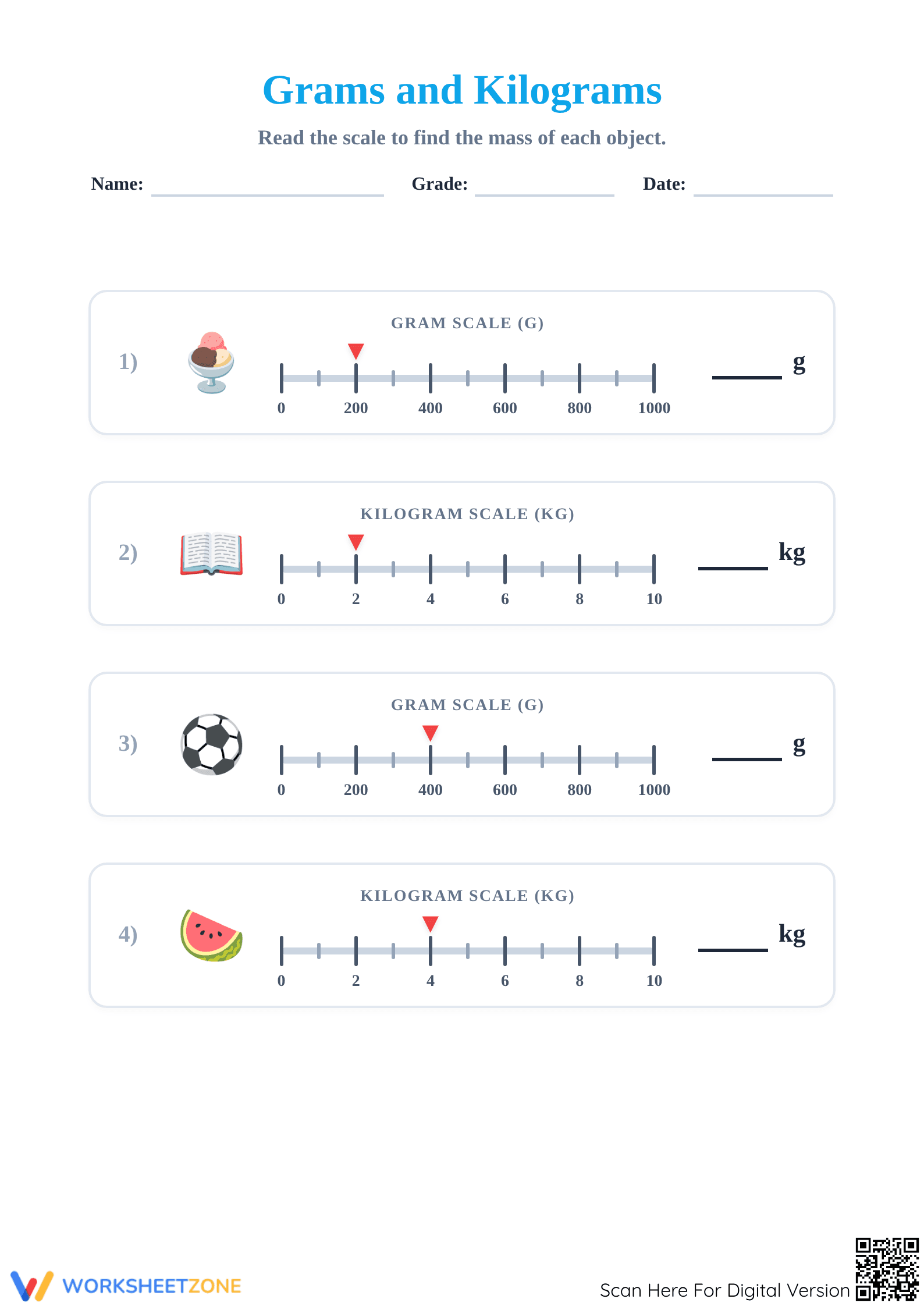
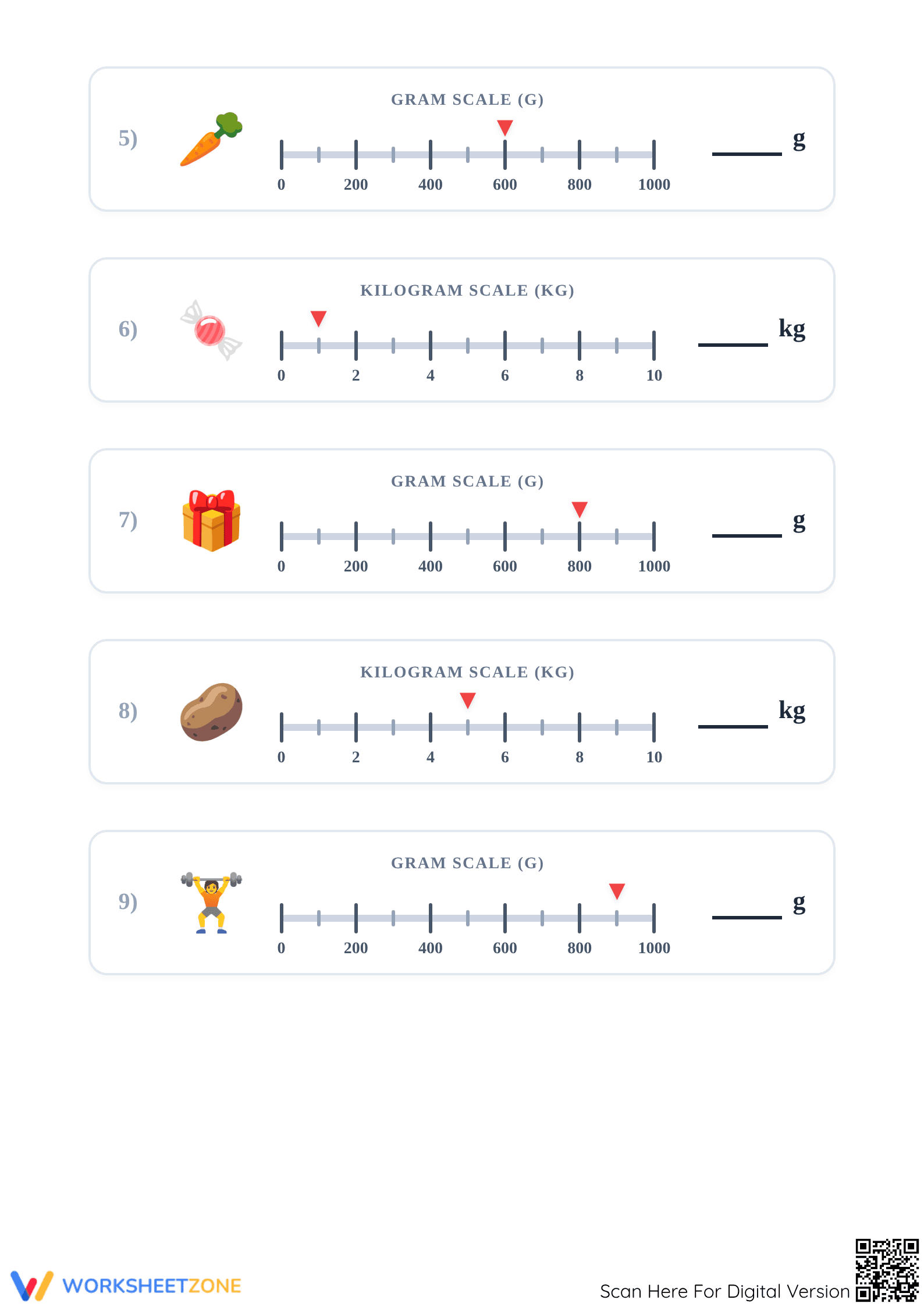

Grams and Kilograms Scale Reading | Grade 3 Essential
Paste this activity's link or code into your existing LMS (Google Classroom, Canvas, Teams, Schoology, Moodle, etc.).
Students can open and work on the activity right away, with no student login required.
You'll still be able to track student progress and results from your teacher account.
This Grade 3 math worksheet helps students master the practical skill of reading metric scales to determine mass. By observing visual representations of gram and kilogram scales, learners develop a concrete understanding of weight measurement. This resource ensures students can accurately identify numerical values on a number line-style scale, a fundamental step toward measurement mastery.
At a Glance
- Grade: 3 · Subject: Math
- Standard:
CCSS.MATH.CONTENT.3.MD.A.2— Measure and estimate masses of objects using grams and kilograms- Skill Focus: Reading metric scales
- Format: 2 pages · 9 problems · Answer key included · PDF
- Best For: Independent practice or quick formative assessment
- Time: 15–20 minutes
What's Inside: This comprehensive 2-page PDF features 9 distinct measurement tasks. Each problem presents a high-quality illustration of a common object—such as a watermelon, a soccer ball, or a book—paired with a clear, labeled scale. The scales alternate between grams (0-1000g) and kilograms (0-10kg), requiring students to pay close attention to units. A full answer key is provided for rapid grading and immediate feedback.
Zero-Prep Workflow
- Print: Select the two-page document and print enough copies for your class (30 seconds).
- Distribute: Hand out the sheets for independent work, morning work, or math center rotations (1 minute).
- Review: Use the included answer key to review results or allow students to self-correct their work (1 minute).
Total teacher preparation time is under 2 minutes, making it an ideal sub plan or emergency lesson option.
Standards Alignment: The primary focus is CCSS.MATH.CONTENT.3.MD.A.2: "Measure and estimate liquid volumes and masses of objects using standard units of grams (g), kilograms (kg), and liters (l)." This worksheet specifically targets the mass component of the standard by providing visual models of measurement tools. Both standard codes can be copied directly into lesson plans, IEP goals, or district curriculum mapping tools.
How to Use It: Use this worksheet during the independent practice phase of a lesson on metric measurement. It serves as an excellent bridge between using physical scales and solving abstract word problems. Alternatively, assign it as a formative assessment after a hands-on lab to verify that students can translate physical measurement concepts to paper-and-pencil tasks. Completion typically takes 15 to 20 minutes.
Who It's For: This resource is tailored for Grade 3 students but is highly effective for Grade 4 or 5 learners who require remediation in metric units. The heavy visual support makes it particularly accessible for English Language Learners (ELLs) and students with IEPs who benefit from clear, uncluttered layouts. It pairs perfectly with a classroom anchor chart showing common objects that weigh approximately one gram or one kilogram.
Effective measurement instruction requires students to move beyond abstract definitions to visual and practical application. According to the RAND AIRS 2024 report on mathematics instruction, visual representations of measurement tools, such as the scales used in this worksheet, significantly improve a student's ability to estimate and measure accurately. By providing 9 specific instances of scale reading, this resource reinforces the relationship between intervals on a number line and physical mass. This alignment with CCSS.MATH.CONTENT.3.MD.A.2 ensures that students are meeting rigorous national expectations for third-grade data and measurement. Research from Fisher & Frey (2014) supports this type of structured practice as a key component of the gradual release of responsibility, allowing students to build confidence before moving to complex multi-step mass problems. This worksheet provides the necessary scaffolding to ensure long-term retention of metric system concepts.


