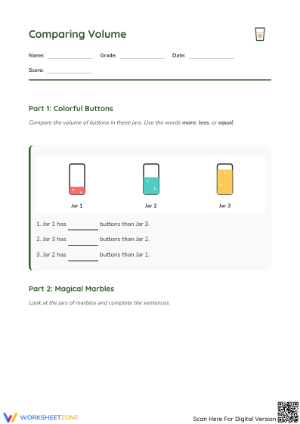
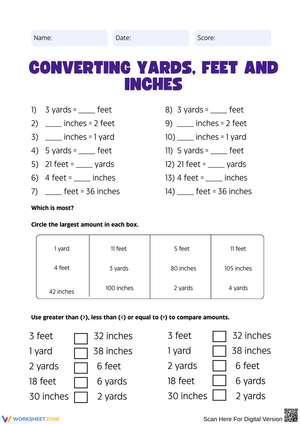
These comparing measurement printable worksheets for 3rd grade give teachers a focused set of practice resources built around the moment students have to decide whether to trust the number or the unit when both appear in the same problem. Each worksheet isolates a specific comparison task — ordering lengths with a ruler, contrasting masses using greater than and less than symbols, matching containers to their liquid capacities — so practice stays concentrated rather than diffuse. The set covers both customary and metric units, matching what third graders encounter in most state-aligned curricula.
What Each Worksheet Targets
Third grade is the year students stop comparing only whole numbers and start comparing quantities that require them to hold two pieces of information at once: the number and its unit. That cognitive demand is real, and every worksheet in this set is built around it. Topics break down as follows:
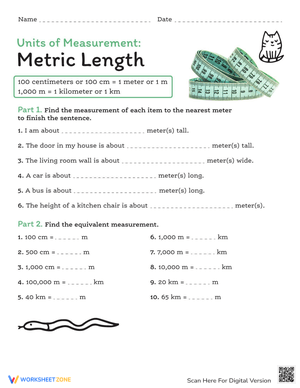
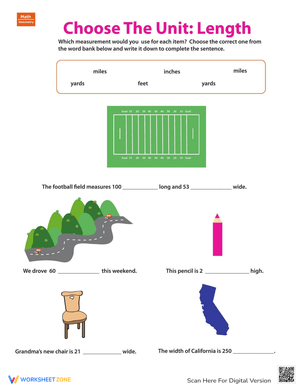
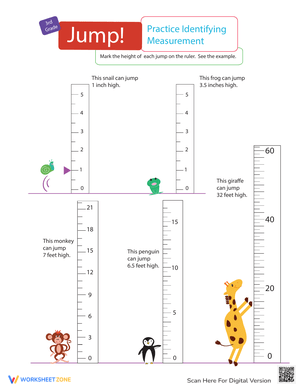
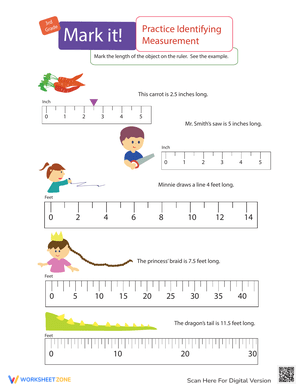
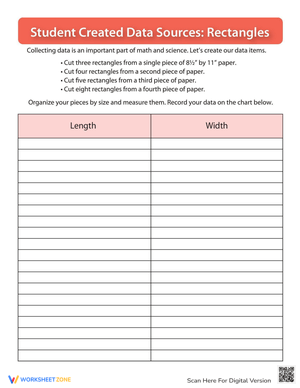
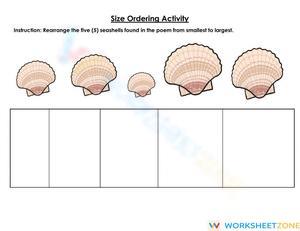
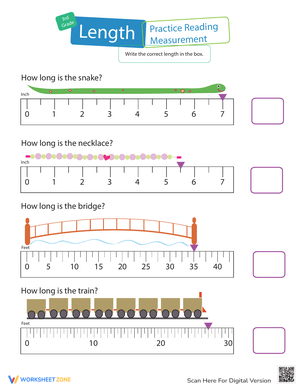
- Length comparisons — Students order measurements given in inches, feet, yards, centimeters, and meters. Some worksheets use ruler markings; others present only numerals, which raises the demand and surfaces a different set of gaps than ruler-based tasks do.
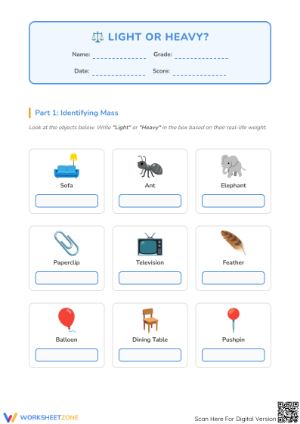
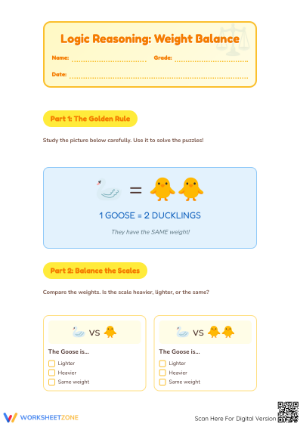
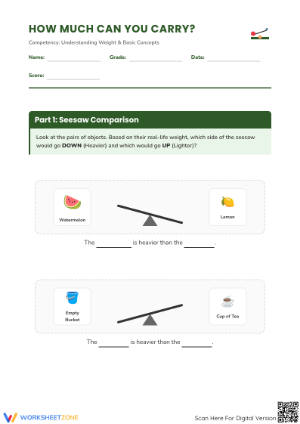
- Mass and weight — Students place greater than, less than, or equal to symbols between pairs of measurements in ounces, pounds, grams, and kilograms. Balance-scale illustrations give students a visual frame before they commit to a symbol.
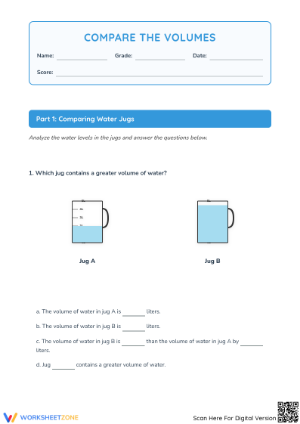
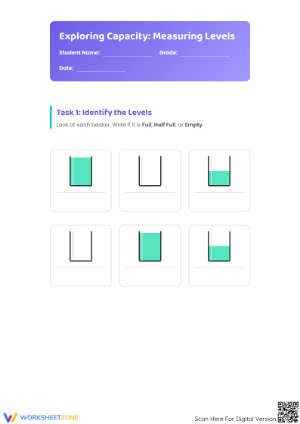
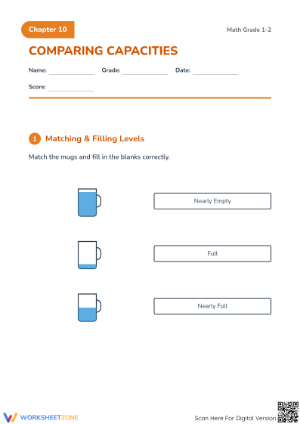
- Liquid volume — Worksheets present containers labeled with capacities in cups, pints, quarts, gallons, milliliters, and liters. Students sort from least to greatest or identify which container holds more.
- Mixed-unit comparisons — These tasks require a conversion step before any comparison can be made — for example, determining whether 2 feet is greater than or less than 20 inches. They appear after same-unit comparisons, once the symbol-placement habit is established.
- Word problems — Brief scenarios ask students to identify the heavier object, shorter distance, or smaller volume from two described quantities. These work cleanly as exit tickets or quick partner discussions.
- Cut-and-sort activities — Students cut symbol cards (greater than, less than, equal to) and place them between printed measurement pairs before pasting. The physical step reduces the pressure of committing in ink and keeps pairs talking a few beats longer than a pencil task would.
Mistakes Students Make That These Worksheets Help You Catch
The most consistent error in third-grade measurement comparison isn't arithmetic — it's ignoring the unit entirely. A student who correctly identifies that 8 is greater than 3 will still write that 8 centimeters is greater than 3 meters if the problem feels like a number comparison rather than a measurement comparison. This pattern appears reliably when students first encounter mixed-unit problems: they strip the units mentally and compare the numerals alone. The mixed-unit worksheets in this set surface exactly that error during practice, which means teachers catch it before an assessment does.
Liquid volume produces a related but distinct confusion. Students who have learned that a gallon is large and a milliliter is tiny sometimes stall when a problem asks them to compare 4,000 milliliters to 3 gallons. They have the vocabulary — they can tell you a gallon dwarfs a cup — but translating that into a direct numerical comparison with unlike units breaks down. Presenting these unlike-unit scenarios explicitly, rather than keeping all quantities unit-matched throughout a worksheet, is the only reliable way to find out who understands the relationship and who has been pattern-matching on unit names.
The equal-to case also trips students in a way that unequal comparisons don't. Twelve inches and one foot produce hesitation and, more often than not, a wrong answer — usually less than — until students have worked through enough examples to internalize that equal length expressed in different units still reads as equal. This rarely surfaces in whole-group discussion but shows up quietly when reviewing individual work.
Building These Worksheets Into Your Week
Word problem worksheets function well as five-minute exit tickets at the end of a measurement lesson. Students complete one scenario — which jar holds more, which rope is shorter — before handing the worksheet in as they leave. That quick check tells a teacher, before the next morning, whether the class is ready to move from same-unit to mixed-unit comparisons or needs another day on one domain.
For small-group centers, the cut-and-sort worksheets give students something to negotiate before they commit. Pairs discuss whether 500 milliliters is less than or greater than 1 liter, then place the symbol card. The conversation that happens before the paste goes on is often more diagnostic than anything written down — listen for students who confidently place the wrong card and explain their reasoning in terms of number size alone.
The comparing measurement printable worksheets for 3rd grade that target lengths with ruler markings pair naturally with a brief concrete anchor: set a 12-inch ruler and a yardstick side by side before students begin. Students who treat "1 yard" as a pure abstraction — a word memorized without a physical referent — locate the unit relationship quickly once they've seen both tools together. The same logic applies to mass: a paperclip on the desk (close to 1 gram) and a heavy hardcover textbook (close to 1 kilogram) give students a felt sense of the unit difference before they evaluate abstract quantities on the worksheet.
Standard Alignment
The primary standard is CCSS 3.MD.A.2, which requires students to measure and estimate liquid volumes and masses using grams, kilograms, and liters, and to solve one-step word problems involving those measurements. Length comparisons consolidate skills from CCSS 2.MD.A — where students first measured with rulers and recorded data — and build toward the unit-conversion work formalized in CCSS 4.MD.A.1. Third grade is the specific transition point where the standards shift from measuring individual objects to reasoning about the relationship between two measurements, which is the core skill every worksheet here practices. States that have adopted their own frameworks address the same three domains at Grade 3 under similar language; the comparison operators and unit vocabulary are consistent across frameworks, so these worksheets cover that common ground regardless of which standards document a school uses.
Adapting the Set Across a Range of Learners
Students who consistently ignore the unit label benefit from one procedural step before they touch a comparison symbol: circle both units in the problem before writing anything. That doesn't simplify the math, but it breaks the habit of treating measurement comparison as number comparison. Pair those students with same-unit worksheets first — where both quantities share a unit and the only task is comparing numerals — then move to mixed-unit tasks once the circling habit is automatic.
For students who work through same-unit comparisons without hesitation, the mixed-unit worksheets and multi-step word problems shift the demand without requiring a different format. A useful extension after a mixed-unit worksheet: ask students to write their own comparison problem using the same unit pair they just worked with. If a student can construct a valid problem with feet and inches, they understand the conversion. If they write a problem where 1 foot and 12 inches are presented as unequal, the misconception is still there and needs direct attention.
The comparing measurement printable worksheets for 3rd grade in this set also lend themselves to concrete support without changing the core task. Students who need more grounding can complete each worksheet with a physical reference nearby — a one-liter bottle, a gram weight from a science kit, a standard ruler — and gradually shift to the symbolic comparison alone as confidence builds. The task on the worksheet stays the same; what changes is how much tangible support surrounds it.
Frequently Asked Questions
What measurement units are covered across the set?
The worksheets cover both customary and metric units in three domains. Length includes inches, feet, yards, centimeters, and meters. Mass and weight include ounces, pounds, grams, and kilograms. Liquid volume includes cups, pints, quarts, gallons, milliliters, and liters. Some worksheets stay within one unit system; others mix units within the same system to require a conversion step before the comparison can be made.
How should students decide whether to convert before comparing?
Direct students to check the units in both quantities first. If the units match, comparing the numerals is sufficient. If the units differ but belong to the same measurement system — feet and inches, liters and milliliters — one quantity needs to be converted before a comparison symbol goes in. Teaching that as an explicit two-step routine (read the units, then compare) prevents most of the symbol-placement errors that show up in student work.
Do the cut-and-sort worksheets require special materials?
Only scissors and a glue stick. Each cut-and-sort worksheet prints as a self-contained activity with symbol cards along a dotted margin. Students cut the cards, place them between printed measurement pairs, check with a partner, and paste. No additional materials are needed, which makes them straightforward to run in a center without direct teacher supervision.
Are these worksheets aligned to Common Core standards?
The comparing measurement printable worksheets for 3rd grade in this set align to CCSS 3.MD.A.2 for mass and liquid volume comparisons, with length tasks building on CCSS 2.MD.A skills that most third graders are consolidating at the start of the year. Mixed-unit comparison worksheets also develop the reasoning that CCSS 4.MD.A.1 formalizes the following year, making the set a reasonable preview for students who are ready for that challenge early.













 Interactive Worksheet Maker
 Quiz Maker
 Word Search Maker
 Crossword Puzzle Maker
 Word Scramble Generator
 Sentence Scramble Generator
 Handwriting Worksheet Generator
 Name Tracing Generator
 Fill In The Blank Generator