




























Views
Downloads


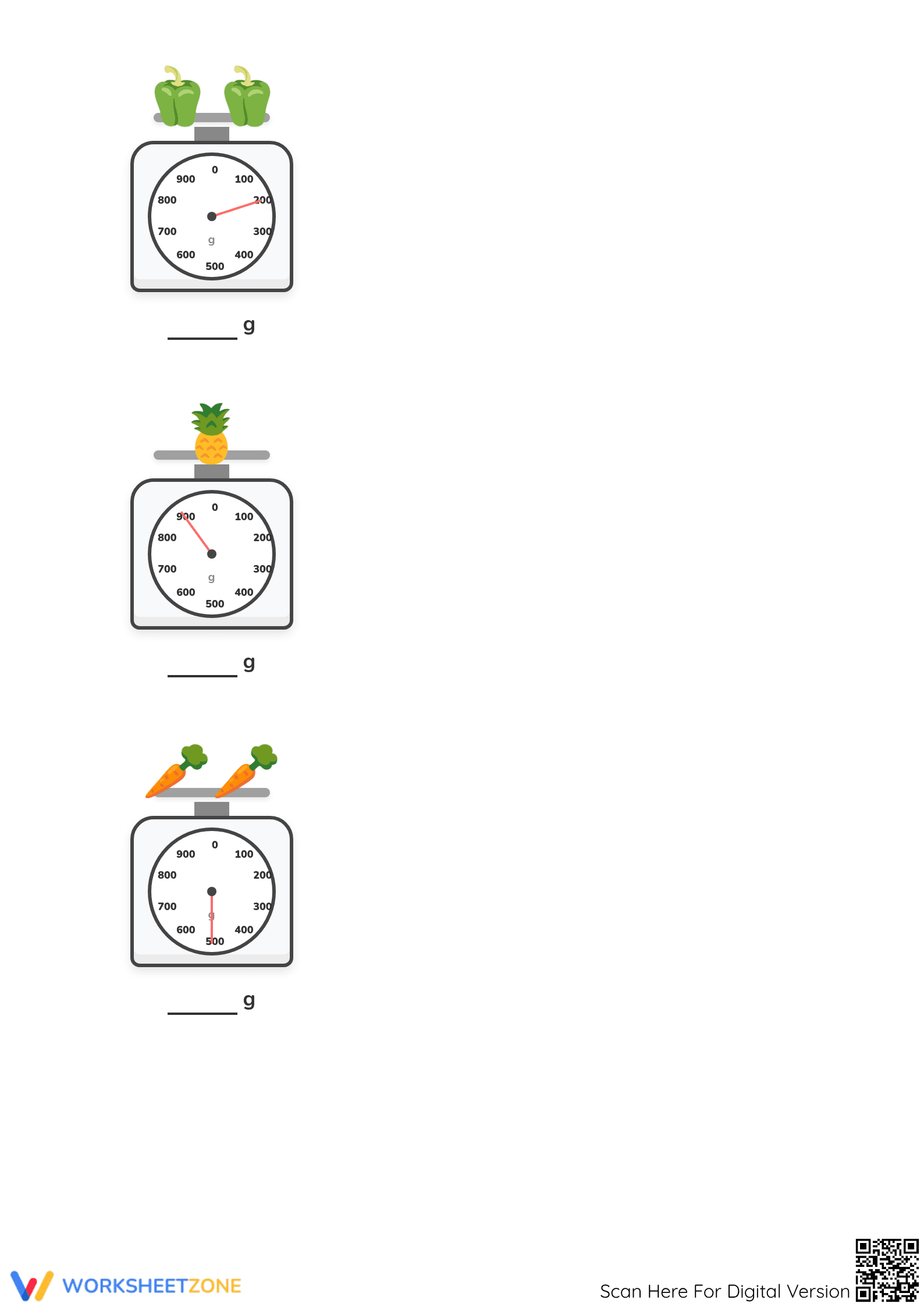


Measuring Weight in Grams: Essential Grade 3 Math Worksheet

Paste this activity's link or code into your existing LMS (Google Classroom, Canvas, Teams, Schoology, Moodle, etc.).
Students can open and work on the activity right away, with no student login required.
You'll still be able to track student progress and results from your teacher account.
This Grade 3 math worksheet helps students master the practical skill of reading analog scales to measure mass in grams. By observing various fruits and vegetables on calibrated scales, learners develop a concrete understanding of metric weight. This resource ensures students can accurately identify measurements and understand scale increments before moving to complex word problems.
At a Glance
- Grade: 3 · Subject: Math
- Standard:
CCSS.MATH.CONTENT.3.MD.A.2— Measure and estimate masses of objects using standard units of grams- Skill Focus: Reading analog scales in grams
- Format: 4 pages · 9 problems · Answer key included · PDF
- Best For: Independent practice or formative assessment
- Time: 15–20 minutes
This comprehensive 4-page PDF features 9 distinct measurement tasks. Each problem presents a high-quality illustration of a kitchen-style analog scale holding common items like bananas, oranges, and broccoli. The scales use clear 100g increments with 50g midpoints, providing a realistic challenge for young mathematicians. A complete answer key is included for rapid grading or student self-correction.
Zero-Prep Workflow
- Print: Select the 4-page PDF and print enough copies for your class in approximately 30 seconds.
- Distribute: Hand out the worksheets as a warm-up or during your measurement unit in under 1 minute.
- Review: Use the provided answer key to check student work or project it for a whole-class review.
Total teacher preparation time is under 2 minutes, making this an ideal resource for busy mornings or unexpected sub plans.
Standards Alignment
This resource is specifically designed to meet `CCSS.MATH.CONTENT.3.MD.A.2`, which requires students to measure and estimate masses of objects using standard units of grams (g). It also supports the development of number sense related to counting by 50s and 100s. Both standard codes can be copied directly into lesson plans, IEP goals, or district curriculum mapping tools.
How to Use It
Use this worksheet during the independent practice phase of a lesson on metric mass. It serves as an excellent bridge between using physical scales and solving abstract word problems. For a quick formative assessment, assign the first page and observe if students correctly identify the 50g increments between the 100g markers. Completion typically takes 15 to 20 minutes depending on student familiarity with analog dials.
Who It's For
This resource is ideal for third-grade students beginning their measurement units, though it provides valuable review for fourth graders. It is particularly helpful for visual learners who benefit from clear, uncluttered diagrams. Pair this worksheet with a physical balance scale and a set of gram weights to create a multi-sensory learning station that reinforces the concepts practiced on paper.
According to the RAND AIRS 2024 report, high-quality visual representations in mathematics are critical for developing conceptual understanding in early elementary learners. This worksheet aligns with those findings by providing clear, realistic analog scales that require students to apply their knowledge of CCSS.MATH.CONTENT.3.MD.A.2. By focusing on the specific skill of reading mass in grams, the resource helps bridge the gap between concrete observation and abstract mathematical reasoning. Research from Fisher & Frey (2014) emphasizes that structured independent practice with immediate feedback—facilitated here by the included answer key—is a cornerstone of the gradual release of responsibility model. This 9-task set ensures students gain the necessary repetitions to achieve mastery in metric measurement. Educators can confidently integrate this tool into their curriculum, knowing it supports evidence-based instructional strategies for improving student outcomes in measurement and data domains.


