These 2d shapes worksheets for 3rd grade give teachers printable practice that covers the full arc of Grade 3 geometry — from naming shapes by their attributes to understanding why a square fits inside the rectangle category. The set moves past simple shape recognition into the classification reasoning the grade actually demands.
The Specific Skills These Worksheets Target
Grade 3 is where geometry shifts from pointing and naming to explaining and categorizing. Students label triangles, quadrilaterals, pentagons, and hexagons by counting sides and describing angles, then use that vocabulary to sort shapes into overlapping groups. That last part — understanding that categories overlap — is often new conceptual territory at this grade level.
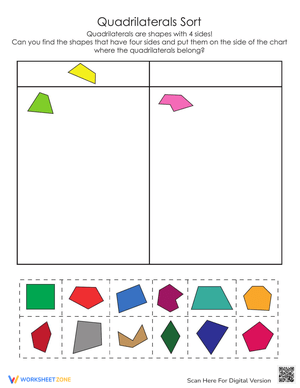
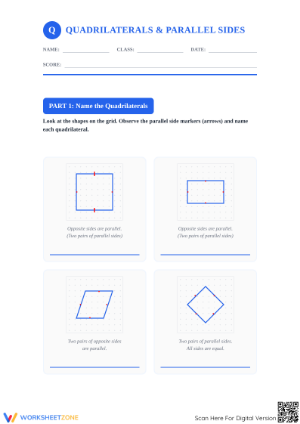
Classification by attributes gets the most sustained attention across the set. Students compare squares, rectangles, and rhombuses side by side, marking equal sides and identifying parallel edges. They decide whether a given shape belongs in one category or two, then write brief justifications using math vocabulary. That written explanation piece matters because it surfaces whether students understand the attribute or are just recognizing a familiar picture.
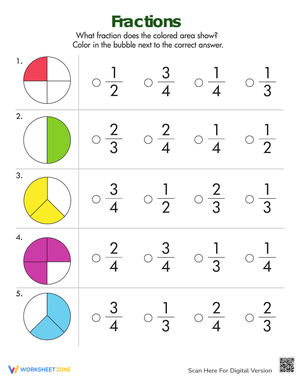
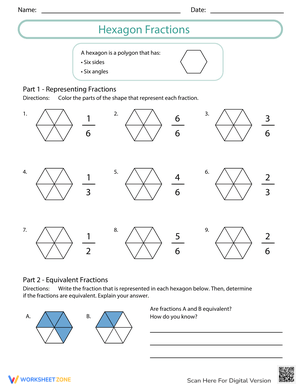
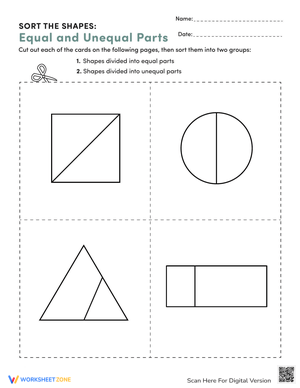
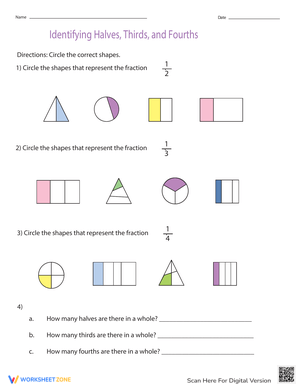
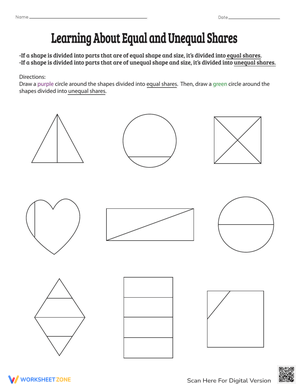
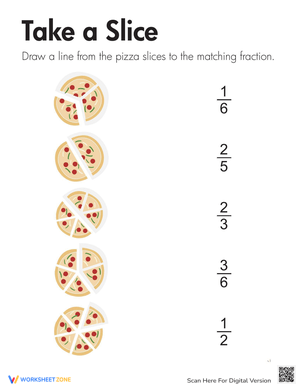
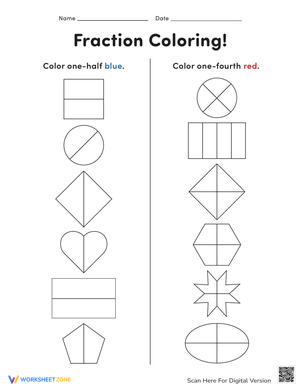
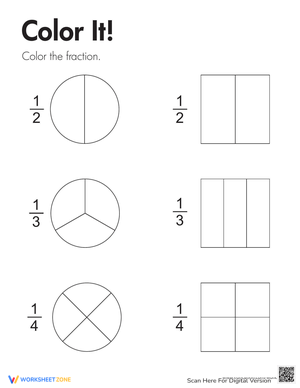
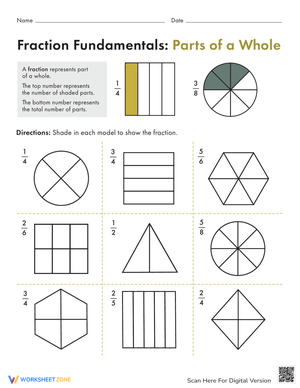
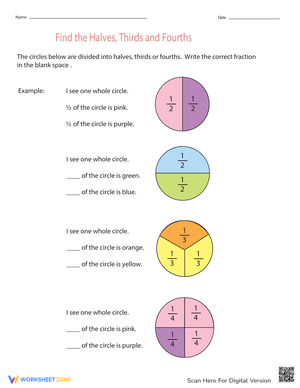
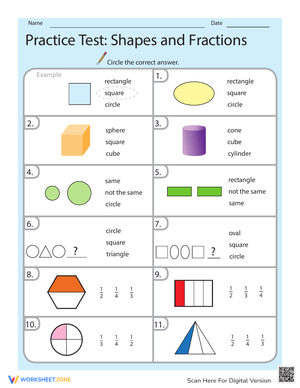
Each worksheet also addresses partitioning: dividing rectangles and circles into halves, thirds, and fourths, then naming the parts using fraction language. This isn't only geometry work — it builds early groundwork for fraction understanding, and students who handle it in a geometry context often find the abstract fraction work later in the year less disorienting.
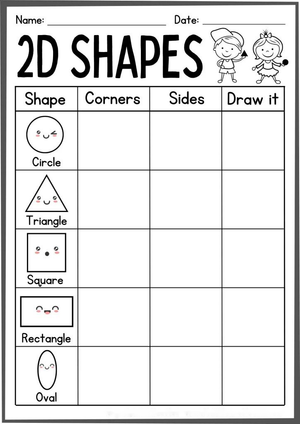
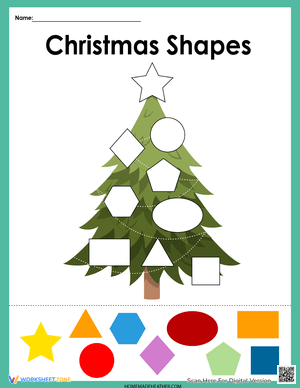
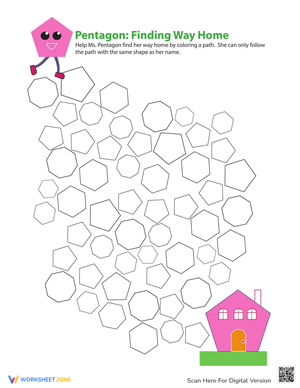
- Shape identification and labeling — naming by attribute count, not appearance alone
- Attribute-based classification — sorting by sides, angles, and parallel sides
- Overlapping categories — placing squares, rectangles, and rhombuses into shared groups
- Drawing from specifications — constructing shapes that meet given attribute conditions
- Equal-part partitioning — halves, thirds, and fourths connected to fraction vocabulary
Common Misconceptions to Watch For and Correct
The most persistent error at this grade is classifying by visual gestalt rather than counted attributes. A student who correctly labels an upright square will often write "diamond" when that same square is rotated 45 degrees — not because they don't know what a square is, but because orientation still feels like a defining feature to them. Worksheets that present shapes in multiple rotations push that misconception into the open, which is the first step toward correcting it.
The square-rectangle relationship produces predictable confusion as well. Students understand that a square has four equal sides and that a rectangle has two pairs of equal sides. The jump to "therefore a square is also a rectangle" feels logically backwards to many eight-year-olds — they read categories as mutually exclusive, the way they sort animals into mammals or reptiles but not both. Any worksheet that asks students to place a square in both a "square" column and a "rectangle" column surfaces this confusion quickly, and a short whole-group follow-up on that item is usually worth the five minutes.
On partitioning tasks, students frequently divide a rectangle into three sections that look roughly equal rather than using a systematic approach. They count the parts, see three, and mark the answer correct. Asking students to explain whether each part would cover the same space — rather than just counting sections — catches this before it hardens into a durable misconception.
How to Build These Worksheets Into Your Lesson Plans
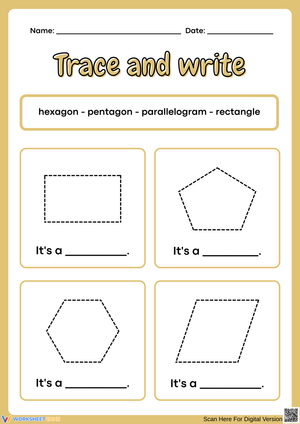
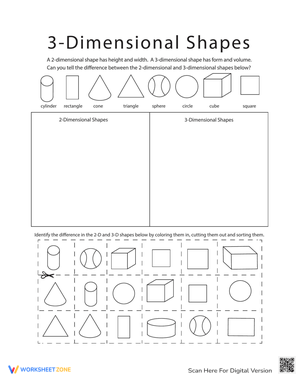
The most efficient use of 2d shapes worksheets for 3rd grade is spread across several lesson contexts rather than concentrated in one block. An identification or labeling worksheet works well as morning work at the start of a geometry unit — five to eight items reactivate vocabulary before whole-group instruction begins. Classification worksheets fit better mid-unit, after students have sorted physical shape cards and built oral language around the categories.
For centers, color-by-attribute and cut-and-sort formats give students a clear independent task. The drawing worksheets — where students construct a shape meeting given attribute conditions — are harder to use as independent center work early in the unit. Placed in a center before students have practiced the underlying skill with concrete materials, they tend to generate anxious guessing rather than real geometry thinking. Mid-unit or later, they become genuinely strong independent tasks.
Exit tasks are where these worksheets show the most formative value. A brief exit task with two or three classification items and one written explanation gives enough information to sort students for the next day's small-group work. Students who explain their sorting using attribute language are ready to move into overlapping categories. Students whose explanations reference appearance — "it looks like a square" — need another round of attribute identification before moving on.
Adjusting the Work for a Range of Learners
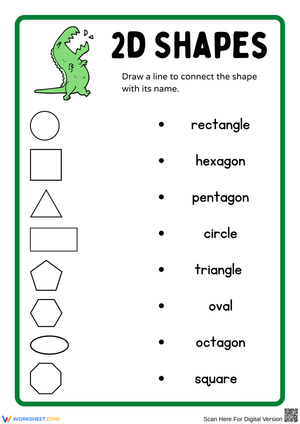
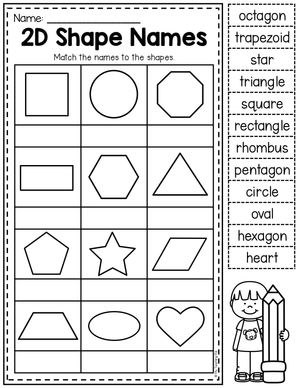
Within the 2d shapes worksheets for 3rd grade set, differentiation usually comes down to task selection rather than sourcing entirely different materials. Students who need support do well with identification and tracing tasks, where the work is constrained: match the name to the shape, count the sides, circle the shape that fits. The brief written explanation prompts are worth holding until their attribute vocabulary is more automatic.
Students ready for more challenge can move into drawing and justification tasks sooner. Asking a student to draw three different quadrilaterals — none of which are squares or rectangles — requires more flexible thinking than any identification task. Having them write two-sentence justifications for why a rhombus is or isn't a rectangle tests attribute reasoning at a genuinely higher level. Because each worksheet spans recognition through justification, teachers can assign specific items to different groups rather than pulling separate resources.
For multilingual learners, pairing classification worksheets with a brief attribute reference card — sides, angles, and parallel sides defined with small diagrams — reduces the chance that a vocabulary gap registers as a geometry gap in student work.
Standard Alignment
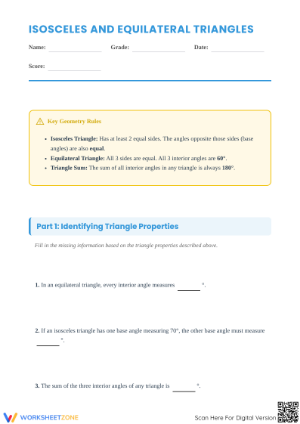
These worksheets align to CCSS.MATH.CONTENT.3.G.A.1, which asks Grade 3 students to understand that shapes in different categories may share attributes and that shared attributes can define a larger category. Students work toward recognizing that rhombuses, rectangles, and squares are all quadrilaterals, and that some shapes belong simultaneously to more than one named group.
Teachers who use 2d shapes worksheets for 3rd grade earlier in the school year — for attribute vocabulary and basic identification — are building toward that standard rather than meeting it directly. The partitioning work connects to CCSS.MATH.CONTENT.3.G.A.2, which covers partitioning shapes into equal areas and expressing each part as a unit fraction. Both standards sit within the Grade 3 geometry domain, and they pair naturally when teachers want to bridge shape work with the fraction unit.
Frequently Asked Questions
What 2D shape skills are new at Grade 3 versus carried over from Grade 2?
Grade 2 covers basic shape naming and recognition. Grade 3 asks students to classify shapes by specific attributes — sides, angles, parallel sides — and to understand that categories can overlap. The concept that a square is also a rectangle is a genuine Grade 3 expectation, not a review skill. Partitioning into equal parts also extends in Grade 3 to connect explicitly to fraction naming, which is new ground for most students at that level.
How do I address student resistance to the idea that a square is a rectangle?
Start with the attribute definition of a rectangle: four right angles and two pairs of equal sides. Then have students check a square against that list, criterion by criterion. Students who work through the attribute check almost always arrive at the correct conclusion — the resistance comes from visual category thinking, not from a failure to understand the math. Worksheets that require students to list attributes before making a classification decision support exactly this kind of step-by-step reasoning.
Do these worksheets work for centers and homework, or mainly whole-group instruction?
The set works across all three settings, but task type matters. For centers, choose sorting and labeling tasks students can complete without teacher facilitation. For homework, the identification and partitioning worksheets travel well because directions are visual and the task is clear without additional teaching. Justification and drawing tasks are better kept for classroom settings where a teacher can prompt and clarify when students get stuck.














 Interactive Worksheet Maker
 Quiz Maker
 Word Search Maker
 Crossword Puzzle Maker
 Word Scramble Generator
 Sentence Scramble Generator
 Handwriting Worksheet Generator
 Name Tracing Generator
 Fill In The Blank Generator




 BACK TOSCHOOL