


























Views
Downloads


Printable Worksheet: Parallel Sides in Quadrilaterals (Grade 4)
Paste this activity's link or code into your existing LMS (Google Classroom, Canvas, Teams, Schoology, Moodle, etc.).
Students can open and work on the activity right away, with no student login required.
You'll still be able to track student progress and results from your teacher account.
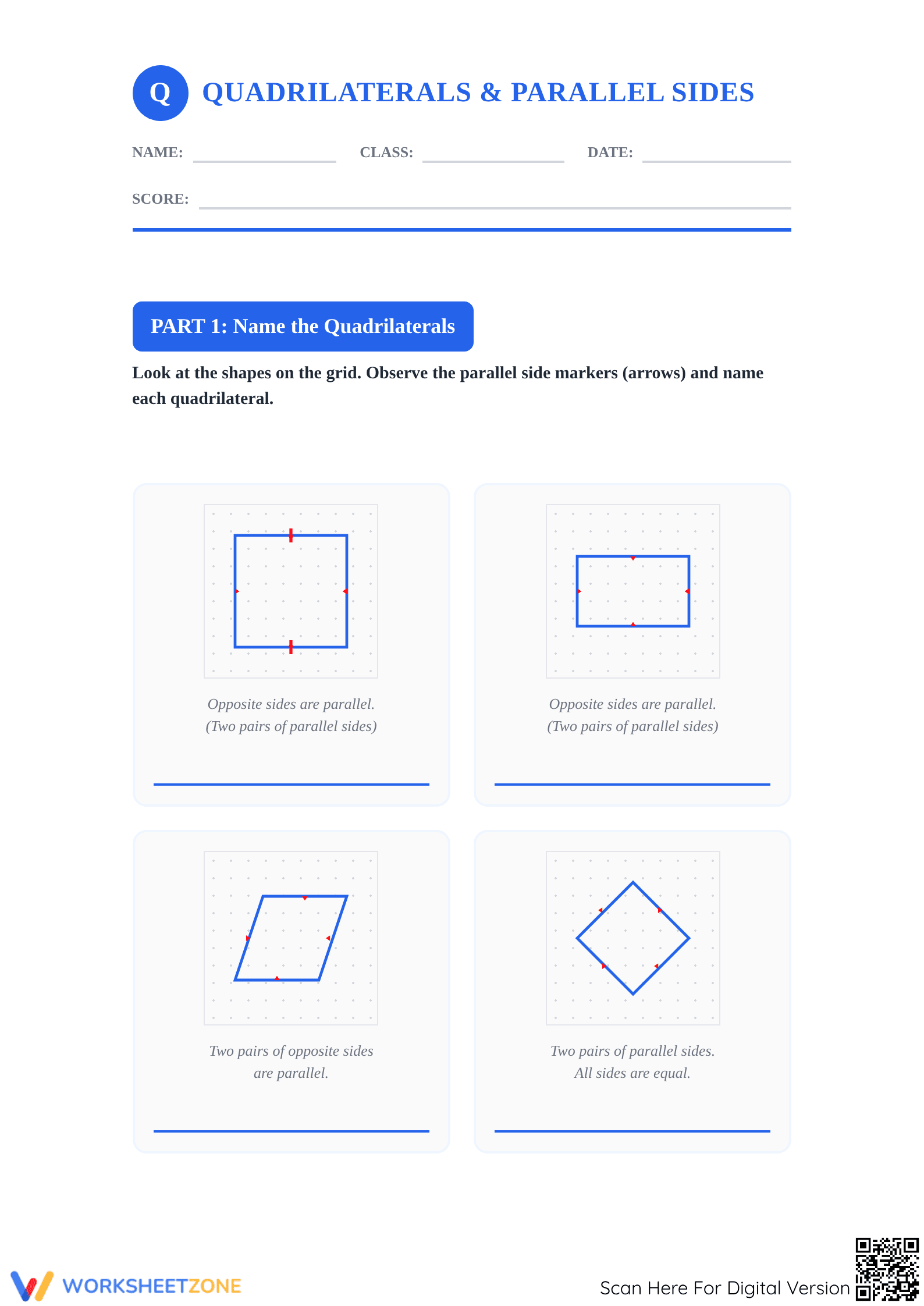
This printable worksheet helps Grade 4 students master the identification of parallel sides in various quadrilaterals. By observing side markers and applying geometric definitions, learners classify shapes like trapezoids, rhombuses, and parallelograms based on their unique attributes. This resource ensures students can accurately distinguish between shapes with zero, one, or two pairs of parallel lines.
At a Glance
- Grade: 4 · Subject: Math
- Standard:
CCSS.MATH.CONTENT.4.G.A.2— Classify two-dimensional figures based on the presence or absence of parallel lines.- Skill Focus: Parallel Side Identification
- Format: 3 pages · 17 problems · Answer key included · PDF
- Best For: Independent practice or formative assessment
- Time: 20–30 minutes
What's Inside
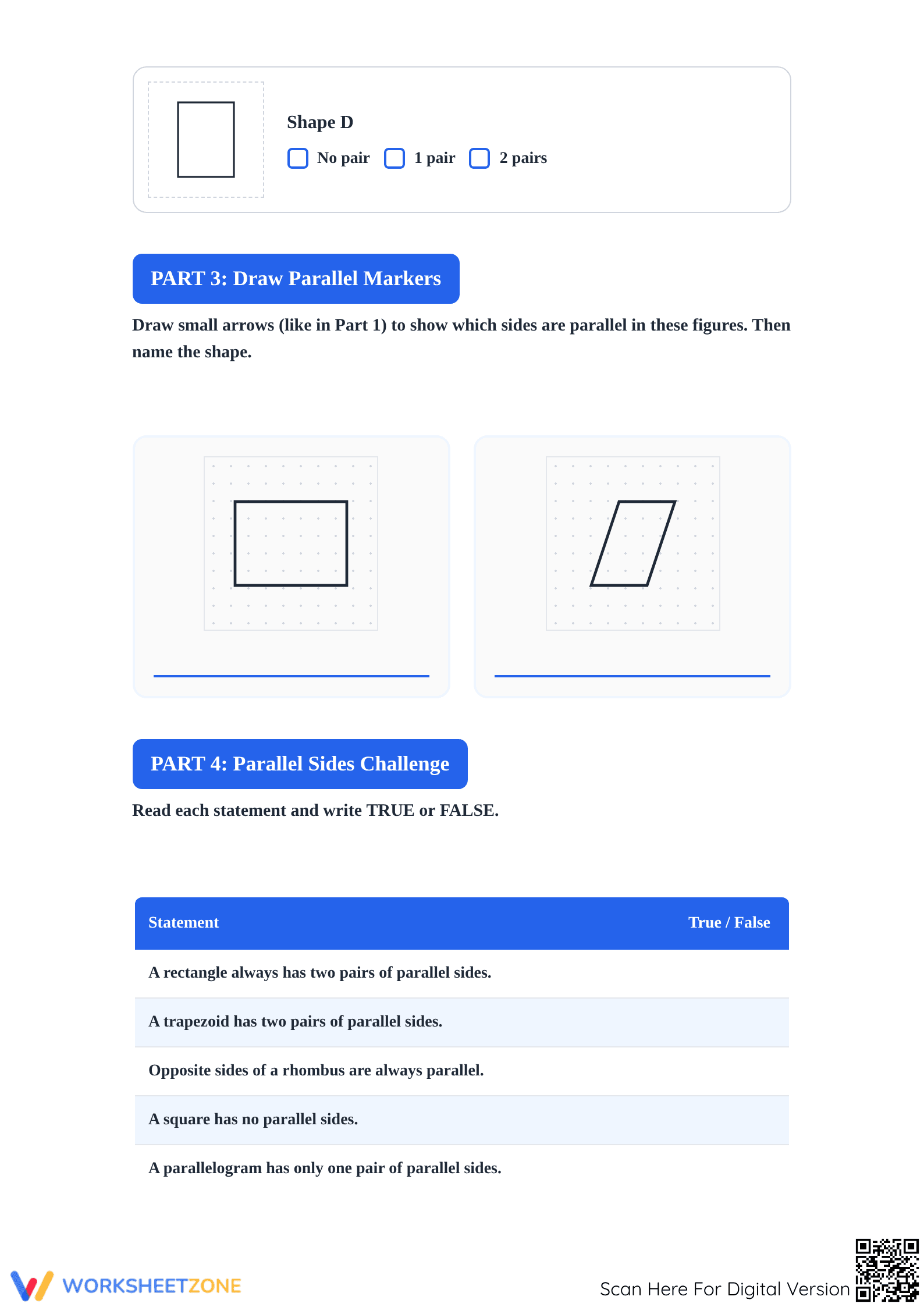
This three-page PDF features a comprehensive progression of geometric tasks. Part 1 requires naming shapes on a grid using parallel markers, while Part 2 involves counting specific pairs of opposite sides. Part 3 challenges students to draw their own parallel markers on blank shapes, and Part 4 concludes with a five-statement True/False challenge to solidify conceptual understanding.
Zero-Prep Workflow
The zero-prep design allows teachers to transition from instruction to practice in under two minutes. First, print the three-page set for each student (1 minute). Next, distribute materials for independent work or rotations (30 seconds). Finally, use the included answer key to review results together or allow for student self-correction (30 seconds). This workflow makes it an ideal resource for emergency sub plans.
Standards Alignment
This resource is directly aligned to CCSS.MATH.CONTENT.4.G.A.2, which requires students to classify two-dimensional figures based on the presence or absence of parallel lines. It also supports category definitions in CCSS.MATH.CONTENT.3.G.A.1. Both standard codes can be copied directly into lesson plans, IEP goals, or district curriculum mapping tools.
How to Use It
Incorporate this worksheet during the "You Do" phase of a gradual release lesson. Teachers should observe students during Part 3 to ensure they are correctly placing arrows on opposite sides. The 20-30 minute completion time makes it perfect for a mid-unit check-in or as a structured homework assignment following direct classroom instruction.
Who It's For
Designed for fourth-grade students, this practice set is also suitable for third-grade enrichment or fifth-grade remediation. The grid-based visuals provide necessary support for visual learners and students with IEP accommodations. It pairs naturally with an anchor chart displaying shape definitions, allowing students to cross-reference their findings as they work through the challenge statements.
Geometric reasoning in elementary years requires moving from holistic shape recognition to attribute-based classification. According to the RAND AIRS 2024 report on mathematics instructional materials, structured practice that requires students to both identify and generate geometric markers significantly improves the retention of vocabulary related to parallel lines. This worksheet aligns with those findings by providing 17 distinct tasks that bridge the gap between visual identification and conceptual application. By explicitly using standard code CCSS.MATH.CONTENT.4.G.A.2, educators can ensure their instruction meets grade-level expectations for figure analysis. The inclusion of a True/False challenge further promotes higher-order thinking, moving students toward a deeper understanding of geometric properties. This resource serves as a validated tool for developing the spatial reasoning skills necessary for success in middle school geometry, as emphasized by NAEP proficiency standards.


