


























Views
Downloads

Printable Isosceles & Equilateral Triangles | Grade 4-5
Paste this activity's link or code into your existing LMS (Google Classroom, Canvas, Teams, Schoology, Moodle, etc.).
Students can open and work on the activity right away, with no student login required.
You'll still be able to track student progress and results from your teacher account.
Master triangle properties with this comprehensive four-page practice set. Moving from conceptual understanding to application, this resource focuses on identifying isosceles and equilateral triangles while calculating missing angles. Students build geometric fluency by applying the triangle sum theorem across thirteen structured problems that challenge their reasoning and calculation skills.
At a Glance
- Grade: 4–5 · Subject: Geometry
- Standard:
CCSS.MATH.CONTENT.4.G.A.2— Classify triangles based on angle size and side properties like equal sides- Skill Focus: Interior angle sums and triangle classification
- Format: 4 pages · 13 problems · Answer key included · PDF
- Best For: Independent practice and formative assessment
- Time: 25–40 minutes
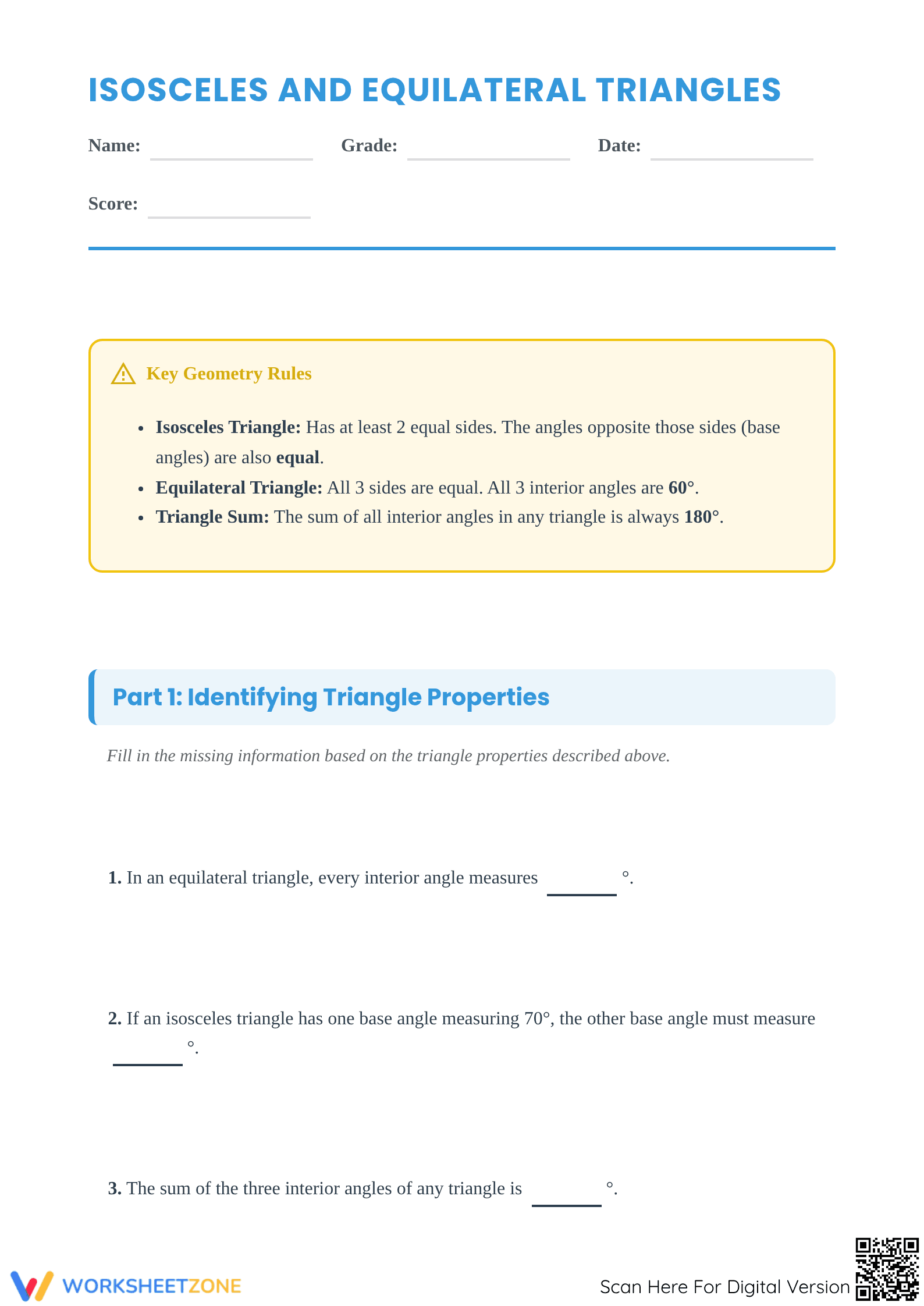
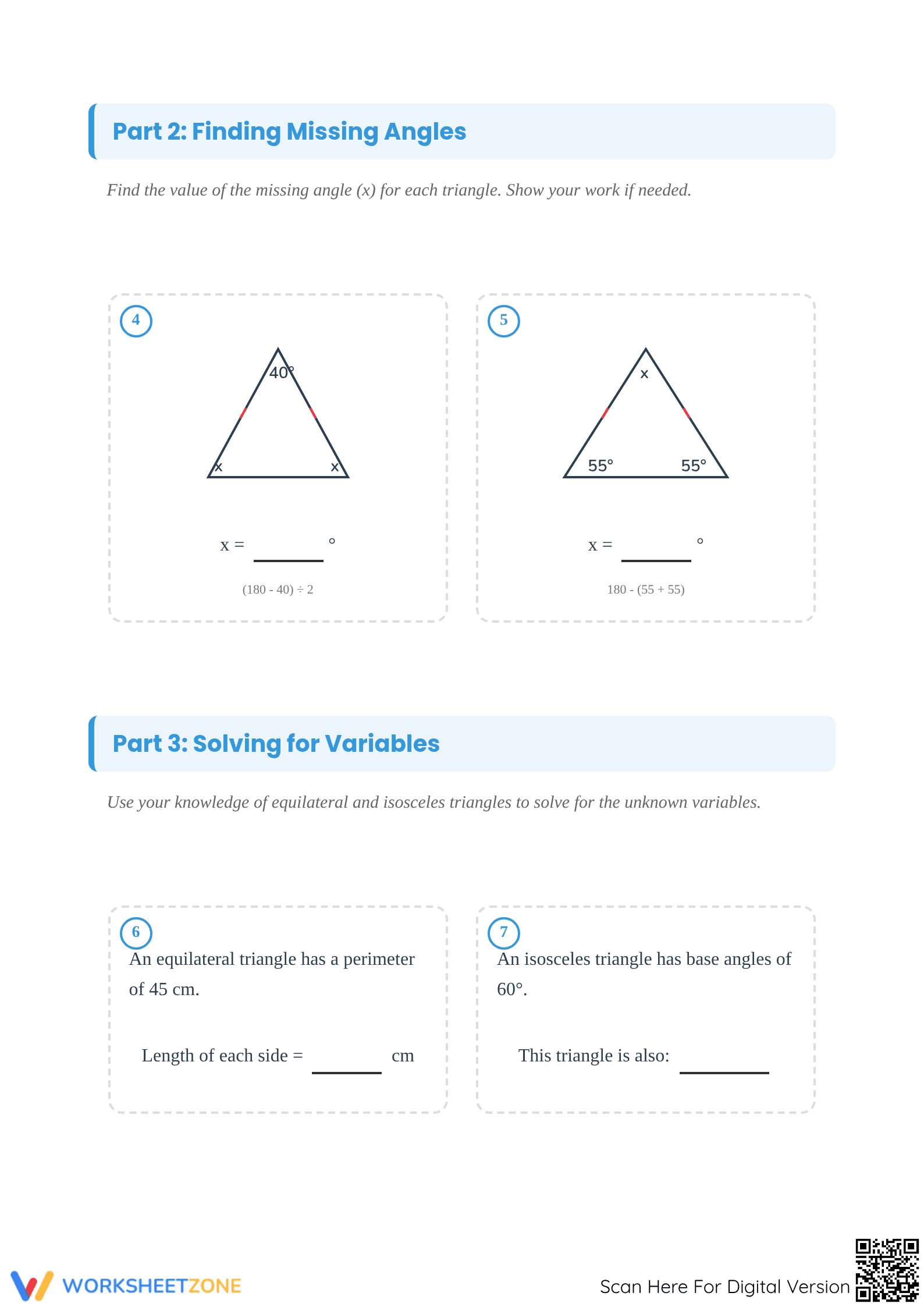
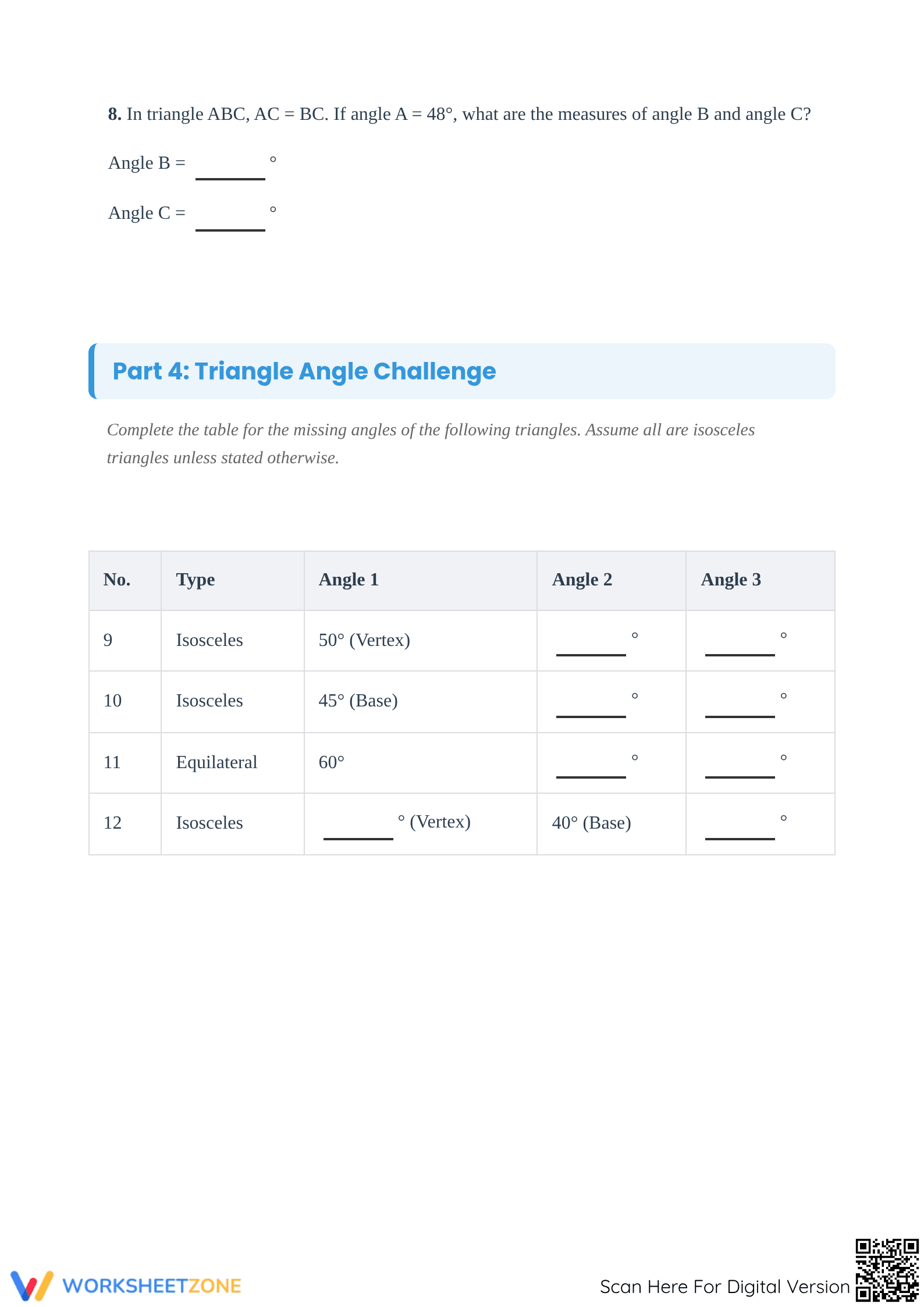
Inside this packet, students find a clear reference guide of "Key Geometry Rules" followed by five distinct sections. The tasks range from fill-in-the-blank property identification to solving for variables (x) and determining perimeter. A multi-step table challenge and a written extension problem ensure students don't just memorize rules but can explain the underlying logic of triangle geometry.
The instructional path follows a scaffolded progression to ensure student success:
- Guided Practice: Three questions verify baseline knowledge of angle measures and the 180-degree rule.
- Supported Practice: Four visual problems require finding missing angles (x) and side lengths using property clues.
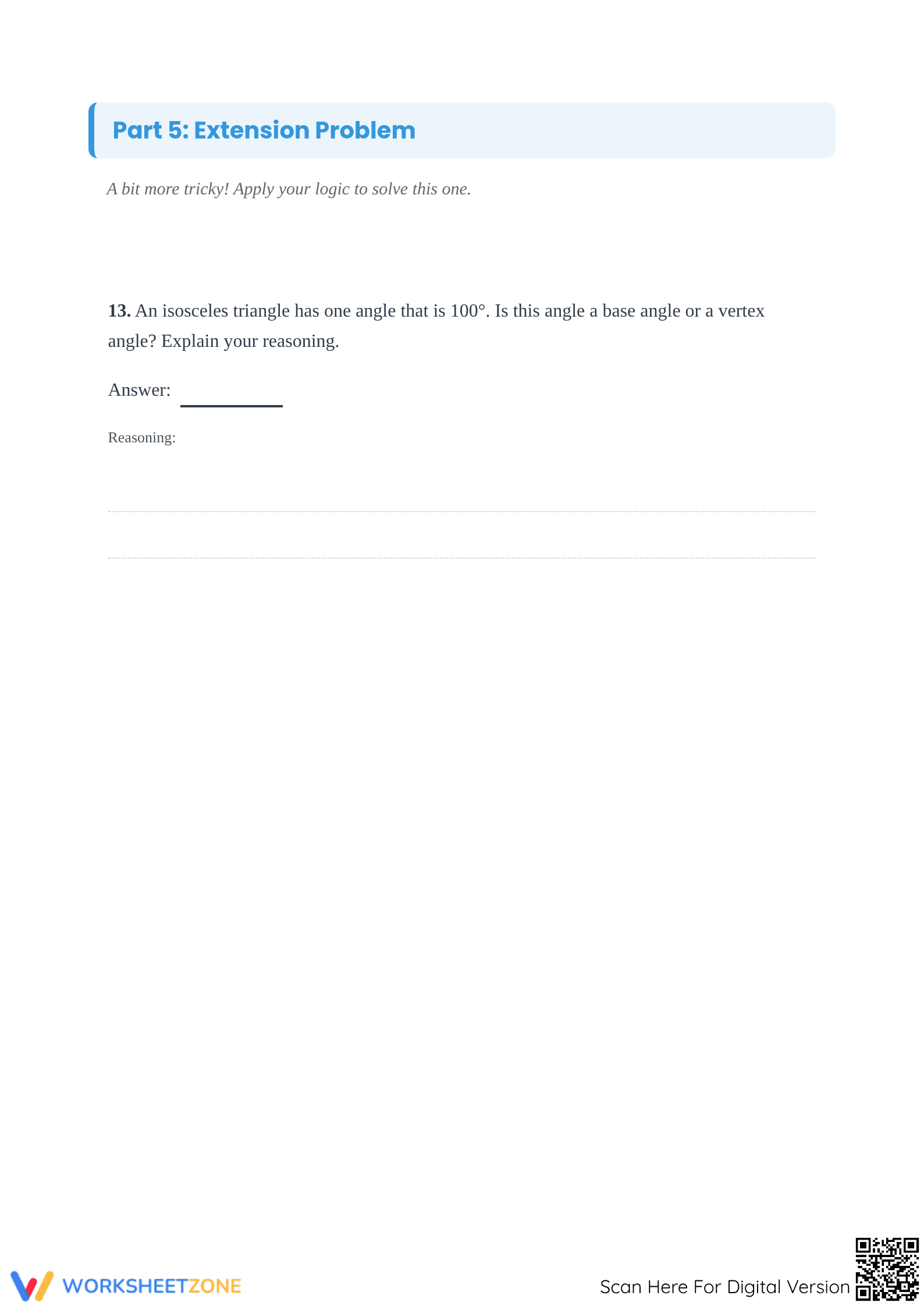
- Independent Practice: Six tasks, including a data table and a reasoning problem, demand higher-order thinking.
This path ensures a gradual release of responsibility.
Standards Alignment
This resource is primary aligned to CCSS.MATH.CONTENT.4.G.A.2: "Classify two-dimensional figures based on the presence or absence of angles of a specified size." It also supports 5.G.B.4 by requiring students to understand the hierarchy of triangle properties. Both standard codes can be copied directly into lesson plans, IEP goals, or district curriculum mapping tools.
How to Use It
Assign this after a direct instruction lesson to reinforce the "Triangle Sum" rule. It works well as homework or a guided math station activity. For a formative assessment, check the Part 5 Extension Problem; explaining why a 100-degree angle is a vertex demonstrates true mastery. Completion takes 30 minutes.
Who It's For
This is ideal for Grade 4 and Grade 5 students, including those requiring IEP accommodations such as sentence frames or visual aids. It pairs naturally with a geometry anchor chart or a manipulative-based lesson using protractors. The clear layout supports diverse learners by reducing visual clutter while maintaining high academic rigor.
According to a RAND AIRS 2024 analysis, structured geometry practice that integrates both visual classification and numerical calculation significantly improves long-term retention of spatial reasoning concepts. This worksheet aligns with those findings by requiring students to bridge the gap between identifying a triangle type and calculating its internal properties. By forcing students to apply the 180-degree rule across varying contexts—including perimeter and variable solving—the material prevents rote memorization. The inclusion of a reasoning-based extension problem supports the NAEP framework for mathematical complexity, ensuring that learners are not merely performing operations but are engaging in authentic geometric proof. For educators, the standards-aligned CCSS.MATH.CONTENT.4.G.A.2 framework provided here simplifies the tracking of student progress toward district benchmarks. This self-contained resource serves as a reliable evidence-based tool for building a solid foundation in middle-school geometry readiness and spatial literacy.


